
The global Iron Ore Market is entering a transformative decade as rising infrastructure investments, urbanization, renewable energy projects, and the worldwide transition toward green steel manufacturing continue to reshape demand.
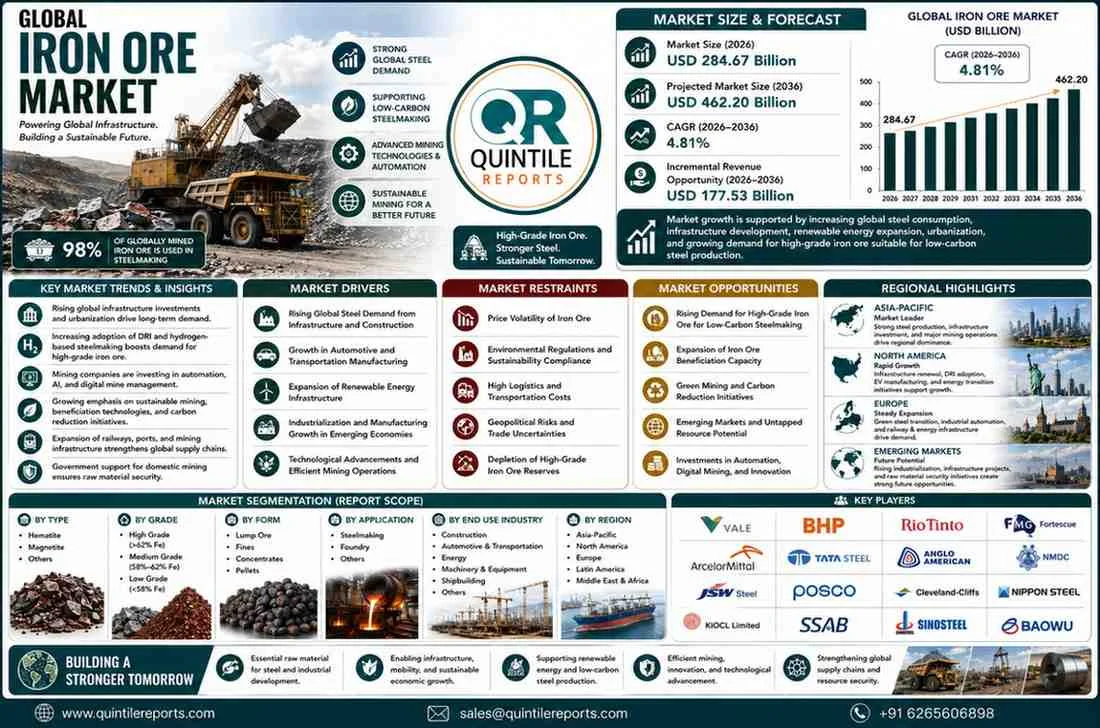
According to the latest industry analysis by Quintile Reports, the market was valued at USD 284.67 billion in 2026 and is projected to reach USD 462.20 billion by 2036, expanding at a CAGR of 4.81% throughout the forecast period.
Iron ore has long been the backbone of industrial development. Nearly 98% of mined iron ore is used in steelmaking, making it one of the world’s most essential mineral commodities. From bridges and skyscrapers to electric vehicles, wind turbines, railways, machinery, and advanced manufacturing facilities, steel remains indispensable—and iron ore continues to be the critical raw material enabling global economic progress.
However, today’s market is no longer driven solely by construction demand. The industry’s evolution is increasingly influenced by sustainability objectives, digital mining technologies, premium ore requirements, and low-carbon steel production methods that are redefining the competitive landscape.
Request Sample PDF Report: https://www.quintilereports.com/request-sample/1323-iron-ore-market/
Infrastructure Spending Continues to Fuel Global Steel Demand
Massive investments in transportation infrastructure, urban housing, industrial facilities, and renewable energy installations remain among the strongest drivers supporting iron ore consumption worldwide.
Developing economies across Asia-Pacific continue to experience rapid urbanization, requiring enormous volumes of steel for highways, railways, airports, ports, commercial buildings, and smart city developments. Meanwhile, developed economies are investing heavily in infrastructure modernization programs that require long-term steel supply.
Large-scale government stimulus initiatives targeting infrastructure renewal further strengthen demand for high-quality iron ore. Public investment in bridges, tunnels, water systems, renewable energy transmission networks, and industrial corridors continues generating stable market opportunities for global mining companies.
Green Steel Is Creating a New Era for Premium Iron Ore
Perhaps the most important structural change occurring within the industry is the global shift toward green steel production.
Steel manufacturers are under increasing pressure to reduce carbon emissions while meeting ambitious sustainability targets established by governments worldwide. Traditional blast furnace production is gradually being complemented by cleaner technologies such as:
- Hydrogen-based Direct Reduced Iron (DRI)
- Electric Arc Furnace (EAF) steelmaking
- Carbon capture integration
- Renewable energy-powered production facilities
These advanced production routes require high-grade iron ore with lower impurities, creating growing demand for premium-quality feedstock.
Mining companies are responding by expanding beneficiation operations, improving ore processing technologies, and increasing investments in premium-grade deposits capable of supporting cleaner steel manufacturing.
As environmental regulations continue tightening globally, suppliers offering high-grade iron ore are expected to enjoy stronger pricing power and long-term competitive advantages.
Discount Now: https://www.quintilereports.com/request-discount/1323-iron-ore-market/
Technology Is Modernizing Global Mining Operations
Digital transformation has become a defining characteristic of the modern iron ore industry.
Mining companies are increasingly deploying:
- Artificial Intelligence
- Autonomous haulage systems
- Drone surveying
- Predictive maintenance
- Remote operations centers
- Digital mine management platforms
- Real-time production analytics
These technologies significantly improve operational efficiency while reducing costs, minimizing downtime, and enhancing worker safety.
Automation also enables mining operators to optimize resource recovery, reduce waste generation, improve environmental performance, and increase productivity across complex mining operations.
As mining companies continue embracing Industry 4.0 technologies, operational excellence is becoming a major competitive differentiator.
Renewable Energy Expansion Strengthens Long-Term Demand
The clean energy transition is emerging as another major growth catalyst for the Iron Ore Market.
Renewable energy infrastructure requires enormous quantities of steel for:
- Wind turbine towers
- Solar panel mounting structures
- Transmission towers
- Grid modernization
- Hydroelectric facilities
- Battery manufacturing infrastructure
Every large-scale renewable energy installation creates substantial demand for steel-intensive construction materials.
Governments worldwide continue accelerating investments in clean energy infrastructure to meet climate goals, ensuring long-term demand for iron ore across multiple industrial sectors.
Asia-Pacific Continues to Lead Global Consumption
Asia-Pacific remains the dominant regional market, supported by extensive steel manufacturing capacity and sustained industrial development.
China continues to represent the world’s largest consumer of iron ore due to its enormous steel production industry, infrastructure investments, and manufacturing base.
India is rapidly expanding domestic steel production while increasing mining capacity to support ambitious infrastructure and industrialization initiatives.
Meanwhile, Southeast Asian economies including Vietnam, Indonesia, and Thailand continue generating substantial demand through manufacturing expansion, transportation development, and urban construction projects.
Australia maintains its position as one of the world’s largest exporters, benefiting from extensive reserves and highly efficient logistics infrastructure.
North America and Europe Focus on Sustainable Steelmaking
North America continues experiencing stable demand supported by domestic manufacturing, infrastructure modernization, and mining investments.
The United States is strengthening domestic supply chains through strategic investments in mining modernization, digital operations, and sustainable steel production technologies.
Europe, meanwhile, is leading the transition toward green steel.
European steel manufacturers increasingly require premium-grade iron ore suitable for hydrogen-based DRI production.
Significant investments in hydrogen infrastructure, renewable energy integration, and industrial decarbonization continue reshaping regional procurement strategies.
This transition creates attractive opportunities for mining companies capable of supplying premium-quality iron ore with reduced contaminants.
Latin America and Africa Expand Global Supply
Brazil remains one of the world’s largest iron ore exporters, supplying major steel producers across Asia and Europe.
The country’s extensive reserves, efficient mining operations, and established export infrastructure continue strengthening its competitive position.
Meanwhile, West Africa is emerging as one of the industry’s most promising long-term growth regions.
Large-scale projects such as Guinea’s Simandou development are expected to significantly expand future global supply while providing high-grade ore suitable for low-carbon steelmaking.
Buy Now: https://www.quintilereports.com/request-enquiry/1323-iron-ore-market/
Improved railway networks, export terminals, and mining infrastructure are gradually transforming the region into a major global supplier.
Competitive Landscape Focuses on Scale and Sustainability
The Iron Ore Market remains highly consolidated.
Leading producers continue competing through:
- Production scale
- High-grade reserves
- Operational efficiency
- Logistics capabilities
- Digital mining technologies
- ESG performance
- Beneficiation expertise
- Carbon reduction initiatives
Major industry participants include:
- Vale S.A.
- Rio Tinto
- BHP
- Fortescue Metals Group
- Anglo American
- LKAB
- Cleveland-Cliffs
- Tata Steel
- POSCO
- JSW Steel
- NMDC
- China Minmetals
Strategic investments increasingly focus on automation, sustainable mining, renewable energy integration, and premium ore production.
Recent Strategic Developments
Several notable developments continue reshaping industry dynamics.
Rio Tinto recently secured final approvals for the world-class Simandou Project, expected to become one of the largest future sources of premium iron ore globally.
Metso announced deployment of an advanced pelletizing plant featuring digital process automation designed to improve pellet quality while reducing emissions.
Mining companies across Australia, Brazil, Canada, and Africa continue expanding production capacity while investing heavily in ESG initiatives, renewable-powered mining operations, and carbon reduction technologies.
Future Outlook
The outlook for the global Iron Ore Market remains highly positive.
While cyclical fluctuations in steel demand will continue influencing pricing, several structural trends provide long-term growth support:
- Infrastructure modernization
- Urbanization
- Renewable energy deployment
- Electric vehicle manufacturing
- Green steel transition
- Hydrogen-based steelmaking
- Digital mining innovation
- High-grade ore demand
- Sustainable resource development
Companies capable of supplying premium-quality iron ore while embracing automation, ESG excellence, and operational efficiency will be best positioned to capture future market opportunities.
As governments and industries continue investing in decarbonization, iron ore will remain a foundational resource powering global economic development for decades to come.
FAQs for Key Opinion Leaders (KOLs)
1. Why is the Iron Ore Market expected to grow steadily through 2036?
Growth is supported by infrastructure expansion, increasing steel demand, renewable energy projects, urbanization, and green steel production initiatives.
2. Why is high-grade iron ore becoming increasingly important?
Premium-grade ore improves steelmaking efficiency while reducing emissions, making it ideal for hydrogen-based DRI and low-carbon steel production.
3. Which region dominates the Iron Ore Market?
Asia-Pacific dominates due to China’s steel production, Australia’s mining capacity, and India’s expanding infrastructure investments.
4. How is digital transformation impacting mining operations?
AI, automation, predictive maintenance, autonomous equipment, and digital mine management significantly improve productivity and operational efficiency.
5. What role does renewable energy play in market growth?
Wind farms, solar projects, transmission infrastructure, and energy storage systems require substantial steel, increasing long-term iron ore demand.
6. Who are the leading companies in the market?
Key companies include Vale, Rio Tinto, BHP, Fortescue Metals Group, Anglo American, LKAB, Cleveland-Cliffs, Tata Steel, POSCO, JSW Steel, and NMDC.
7. What challenges does the market face?
Price volatility, environmental regulations, logistics constraints, and high capital investment remain key industry challenges.
8. What opportunities will shape the industry’s future?
Green steel production, smart mining technologies, premium ore beneficiation, digital transformation, and sustainable mining practices will drive future growth.
Our Latest Publication:
Iron Ore Market (2026 – 2036)
Silicon Carbide Market to Reach USD 21.47 Billion by 2036 Driven by EVs, AI & Renewable Energy

Adarsh
Business Strategy — Quintile Reports
Adarsh is a Business Strategy professional focused on transforming market insights into actionable growth plans. He supports strategic initiatives through market analysis, competitive intelligence, and data-driven decision-making to help drive long-term business success.
His core skills include strategic planning, market research, growth opportunity assessment, trend analysis, performance tracking, stakeholder communication, cross-functional collaboration, and critical problem-solving.