
The global economy is undergoing a massive transformation fueled by infrastructure modernization, industrial expansion, renewable energy investments, and rapid urbanization. At the heart of this transformation lies one of the world’s most essential industrial materials—Hot Rolled Coil (HRC) Steel. From towering skyscrapers and high-speed rail networks to electric vehicles and energy pipelines, hot rolled coil steel serves as the foundation for countless industries that shape modern civilization.
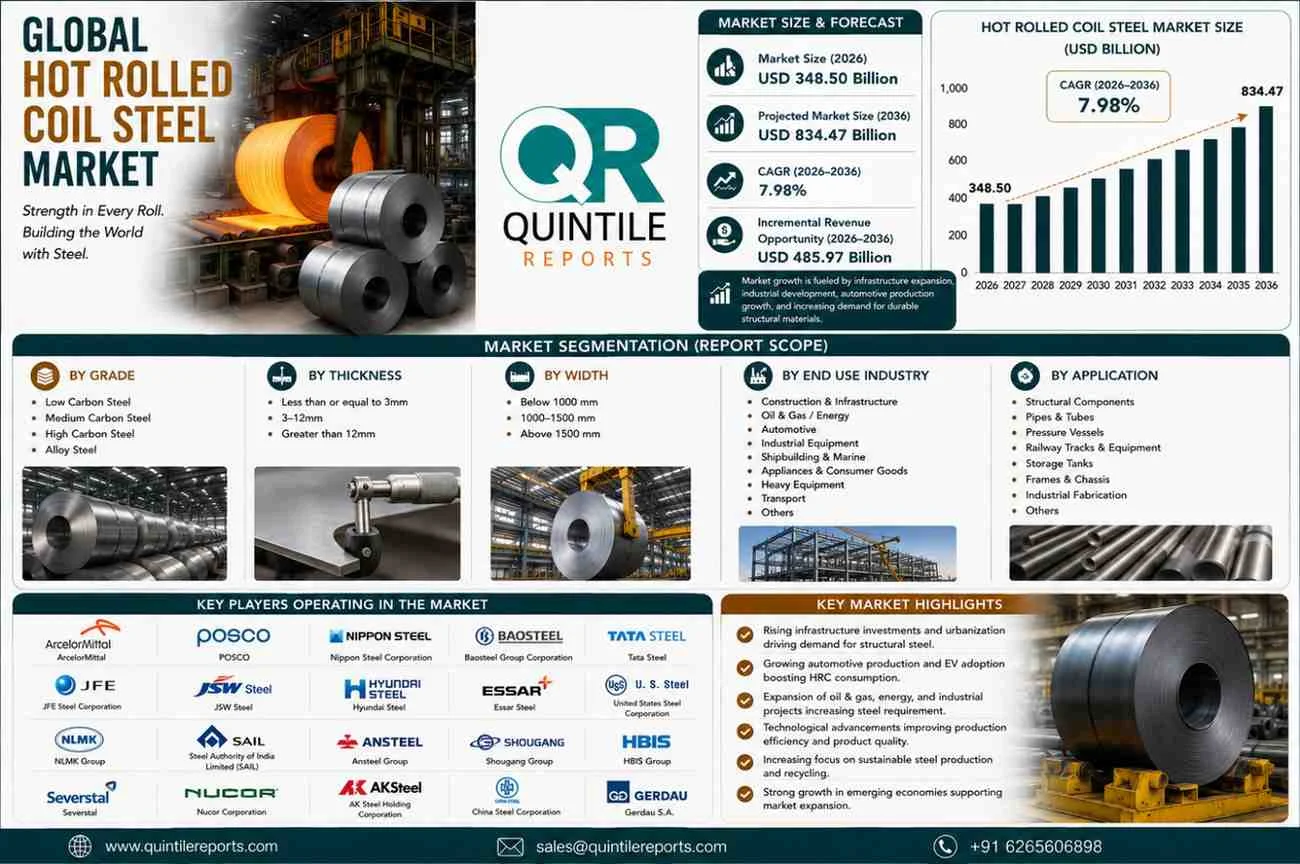
According to recent industry analysis, the global Hot Rolled Coil Steel Market was valued at USD 348.50 billion in 2026 and is projected to reach USD 834.47 billion by 2036, expanding at a CAGR of 7.98% during the forecast period. The remarkable growth reflects increasing investments in infrastructure development, automotive manufacturing, industrial modernization, and sustainable energy projects worldwide.
Request Sample PDF Report: https://www.quintilereports.com/request-sample/1315-hot-rolled-coil-steel-market/
Understanding the Importance of Hot Rolled Coil Steel
Hot rolled coil steel is one of the most widely used flat steel products globally. Produced through high-temperature rolling processes, HRC steel offers exceptional strength, durability, formability, and cost efficiency.
The manufacturing process involves heating steel slabs above their recrystallization temperature and rolling them into coils of varying thicknesses and widths. This method produces steel that is highly versatile and suitable for numerous industrial applications.
Key industries utilizing hot rolled coil steel include:
- Construction and Infrastructure
- Automotive Manufacturing
- Oil and Gas
- Shipbuilding
- Heavy Machinery
- Renewable Energy
- Industrial Equipment Manufacturing
- Transportation Systems
Its ability to withstand heavy loads and harsh operating conditions makes it a preferred material across both developed and emerging economies.
Infrastructure Development Remains the Primary Growth Engine
One of the strongest drivers of HRC steel demand is the continued expansion of infrastructure projects worldwide.
Governments are investing heavily in transportation networks, bridges, airports, railways, industrial corridors, ports, and smart city developments. These projects require enormous quantities of structural steel capable of supporting large-scale engineering requirements.
Emerging economies, particularly in Asia-Pacific, Latin America, and the Middle East, are accelerating infrastructure investments to support urban population growth and economic development. At the same time, developed nations are modernizing aging infrastructure to improve efficiency, safety, and sustainability.
Discount Now: https://www.quintilereports.com/request-discount/1315-hot-rolled-coil-steel-market/
The durability and cost-effectiveness of hot rolled coil steel make it indispensable for these long-term infrastructure projects.
Automotive Industry Continues to Fuel Demand
The automotive sector remains one of the largest consumers of hot rolled coil steel.
Vehicle manufacturers utilize HRC steel extensively in:
- Chassis systems
- Structural frames
- Suspension components
- Wheels
- Reinforcement structures
- Commercial vehicle platforms
The transition toward electric vehicles (EVs) is creating additional opportunities for steel manufacturers. While EV designs continue evolving, steel remains a critical material for ensuring structural integrity, crash protection, and manufacturing efficiency.
As global vehicle production increases and governments support EV adoption through incentives and policy initiatives, demand for high-quality hot rolled coil steel is expected to rise significantly throughout the forecast period.
Industrialization Across Emerging Markets Strengthens Growth
Rapid industrialization remains a major catalyst for market expansion.
Countries such as India, China, Indonesia, Vietnam, Brazil, Saudi Arabia, and South Africa continue investing in manufacturing facilities, industrial parks, logistics infrastructure, and export-oriented production hubs.
Industrial machinery, factory equipment, material handling systems, and manufacturing infrastructure all rely heavily on hot rolled coil steel components.
As businesses modernize operations and governments promote domestic manufacturing capabilities, steel consumption across industrial sectors continues to accelerate.
Renewable Energy Projects Create New Opportunities
The global transition toward renewable energy is generating substantial demand for steel products.
Wind farms, solar power installations, energy storage systems, transmission networks, and hydrogen infrastructure require large quantities of durable structural steel.
Wind turbine towers, support structures, transmission poles, and energy facilities all depend on high-performance steel capable of operating under demanding environmental conditions.
As countries pursue carbon neutrality goals and expand renewable energy capacity, steel manufacturers are expected to benefit from long-term infrastructure investments associated with the clean energy transition.
Oil, Gas, and Energy Infrastructure Remain Key Consumers
Despite the growth of renewable energy, conventional energy infrastructure continues to represent a significant demand source for hot rolled coil steel.
The material is widely used in:
- Pipelines
- Storage tanks
- Drilling equipment
- Refinery infrastructure
- Power generation facilities
- Petrochemical plants
Growing energy demand across developing economies and ongoing investments in energy security continue to support steel consumption across these sectors.
The combination of traditional energy projects and renewable infrastructure expansion creates a diversified demand base that strengthens market stability.
Buying Now: https://www.quintilereports.com/request-enquiry/1315-hot-rolled-coil-steel-market/
Sustainability Becomes a Competitive Differentiator
Environmental sustainability is rapidly reshaping the global steel industry.
Steel production has historically been associated with significant carbon emissions. As governments introduce stricter environmental regulations and customers prioritize sustainable sourcing, steel producers are investing heavily in decarbonization initiatives.
Major manufacturers are pursuing:
- Electric Arc Furnace (EAF) technologies
- Hydrogen-based steelmaking
- Carbon capture solutions
- Renewable energy integration
- Energy-efficient manufacturing systems
The emergence of green steel is creating new opportunities for companies capable of reducing emissions while maintaining product quality and competitiveness.
Customers across construction, automotive, and industrial sectors increasingly view low-carbon steel as a strategic procurement priority.
Challenges Facing the Industry
Despite strong growth prospects, the market faces several challenges.
Raw Material Price Volatility
Iron ore and coking coal prices remain highly sensitive to supply disruptions, geopolitical developments, and global economic conditions. Price fluctuations can significantly impact steel production costs and profitability.
Environmental Compliance Costs
Meeting stricter sustainability standards often requires substantial capital investment in cleaner technologies, emissions reduction systems, and production upgrades.
Global Overcapacity
Certain regions continue to experience steel overcapacity, creating pricing pressure and competitive challenges for producers.
Trade and Geopolitical Risks
Tariffs, anti-dumping measures, export restrictions, and geopolitical tensions can disrupt supply chains and influence global trade patterns.
Successfully navigating these challenges will be essential for maintaining long-term competitiveness.
Asia-Pacific Leads Global Market Expansion
Asia-Pacific remains the dominant force in the global hot rolled coil steel market.
China
China continues to be the largest producer and consumer of steel worldwide. Massive infrastructure projects, manufacturing output, and urban development initiatives support sustained demand.
India
India is emerging as one of the fastest-growing steel markets due to railway expansion, industrialization, automotive growth, and government infrastructure programs.
Japan and South Korea
These countries maintain strong positions through advanced manufacturing capabilities, technological innovation, and export-oriented production.
Collectively, the Asia-Pacific region is expected to remain the primary growth engine for the global steel industry over the next decade.
Competitive Landscape Focuses on Scale and Innovation
The market is characterized by intense competition among global steel producers.
Leading companies continue investing in production capacity, digital manufacturing technologies, automation systems, and sustainability initiatives.
Major market participants include:
- ArcelorMittal
- POSCO
- Nippon Steel Corporation
- Baosteel Group Corporation
- Tata Steel
- JFE Steel Corporation
- JSW Steel
- Hyundai Steel
- Nucor Corporation
- Steel Authority of India Limited (SAIL)
Competitive success increasingly depends on operational efficiency, raw material security, sustainability performance, product quality, and supply chain resilience.
Future Outlook: Building the Next Industrial Era
The future of the Hot Rolled Coil Steel Market appears highly promising.
Infrastructure modernization, renewable energy expansion, industrial growth, transportation development, and manufacturing investments are expected to drive sustained demand over the coming decade.
At the same time, the industry’s shift toward green steel production will redefine competitive dynamics and create new opportunities for innovation.
As nations build smarter cities, cleaner energy systems, and more resilient industrial economies, hot rolled coil steel will remain a cornerstone material supporting global development.
With projected revenues surpassing USD 834 billion by 2036, the HRC steel market is not simply growing—it is helping build the physical foundation of the world’s next era of economic progress.
1. What is the projected size of the Hot Rolled Coil Steel Market by 2036?
The market is expected to reach USD 834.47 billion by 2036.
2. What CAGR is anticipated during the forecast period?
The market is projected to grow at a CAGR of 7.98% from 2026 to 2036.
3. What are the primary growth drivers?
Infrastructure development, automotive production, industrial expansion, renewable energy investments, and urbanization are major growth drivers.
4. Why is hot rolled coil steel important?
It provides strength, durability, weldability, and cost-efficiency for construction, transportation, energy, and manufacturing applications.
5. Which region dominates the market?
Asia-Pacific leads the market, driven by China, India, Japan, and South Korea.
6. How is sustainability influencing the industry?
Manufacturers are investing in green steel technologies, hydrogen-based production, and carbon reduction initiatives to meet environmental regulations.
7. Which industries consume the most HRC steel?
Construction, automotive, oil & gas, renewable energy, shipbuilding, and industrial equipment manufacturing are major consumers.
8. What challenges could impact future growth?
Raw material price volatility, environmental compliance costs, trade restrictions, and global steel overcapacity remain key challenges.
Our Latest Publication:
Hot Rolled Coil Steel Market (2026 – 2036)
Point-of-Use Water Treatment Systems Are Transforming Global Access to Clean Drinking Water

Adarsh
Business Strategy — Quintile Reports
Adarsh is a Business Strategy professional focused on transforming market insights into actionable growth plans. He supports strategic initiatives through market analysis, competitive intelligence, and data-driven decision-making to help drive long-term business success.
His core skills include strategic planning, market research, growth opportunity assessment, trend analysis, performance tracking, stakeholder communication, cross-functional collaboration, and critical problem-solving.