
The global logistics industry is entering a new era where speed, automation, and sustainability are becoming essential competitive advantages.
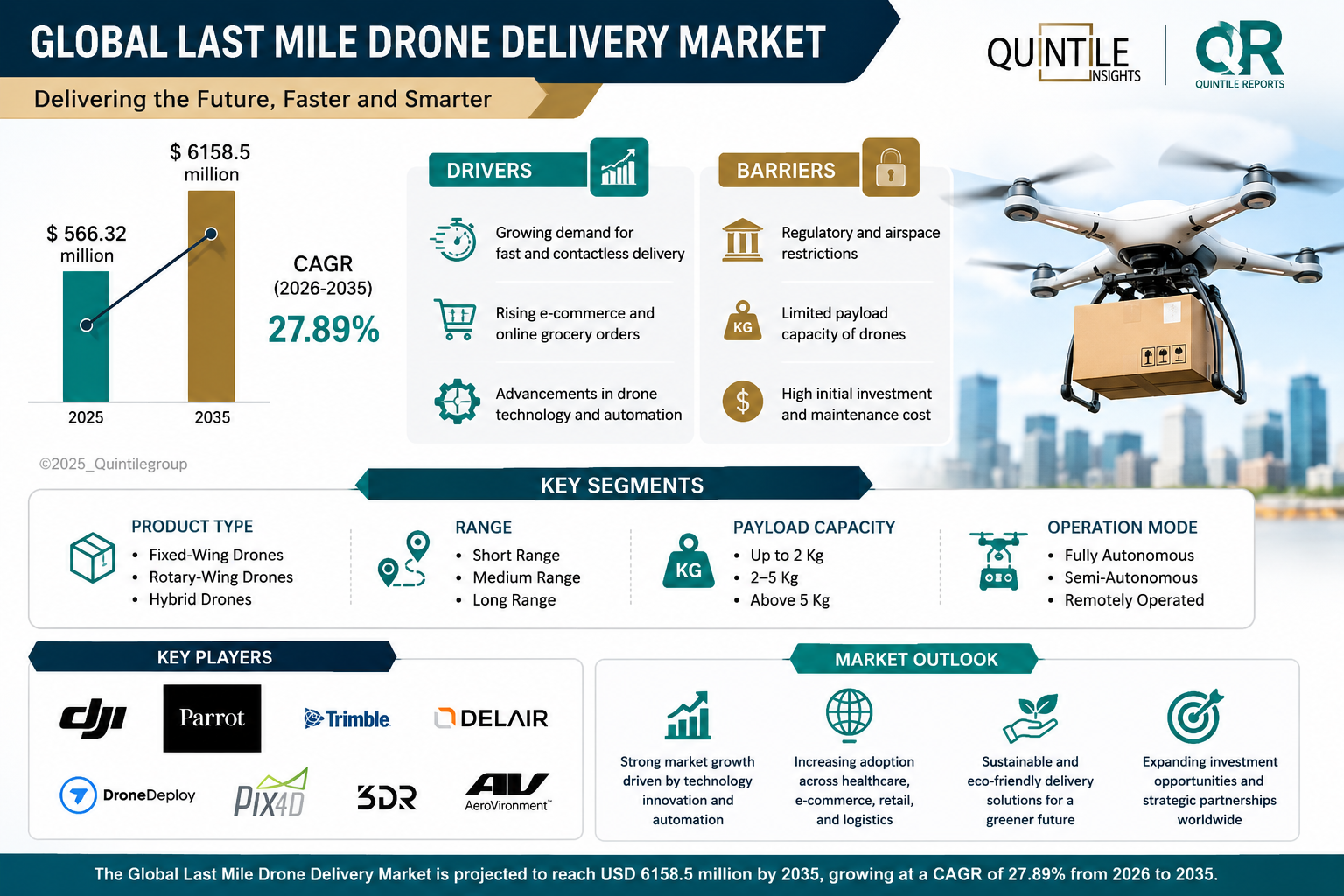
At the center of this transformation is the rapidly growing Last Mile Drone Delivery Market, which is redefining how goods are transported from distribution centers to consumers. According to recent industry analysis, the global Last Mile Drone Delivery Market was valued at USD 566.32 million in 2025 and is projected to reach USD 6,158.5 million by 2035, expanding at an impressive CAGR of 27.89% during the forecast period.
The rise of drone-enabled logistics reflects a broader shift toward intelligent transportation systems capable of addressing modern delivery challenges. As e-commerce volumes surge worldwide and consumers increasingly demand faster delivery services, businesses are exploring innovative solutions that can reduce costs, improve efficiency, and minimize environmental impact.
Request Sample PDF Report: https://www.quintilereports.com/request-sample/1266-last-mile-drone-delivery-market/
The Growing Importance of Last-Mile Delivery
Last-mile delivery represents the final step in the logistics chain, where products move from fulfillment centers to end customers. Despite being the shortest distance in the supply chain, it often accounts for the largest share of delivery costs due to traffic congestion, labor expenses, and route complexities.
Drone technology offers a compelling solution to these challenges. By flying directly to delivery destinations, drones bypass traditional road infrastructure and significantly reduce delivery times. This capability is particularly valuable for urgent deliveries such as pharmaceuticals, medical supplies, food products, and high-priority e-commerce orders.
Industry studies indicate that drone delivery systems can reduce delivery times by up to 70% while lowering operational expenses by nearly 40%. These benefits are attracting substantial investments from logistics providers, retailers, healthcare organizations, and technology companies worldwide.
E-Commerce Expansion Driving Market Growth
One of the strongest catalysts behind the growth of the last-mile drone delivery market is the unprecedented expansion of global e-commerce.
Consumers have become accustomed to rapid delivery services, with same-day and even same-hour delivery increasingly becoming standard expectations. Traditional delivery networks often struggle to meet these demands efficiently, especially during peak shopping seasons.
Drone delivery platforms provide businesses with the ability to offer faster fulfillment without significantly increasing operating costs. As online shopping continues to penetrate emerging markets and digital commerce ecosystems expand, drone-based delivery networks are expected to become an integral component of modern retail strategies.
Major retailers and logistics providers are actively investing in drone delivery pilot programs, viewing autonomous aerial delivery as a long-term competitive differentiator.
Special Discount: https://www.quintilereports.com/request-discount/1266-last-mile-drone-delivery-market/
The Last Mile Drone Delivery Market is gaining remarkable momentum as businesses increasingly adopt autonomous delivery technologies to improve operational efficiency and customer satisfaction. The rapid expansion of e-commerce platforms, coupled with growing demand for same-day delivery services, is creating substantial opportunities within the Last Mile Drone Delivery Market. Industry stakeholders are investing heavily in advanced navigation systems, AI-powered route optimization, and next-generation battery technologies to strengthen their position in the Last Mile Drone Delivery Market.
Healthcare Sector Emerging as a Major Application Area
Beyond retail, healthcare is becoming one of the most promising application segments for drone delivery services.
In many regions, particularly rural and remote communities, access to healthcare resources remains a persistent challenge. Drone technology enables rapid transportation of essential medical supplies, vaccines, blood samples, emergency medications, and diagnostic equipment to locations that may be difficult to reach through conventional transportation methods.
The ability to deliver life-saving supplies within minutes rather than hours is creating significant opportunities for healthcare providers and government agencies. Several successful pilot programs across Asia, Africa, Europe, and North America have demonstrated the effectiveness of drone-enabled medical logistics.
As healthcare systems increasingly prioritize accessibility and emergency response capabilities, demand for autonomous aerial delivery solutions is expected to accelerate significantly.
Technological Innovations Fueling Adoption
Recent advancements in drone technology are making commercial deployment more practical and scalable than ever before.
Artificial intelligence and machine learning systems are enabling drones to navigate complex urban environments autonomously while avoiding obstacles and adapting to changing weather conditions. Enhanced battery technologies are extending flight duration and increasing payload capacities, allowing drones to serve a wider range of delivery applications.
The emergence of 5G connectivity is further strengthening the drone ecosystem by facilitating real-time communication between drones, operators, and logistics management systems. Advanced analytics platforms are also helping organizations optimize routes, monitor fleet performance, and improve operational efficiency.
These technological developments are reducing operational risks and creating the foundation for large-scale commercial drone delivery networks.
Sustainability Benefits Supporting Market Expansion
Environmental sustainability is becoming an increasingly important consideration for logistics providers worldwide.
Traditional delivery vehicles contribute significantly to urban congestion and carbon emissions. Electric-powered drones offer an environmentally friendly alternative by reducing fuel consumption and lowering greenhouse gas emissions.
Many organizations are incorporating drone delivery into broader sustainability initiatives aimed at achieving carbon neutrality targets. Governments and municipalities are also recognizing the environmental advantages of aerial delivery systems, particularly within smart city development programs.
As regulatory support grows and environmental regulations become more stringent, sustainable logistics solutions such as drone delivery are expected to gain further momentum.
Regulatory Progress Unlocking Commercial Opportunities
Regulatory frameworks have historically been one of the primary barriers to commercial drone deployment. However, significant progress is being made globally.
In the United States, the Federal Aviation Administration (FAA) continues to expand commercial drone capabilities through pilot programs and evolving regulations. Similar efforts are underway across Europe through the European Union Aviation Safety Agency (EASA), which is streamlining certification processes and enabling Beyond Visual Line of Sight (BVLOS) operations.
Countries such as China, Japan, India, and the United Arab Emirates are also introducing supportive policies designed to accelerate drone integration into national transportation infrastructures.
These regulatory advancements are creating greater certainty for investors and encouraging broader commercial adoption.
Buying Now: https://www.quintilereports.com/request-enquiry/1266-last-mile-drone-delivery-market/
Regional Market Outlook
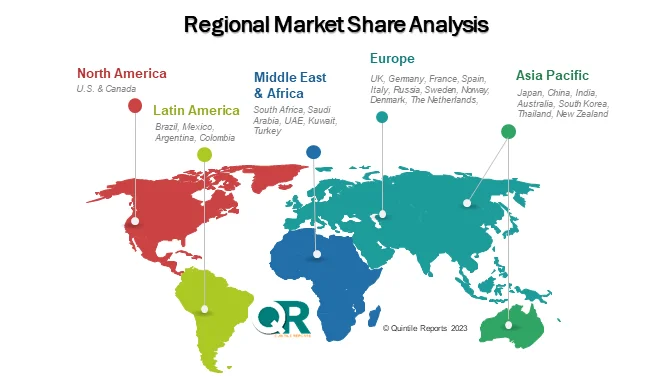
North America currently leads the global market, supported by advanced drone technologies, strong investment activity, and favorable regulatory developments. The United States remains a key innovation hub, with leading companies actively testing and scaling commercial delivery operations.
Europe is emerging as another significant growth region, particularly in Germany, France, and the Netherlands, where urban logistics and healthcare delivery projects continue to gain traction.
Asia-Pacific is expected to experience the fastest growth during the forecast period. China’s manufacturing capabilities, India’s expanding healthcare initiatives, and Japan’s leadership in robotics and automation are contributing to strong regional momentum.
Meanwhile, Latin America, the Middle East, and Africa are increasingly exploring drone delivery solutions to address infrastructure limitations and improve accessibility in remote areas.
Competitive Landscape
Competition within the last-mile drone delivery market is intensifying as technology providers, logistics companies, and retailers race to establish leadership positions.
Key areas of competition include delivery speed, payload capacity, operational range, safety systems, battery performance, autonomous navigation capabilities, and regulatory compliance.
Leading companies are investing heavily in artificial intelligence, fleet management software, collision avoidance systems, geofencing technologies, and next-generation battery solutions.
Strategic partnerships between drone manufacturers, logistics providers, healthcare organizations, and e-commerce companies are also becoming increasingly common as stakeholders seek to accelerate commercialization.
Looking Ahead
The future of last-mile drone delivery appears exceptionally promising. As technological capabilities continue to advance and regulatory barriers gradually diminish, drones are expected to become a mainstream logistics solution rather than a niche innovation.
The convergence of e-commerce growth, healthcare modernization, sustainability objectives, and smart city development is creating an environment where drone delivery can thrive. Organizations that successfully integrate drone technologies into their logistics operations will likely gain significant competitive advantages in speed, efficiency, and customer satisfaction.
With the market projected to surpass USD 6.15 billion by 2035, last-mile drone delivery is poised to become one of the most transformative innovations shaping the future of global logistics.
Q1. What is Last Mile Drone Delivery?
Answer:
Last-mile drone delivery refers to the use of unmanned aerial vehicles (UAVs) to transport goods from a distribution center or fulfillment hub directly to the end customer. It helps reduce delivery times, lower operational costs, and improve accessibility to remote locations.
Q2. What is driving the growth of the Last Mile Drone Delivery Market?
Answer:
The market is growing due to increasing e-commerce demand, advancements in autonomous drone technology, rising demand for contactless delivery services, improvements in battery performance, AI-powered navigation systems, and government support for drone integration.
Q3. How big is the Last Mile Drone Delivery Market expected to become by 2035?
Answer:
The global Last Mile Drone Delivery Market is projected to grow from USD 566.32 million in 2025 to approximately USD 6,158.5 million by 2035, registering a CAGR of 27.89% during the forecast period.
Q4. Which industries benefit the most from drone delivery services?
Answer:
Key industries benefiting from drone delivery include:
- Retail & E-commerce
- Healthcare & Pharmaceuticals
- Food Delivery
- Postal & Parcel Services
- Industrial Logistics
- Emergency Response & Disaster Relief
Q5. How do drones improve delivery efficiency?
Answer:
Drones bypass road congestion, take direct flight paths, reduce dependency on labor-intensive transportation, and can complete deliveries significantly faster than traditional ground vehicles, especially in urban and remote environments.
Q6. What role does Artificial Intelligence play in drone delivery?
Answer:
Artificial Intelligence helps drones autonomously navigate routes, avoid obstacles, optimize flight paths, manage fleet operations, improve safety, and process real-time environmental data for efficient delivery performance.
Q7. Are drone deliveries environmentally friendly?
Answer:
Yes. Most delivery drones are electrically powered, resulting in lower carbon emissions compared to fuel-powered delivery vehicles. They also contribute to reduced traffic congestion and support sustainable logistics initiatives.
Q8. What challenges are limiting large-scale drone delivery adoption?
Answer:
Major challenges include:
- Regulatory restrictions
- Limited flight range
- Payload capacity constraints
- Airspace management issues
- Cybersecurity concerns
- Public acceptance and privacy concerns
- Infrastructure limitations
Q9. Which regions are leading the adoption of drone delivery technology?
Answer:
North America currently leads the market, followed by Europe and Asia-Pacific. Countries such as the United States, China, Germany, Japan, India, and the UAE are actively investing in drone delivery ecosystems.
Q10. What are Beyond Visual Line of Sight (BVLOS) operations?
Answer:
BVLOS operations allow drones to fly beyond the direct visual observation of operators. These capabilities are crucial for large-scale commercial drone delivery networks and are increasingly being approved by aviation regulators worldwide.
Our Latest Publication:
Last Mile Drone Delivery Market 2026-2036
Eugenol Market Growth Accelerates as Natural Ingredients Transform Food, Healthcare, and Personal Care Industries

Adarsh
Business Strategy — Quintile Reports
Adarsh is a Business Strategy professional focused on transforming market insights into actionable growth plans. He supports strategic initiatives through market analysis, competitive intelligence, and data-driven decision-making to help drive long-term business success.
His core skills include strategic planning, market research, growth opportunity assessment, trend analysis, performance tracking, stakeholder communication, cross-functional collaboration, and critical problem-solving.