
The global healthcare industry is witnessing a major transformation driven by precision medicine, molecular diagnostics, and targeted therapies.
At the center of this evolution lies the radiopharmaceuticals market, a specialized segment of nuclear medicine that is rapidly expanding its role in disease diagnosis, treatment planning, and personalized patient care.
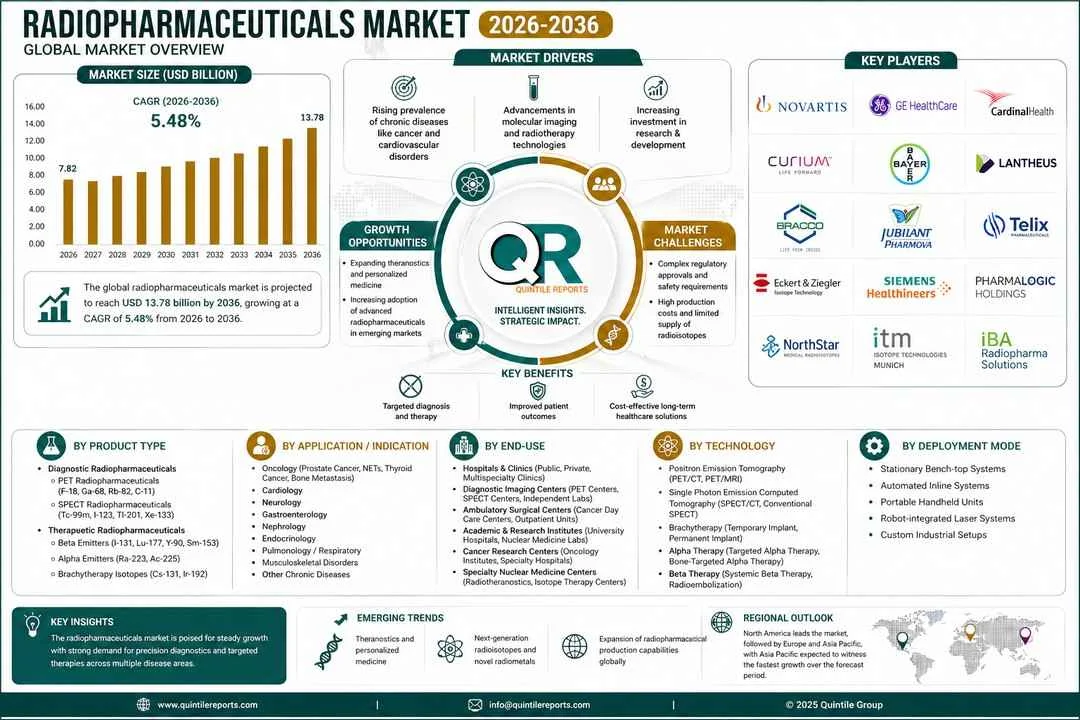
According to recent industry analysis, the global radiopharmaceuticals market is expected to grow from approximately USD 7.82 billion in 2026 to USD 13.78 billion by 2036, registering a compound annual growth rate (CAGR) of 5.48% during the forecast period. This growth reflects increasing demand for advanced diagnostic imaging technologies, rising cancer prevalence, and growing investments in targeted radionuclide therapies worldwide.
Request Sample PDF Report: https://www.quintilereports.com/request-sample/1298-radiopharmaceuticals-market/
Why Radiopharmaceuticals Matter
Radiopharmaceuticals are unique pharmaceutical compounds that contain radioactive isotopes and are used in both diagnostic and therapeutic medical applications. Unlike conventional drugs, these products allow physicians to visualize biological processes within the body and target diseased tissues with exceptional precision.
Their applications extend across numerous medical specialties including oncology, cardiology, neurology, endocrinology, nephrology, and gastroenterology. Through technologies such as Positron Emission Tomography (PET) and Single Photon Emission Computed Tomography (SPECT), healthcare professionals can detect diseases at earlier stages and develop highly personalized treatment plans.
The increasing shift toward precision healthcare is creating substantial opportunities for radiopharmaceutical manufacturers, healthcare providers, and nuclear medicine facilities around the world.
Special Discount: https://www.quintilereports.com/request-discount/1298-radiopharmaceuticals-market/
Cancer Burden Continues to Fuel Market Expansion
One of the most significant growth drivers for the radiopharmaceuticals market is the global rise in cancer incidence. Cancer remains among the leading causes of mortality worldwide, increasing demand for advanced diagnostic and therapeutic solutions.
Radiopharmaceuticals play a critical role throughout the cancer care pathway. They are used for tumor detection, disease staging, treatment monitoring, recurrence assessment, and increasingly for targeted radioligand therapies.
The oncology segment currently represents more than half of the total market demand. The growing adoption of molecular imaging techniques has significantly improved physicians’ ability to identify tumors with greater accuracy while minimizing invasive procedures.
As healthcare systems focus on early detection and personalized treatment strategies, demand for radiopharmaceutical products is expected to remain strong throughout the forecast period.
Rise of Theranostics Reshaping Nuclear Medicine
One of the most exciting developments in the industry is the emergence of theranostics, a revolutionary approach that combines diagnostic imaging and therapy into a single treatment pathway.
Theranostics allows physicians to identify disease-specific biomarkers through diagnostic imaging and subsequently administer targeted radioactive therapies to treat the same disease.
This approach is particularly effective in treating prostate cancer, neuroendocrine tumors, and other difficult-to-manage malignancies. Isotopes such as Gallium-68 and Lutetium-177 have become central to these treatment strategies.
The growing success of theranostic platforms is encouraging healthcare providers and pharmaceutical companies to expand investments in research and development, further strengthening the long-term outlook for the market.
Buying Now: https://www.quintilereports.com/request-enquiry/1298-radiopharmaceuticals-market/
Technetium-99m Remains the Industry Workhorse
Among the various radioisotopes available today, Technetium-99m continues to dominate global utilization.
Its popularity stems from several advantages, including favorable imaging characteristics, broad clinical applicability, relatively short half-life, and compatibility with a wide range of diagnostic procedures.
Technetium-99m is routinely used for:
- Cardiac perfusion imaging
- Bone scans
- Kidney function assessments
- Thyroid evaluations
- Neurological imaging
Despite the emergence of newer isotopes, Technetium-99m remains foundational to nuclear medicine workflows across hospitals and imaging centers globally.
PET Imaging Driving New Opportunities
Positron Emission Tomography continues to gain prominence due to its superior imaging capabilities and expanding clinical applications.
Fluorine-18 remains the most widely used PET isotope, particularly through fluorodeoxyglucose (FDG) imaging, which is essential for cancer diagnosis and metabolic assessments.
Meanwhile, Gallium-68 is gaining significant traction in prostate cancer diagnostics and neuroendocrine tumor imaging. The rapid adoption of prostate-specific membrane antigen (PSMA) imaging is expected to further boost demand for Gallium-68-based radiopharmaceuticals.
Healthcare institutions are increasingly investing in PET/CT and PET/MRI technologies, supporting broader utilization of advanced radiopharmaceutical products.
Therapeutic Applications Enter a New Growth Phase
While diagnostic imaging historically dominated the market, therapeutic radiopharmaceuticals are emerging as one of the fastest-growing segments.
Targeted radionuclide therapies enable healthcare providers to deliver radiation directly to diseased cells while minimizing damage to surrounding healthy tissues.
Several isotopes are becoming increasingly important:
Lutetium-177
Widely used in prostate cancer and neuroendocrine tumor treatments.
Iodine-131
A longstanding therapy for thyroid disorders and thyroid cancer.
Yttrium-90
Used in radioembolization procedures and selected cancer therapies.
Radium-223
Particularly effective for bone metastases associated with advanced prostate cancer.
The expanding approval pipeline for radioligand therapies is expected to create substantial commercial opportunities over the next decade.
Infrastructure Investments Supporting Growth
The success of the radiopharmaceutical industry depends heavily on production and distribution infrastructure.
Governments, healthcare providers, and private investors are increasingly funding:
- Cyclotron installations
- Nuclear reactor modernization
- Radiopharmacy expansion
- PET imaging centers
- Nuclear medicine departments
Emerging economies are particularly focused on expanding nuclear medicine capabilities to improve access to advanced healthcare services.
As infrastructure improves, patient access to both diagnostic and therapeutic radiopharmaceuticals is expected to increase significantly.
Regional Outlook Highlights Strong Growth Potential
North America
North America remains the largest regional market, supported by advanced healthcare infrastructure, extensive PET and SPECT adoption, and strong regulatory oversight.
The United States continues to dominate global revenue generation due to high procedural volumes and ongoing innovation in precision oncology.
Europe
Europe represents a mature yet resilient market. Countries such as Germany, France, the United Kingdom, and Italy continue to invest heavily in precision medicine initiatives and targeted radionuclide therapies.
East Asia
East Asia is emerging as the fastest-growing regional market.
China, in particular, is experiencing rapid expansion due to increasing healthcare investments, growing oncology treatment capacity, and broader adoption of advanced imaging technologies.
Japan and South Korea continue to strengthen their positions through technological leadership and highly developed healthcare systems.
South Asia and Pacific
India is becoming an increasingly important growth market due to rising cancer incidence, improving healthcare infrastructure, and expanding nuclear medicine capabilities.
The region is expected to generate attractive long-term opportunities for manufacturers and healthcare providers seeking market expansion.
Challenges Remain Despite Positive Outlook
Despite strong growth prospects, several challenges continue to affect market development.
One major concern is isotope supply reliability. Many critical isotopes are produced by a limited number of reactors and cyclotrons worldwide, creating supply chain vulnerabilities.
The short half-life of many radioisotopes also presents logistical difficulties, requiring highly coordinated manufacturing and transportation systems.
Additional challenges include:
- Stringent regulatory requirements
- Specialized handling and storage procedures
- High infrastructure investment costs
- Limited availability of trained nuclear medicine professionals
Addressing these barriers will be essential for sustaining future market growth.
Competitive Landscape Intensifies
Competition within the radiopharmaceuticals market is increasingly centered around isotope access, manufacturing reliability, regulatory expertise, and therapeutic innovation.
Leading industry participants are expanding production capabilities, investing in research pipelines, and strengthening strategic partnerships to secure long-term market positions.
Key companies actively shaping industry development include Novartis, GE HealthCare, Cardinal Health, Curium Pharma, Bayer, Lantheus Holdings, Bracco Imaging, Telix Pharmaceuticals, Siemens Healthineers, and Eckert & Ziegler.
Particularly notable is the growing competition in the radioligand therapy segment, where companies are aggressively expanding manufacturing networks and pursuing new regulatory approvals.
Future Outlook
The next decade is expected to redefine the role of radiopharmaceuticals in modern healthcare.
As precision medicine becomes the standard of care, demand for advanced molecular imaging and targeted radionuclide therapies will continue to rise. Theranostics, personalized treatment pathways, and next-generation PET tracers are likely to become central pillars of cancer care and disease management.
With expanding infrastructure, growing healthcare investments, and continuous technological innovation, the radiopharmaceuticals market is positioned for sustained growth through 2036.
For healthcare providers, pharmaceutical companies, investors, and policymakers, the sector represents one of the most promising opportunities within the evolving landscape of precision medicine and nuclear healthcare.
1. What is driving growth in the global radiopharmaceuticals market?
The primary growth drivers include increasing cancer prevalence, rising adoption of PET and SPECT imaging, expansion of theranostics, and growing investments in precision medicine.
2. What market size is projected for the radiopharmaceuticals industry by 2036?
The market is projected to reach approximately USD 13.78 billion by 2036.
3. Which application segment dominates the market?
Oncology remains the leading application segment, accounting for more than 50% of global demand.
4. Why is theranostics considered a breakthrough technology?
Theranostics combines diagnosis and treatment using the same molecular target, enabling highly personalized and effective patient care.
5. Which radioisotope currently holds the largest market share?
Technetium-99m remains the most widely utilized isotope due to its versatility and extensive use in SPECT imaging.
6. What role does Lutetium-177 play in market growth?
Lutetium-177 is driving growth in targeted radionuclide therapy, particularly for prostate cancer and neuroendocrine tumors.
7. Which region is expected to experience the fastest growth?
East Asia, particularly China, is forecast to be the fastest-growing regional market through 2036.
8. What are the major challenges facing the industry?
Challenges include isotope supply constraints, short isotope half-lives, regulatory complexities, infrastructure costs, and transportation requirements.
9. How are radiopharmaceuticals transforming cancer treatment?
They enable early diagnosis, precise disease monitoring, and targeted treatment delivery while minimizing damage to healthy tissues.
10. Which companies are leading innovation in radioligand therapies?
Key innovators include Novartis, Lantheus Holdings, Telix Pharmaceuticals, Curium Pharma, Bayer, and GE HealthCare.
Our Latest Publication:
Radiopharmaceuticals Market (2026 – 2036)
India Outdoor Air Pollution Control Market to Reach INR 26,951 Cr by 2036 Amid Clean Air Push

Adarsh
Business Strategy — Quintile Reports
Adarsh is a Business Strategy professional focused on transforming market insights into actionable growth plans. He supports strategic initiatives through market analysis, competitive intelligence, and data-driven decision-making to help drive long-term business success.
His core skills include strategic planning, market research, growth opportunity assessment, trend analysis, performance tracking, stakeholder communication, cross-functional collaboration, and critical problem-solving.