
The global energy industry is undergoing a profound transformation as operators increasingly embrace automation, digital monitoring, and sustainability-focused technologies.
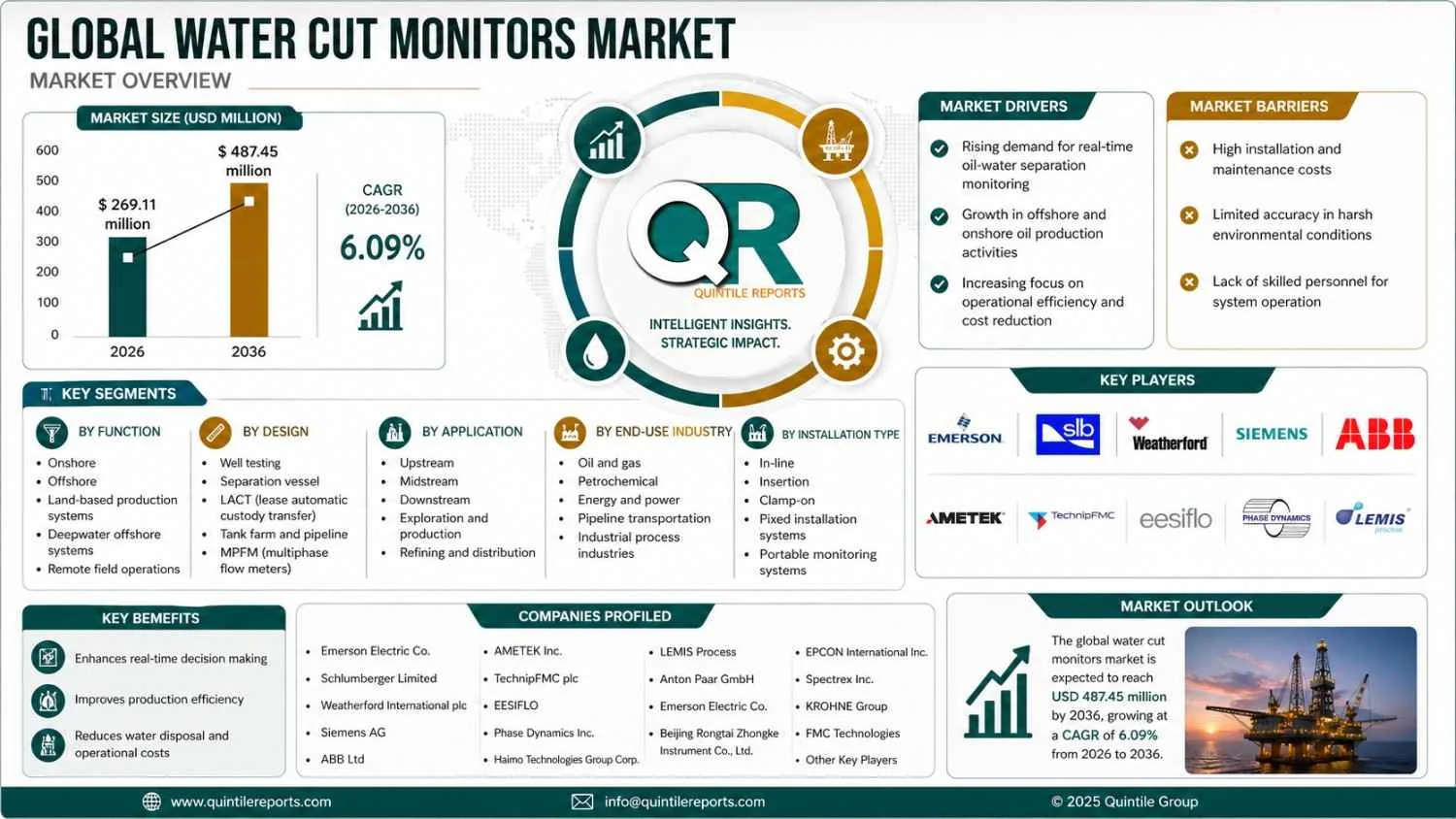
Among the solutions gaining significant momentum is the adoption of water cut monitors—advanced instruments that continuously measure the percentage of water present in oil production streams. According to recent industry analysis, the global Water Cut Monitors Market is projected to grow from USD 269.11 million in 2026 to USD 487.45 million by 2036, reflecting a CAGR of 5.81% during the forecast period.
This growth trajectory highlights the increasing importance of accurate fluid monitoring across upstream, midstream, and downstream oil and gas operations. As production fields mature and water content in extracted hydrocarbons rises, operators are seeking more precise and reliable monitoring systems to optimize production efficiency, reduce operational costs, and maintain compliance with evolving environmental regulations.
Sample PDF Report: https://www.quintilereports.com/request-sample/1297-water-cut-monitors-market/
Why Water Cut Monitoring Matters
Water cut refers to the percentage of water contained within produced oil. Monitoring this parameter is critical because excessive water production can significantly impact operational efficiency, increase processing costs, and reduce the commercial value of crude oil.
Water cut monitors provide continuous real-time measurements, allowing operators to make informed decisions regarding reservoir management, separation processes, and transportation systems. These devices help identify production challenges early, minimize waste, and improve overall asset performance.
As oilfields become more technologically advanced, water cut monitoring is evolving from a simple measurement tool into an essential component of integrated digital oilfield ecosystems.
Digital Oilfields Fuel Market Expansion
One of the strongest growth catalysts for the water cut monitors market is the rapid expansion of digital oilfield technologies. The integration of Industrial Internet of Things (IIoT), artificial intelligence, machine learning, and cloud-based analytics has significantly enhanced the capabilities of monitoring systems.
Modern water cut monitors are no longer isolated instruments. They are increasingly connected to centralized operational platforms, enabling remote monitoring, predictive maintenance, and automated decision-making.
Special Discount: https://www.quintilereports.com/request-discount/1297-water-cut-monitors-market/
Real-time data collection allows operators to identify anomalies, optimize separation equipment performance, and prevent costly downtime. The ability to remotely manage assets is especially valuable in offshore and remote production environments where operational interruptions can lead to substantial financial losses.
Environmental Compliance Becomes a Key Driver
Environmental regulations continue to tighten across major energy-producing regions, creating strong demand for advanced monitoring technologies.
Governments and regulatory agencies are implementing stricter standards regarding produced water management, wastewater disposal, and hydrocarbon discharge. Failure to comply with these regulations can result in significant penalties, operational disruptions, and reputational damage.
Water cut monitors help companies meet these requirements by providing accurate and verifiable measurement data. Continuous monitoring supports environmental reporting, facilitates regulatory audits, and enhances transparency in production operations.
As sustainability becomes a strategic priority for energy companies, investments in monitoring technologies are increasingly viewed as both compliance necessities and corporate responsibility initiatives.
Resource Optimization Gains Strategic Importance
The oil and gas industry faces ongoing pressure to maximize production efficiency while controlling costs. Water cut monitoring contributes directly to these objectives by improving resource utilization and process optimization.
Accurate water cut measurements allow operators to:
- Improve oil-water separation efficiency
- Reduce processing and transportation costs
- Optimize chemical injection programs
- Enhance reservoir management strategies
- Minimize equipment wear and maintenance requirements
- Increase production uptime
These operational benefits are particularly valuable in mature oilfields where water production tends to increase over time.
Technological Advancements Reshape the Competitive Landscape
Innovation remains a central theme in the water cut monitors market. Manufacturers are investing heavily in research and development to improve measurement accuracy, reliability, and system integration capabilities.
Advanced microwave and radio-frequency (RF) technologies are becoming increasingly popular due to their ability to deliver highly accurate readings under challenging operating conditions. These technologies provide improved performance across varying fluid compositions, temperatures, and pressure levels.
Buying Now: https://www.quintilereports.com/request-enquiry/1297-water-cut-monitors-market/
Additionally, manufacturers are focusing on developing systems capable of seamless integration with Distributed Control Systems (DCS), Supervisory Control and Data Acquisition (SCADA) platforms, and Remote Terminal Units (RTUs).
Cloud connectivity and IoT compatibility are also emerging as key differentiators, enabling operators to leverage advanced analytics and real-time operational insights.
Regional Market Dynamics
North America Leads Global Adoption
North America currently represents the largest market for water cut monitors, supported by a combination of stringent environmental regulations, technological innovation, and extensive oil and gas operations.
The United States remains a major growth engine due to its advanced digital oilfield infrastructure and strong focus on operational efficiency. Regulatory oversight from environmental agencies encourages widespread adoption of monitoring technologies across production facilities.
Canada also contributes significantly to regional growth, particularly within its oil sands and conventional production sectors.
Europe Focuses on Sustainability
Europe’s market growth is heavily influenced by strict environmental and safety standards. Countries such as Norway and the United Kingdom have established rigorous requirements regarding produced water management and offshore operational safety.
These regulations are encouraging operators to invest in highly accurate monitoring systems capable of supporting compliance and environmental stewardship objectives.
Asia-Pacific Emerges as a High-Growth Region
The Asia-Pacific region is expected to experience substantial growth during the forecast period. Expanding energy demand, increased exploration activities, and government initiatives focused on energy security are creating favorable market conditions.
China, India, and Southeast Asian nations are investing heavily in oil and gas infrastructure while simultaneously strengthening environmental regulations, driving demand for advanced monitoring technologies.
Latin America and Middle East Gain Momentum
Countries such as Brazil and Argentina are revitalizing hydrocarbon development projects, creating new opportunities for monitoring technology providers.
Meanwhile, the Middle East and Africa continue to benefit from extensive upstream oil and gas activities. Operators throughout the region are increasingly adopting digital solutions to improve operational efficiency and support sustainability initiatives.
Challenges Limiting Market Growth
Despite positive growth prospects, the water cut monitors market faces several challenges.
The high initial cost of advanced monitoring systems remains a significant barrier, particularly for small and medium-sized operators. Installation, integration, and ongoing maintenance expenses can be substantial.
Harsh operating environments also present technical challenges. Offshore installations, extreme temperatures, and sensor fouling can affect system performance and increase maintenance requirements.
Additionally, effective utilization of advanced monitoring technologies requires skilled personnel capable of interpreting data and maintaining sophisticated equipment. Talent shortages in certain regions may slow adoption rates.
Market volatility, especially fluctuations in oil prices, can also impact capital expenditure decisions and delay investments in process monitoring infrastructure.
Competitive Landscape Intensifies
Competition within the water cut monitors market is becoming increasingly focused on technological differentiation and integration capabilities.
Leading manufacturers are prioritizing:
- Measurement precision
- Equipment durability
- Low-maintenance operation
- Remote monitoring capabilities
- Digital integration features
- Cloud connectivity solutions
Industry participants are also pursuing strategic partnerships, acquisitions, and product innovation initiatives to strengthen their market positions.
Major companies operating in the market include Emerson Electric Co., Schlumberger Limited, Weatherford International plc, Siemens AG, ABB Ltd., AMETEK Inc., TechnipFMC plc, EESIFLO, Phase Dynamics Inc., Haimo Technologies Group Corp., LEMIS Process, Anton Paar GmbH, and Beijing Rongtai Zhongke Instrument Co., Ltd.
Looking Ahead
As energy producers continue their transition toward smarter, more sustainable operations, water cut monitoring technologies will play an increasingly important role in production optimization and environmental compliance.
The convergence of digitalization, automation, and sustainability objectives is expected to create significant opportunities for market expansion over the coming decade. Organizations that invest in advanced monitoring capabilities will be better positioned to improve operational efficiency, reduce environmental impact, and maintain competitiveness in an increasingly data-driven energy landscape.
With technological innovation accelerating and regulatory expectations continuing to evolve, the water cut monitors market is poised to become a critical pillar of future oil and gas operations worldwide.
1. What is driving the growth of the global Water Cut Monitors Market?
The primary growth drivers include digital oilfield adoption, stricter environmental regulations, increasing demand for real-time production monitoring, and the need for operational efficiency across oil and gas facilities.
2. Why are water cut monitors becoming critical in modern oilfields?
They provide continuous measurement of water content in produced oil, enabling operators to optimize production, reduce processing costs, and improve reservoir management decisions.
3. How does digital transformation influence water cut monitoring?
IoT-enabled sensors, cloud analytics, AI-driven insights, and remote monitoring capabilities are transforming traditional monitoring systems into intelligent operational tools.
4. Which industries use water cut monitors beyond oil and gas?
Apart from oil and gas, petrochemical plants, energy and power facilities, pipeline transportation companies, and industrial process industries increasingly utilize these systems.
5. What technologies are shaping next-generation water cut monitors?
Microwave measurement, radio-frequency sensing, IoT connectivity, wireless communication, predictive analytics, and cloud-based monitoring platforms are key innovations.
6. Which region currently dominates the market?
North America leads due to advanced oilfield technologies, strict environmental regulations, and widespread deployment of digital production systems.
7. What are the major challenges facing market adoption?
High installation costs, maintenance requirements, harsh operating conditions, and shortages of skilled personnel remain major barriers.
8. How do water cut monitors contribute to ESG and sustainability goals?
They support water conservation, reduce waste generation, improve environmental reporting accuracy, and help organizations comply with regulatory standards.
Our Latest Publication:
Water Cut Monitors Market (2026-2036)
Flexi Bag Market Surges as Sustainable Bulk Liquid Transport Gains Worldwide Momentum

Adarsh
Business Strategy — Quintile Reports
Adarsh is a Business Strategy professional focused on transforming market insights into actionable growth plans. He supports strategic initiatives through market analysis, competitive intelligence, and data-driven decision-making to help drive long-term business success.
His core skills include strategic planning, market research, growth opportunity assessment, trend analysis, performance tracking, stakeholder communication, cross-functional collaboration, and critical problem-solving.