
The global cosmetic chemicals industry is entering a transformative decade as consumer preferences, sustainability initiatives, and scientific innovation converge to reshape the beauty and personal care landscape.
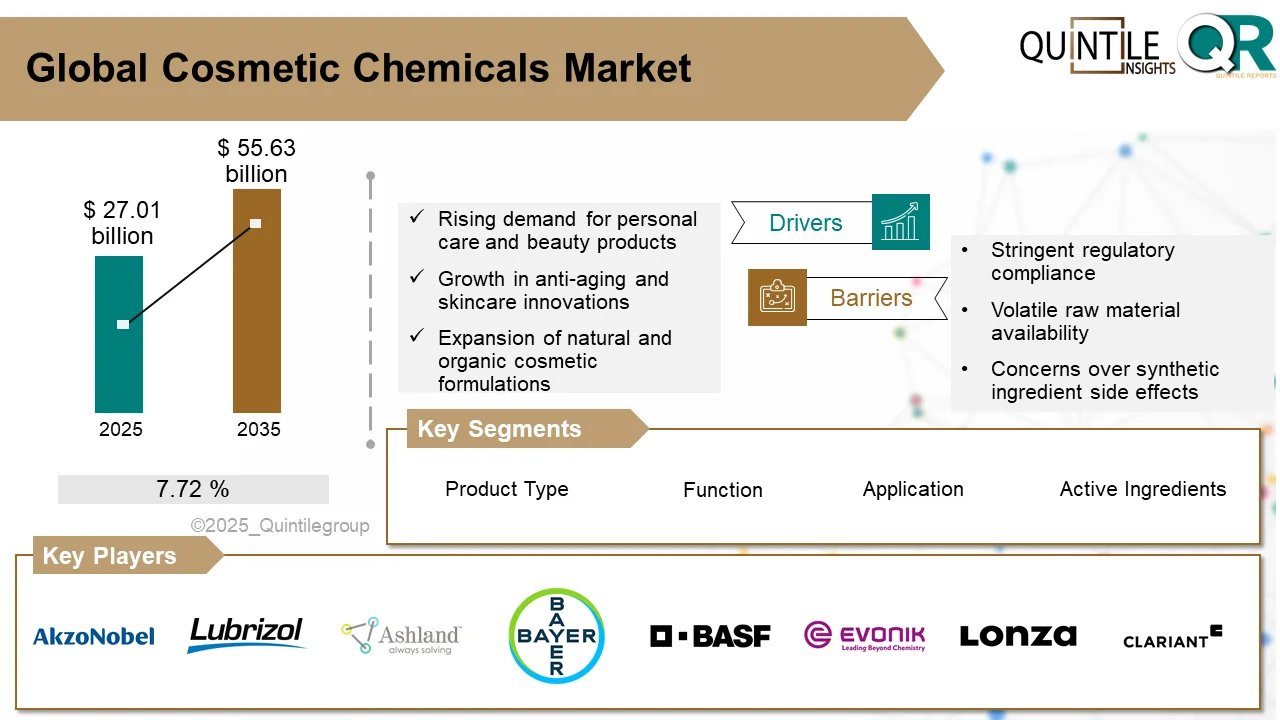
According to recent market intelligence, the Cosmetic Chemicals Market, valued at USD 27.01 billion in 2025, is projected to reach USD 55.63 billion by 2035, expanding at a CAGR of 7.72% during the forecast period.
The remarkable growth trajectory highlights the increasing importance of advanced ingredients in modern beauty formulations. From premium skincare serums and anti-aging creams to haircare products and cosmetics, manufacturers are investing heavily in ingredient innovation to meet evolving consumer demands for efficacy, safety, and sustainability.
Request Sample PDF Report: https://www.quintilereports.com/request-sample/1292-cosmetic-chemicals-market/
The Foundation of Modern Beauty Products
Cosmetic chemicals serve as the backbone of virtually every beauty and personal care product available today. These ingredients include surfactants, emulsifiers, preservatives, colorants, moisturizers, active compounds, and specialized additives that ensure product stability, texture, effectiveness, and shelf life.
As consumers become increasingly educated about ingredient labels, cosmetic manufacturers are under pressure to formulate products that deliver visible results while maintaining transparency and environmental responsibility. This shift has elevated the role of specialty chemical suppliers, making them strategic partners in product development and brand differentiation.
Industry experts note that cosmetic ingredients are no longer viewed simply as functional components. Instead, they are becoming key value drivers that influence purchasing decisions, brand loyalty, and long-term market competitiveness.
Clean Beauty Becomes a Global Growth Catalyst
One of the most influential trends driving the cosmetic chemicals market is the rise of clean beauty. Consumers worldwide are seeking products formulated with ingredients perceived as safe, ethical, and environmentally responsible.
Discount Now: https://www.quintilereports.com/request-discount/1292-cosmetic-chemicals-market/
The demand for clean-label formulations has encouraged manufacturers to reduce reliance on controversial ingredients and replace them with alternatives that meet stricter safety and sustainability criteria. As a result, suppliers are focusing on biodegradable surfactants, naturally derived emollients, plant-based preservatives, and environmentally friendly polymers.
The clean beauty movement is particularly strong among younger consumers who actively research product ingredients and expect brands to disclose sourcing practices and environmental impact. This growing awareness is encouraging cosmetic companies to invest in ingredient transparency and traceability throughout their supply chains.
For chemical manufacturers, the trend presents significant opportunities to develop innovative ingredient platforms that align with both regulatory requirements and consumer expectations.
Multifunctional Ingredients Gain Momentum
Today’s beauty consumers expect products to perform multiple functions simultaneously. This expectation has fueled demand for multifunctional cosmetic chemicals capable of delivering aesthetic, protective, and therapeutic benefits within a single formulation.
Ingredients such as niacinamide, hyaluronic acid, peptides, retinol, ceramides, and vitamin C continue to gain popularity due to their ability to address multiple skincare concerns. These compounds offer hydration, anti-aging effects, skin barrier support, brightening properties, and improved texture, making them valuable additions to modern formulations.
The growing popularity of multifunctional ingredients is also helping manufacturers streamline product development and reduce formulation complexity. By incorporating ingredients with multiple benefits, brands can create more effective products while simplifying ingredient lists—an important consideration for consumers seeking cleaner formulations.
Biotechnology Reshapes Ingredient Innovation
Biotechnology is emerging as a major force in cosmetic chemical development. Advanced fermentation processes, microbial engineering, and biotechnology-driven ingredient production are enabling manufacturers to create high-performance compounds with improved sustainability profiles.
Buying Now: https://www.quintilereports.com/request-enquiry/1292-cosmetic-chemicals-market/
Biotech-derived actives offer several advantages, including consistency, scalability, reduced environmental impact, and enhanced efficacy. These characteristics are particularly attractive in an industry where ingredient quality and reproducibility directly influence product performance.
Leading cosmetic ingredient suppliers are increasingly investing in research programs focused on biotechnology, creating alternatives to traditionally sourced materials while reducing pressure on natural resources. As biotechnology technologies become more sophisticated, they are expected to play an even larger role in the future of cosmetic formulation.
Sustainability Drives Strategic Investments
Environmental responsibility has become a critical business priority throughout the cosmetic chemicals value chain. Brands, retailers, investors, and consumers are placing growing emphasis on sustainable manufacturing practices and responsible ingredient sourcing.
To address these expectations, ingredient manufacturers are investing in green chemistry initiatives aimed at reducing waste, lowering carbon emissions, and improving resource efficiency. Sustainable innovations include biodegradable ingredients, renewable feedstocks, water-saving production processes, and circular economy approaches to chemical manufacturing.
These initiatives not only support environmental objectives but also create long-term economic benefits through improved operational efficiency and reduced regulatory risks.
Companies capable of demonstrating measurable sustainability achievements are increasingly securing preferred supplier status among major global beauty brands.
Digital Beauty Brands Accelerate Demand
The rapid rise of digital-first beauty companies is creating new opportunities for cosmetic ingredient suppliers. Online-focused brands are often more agile than traditional manufacturers, introducing products quickly and responding rapidly to changing consumer trends.
This accelerated product development cycle requires ingredient suppliers to provide versatile, effective, and market-ready solutions that can support fast innovation. As a result, demand is growing for customizable ingredients that enable brands to differentiate their products while maintaining regulatory compliance.
Social media and influencer marketing continue to amplify this trend, encouraging brands to launch innovative formulations featuring novel ingredients that capture consumer attention and drive engagement.
Regional Growth Highlights
Asia-Pacific Leads Global Expansion
Asia-Pacific remains the fastest-growing region in the cosmetic chemicals market. Countries such as China, Japan, South Korea, and India continue to influence global beauty trends and ingredient innovation.
The region’s strong demand for skincare, sun protection, hydration products, and advanced cosmetic formulations is driving significant investment in ingredient research and manufacturing capabilities. Local consumers increasingly seek high-performance products that combine efficacy with gentle, skin-friendly formulations.
North America Focuses on Transparency
In North America, regulatory developments and consumer awareness are driving demand for cleaner, safer cosmetic ingredients. The implementation of updated cosmetic regulations is encouraging manufacturers to improve ingredient documentation, quality control, and product transparency.
The region is also witnessing substantial investment in green chemistry, sustainable sourcing, and biotech-based active ingredients.
Europe Strengthens Sustainability Leadership
Europe continues to set global standards for cosmetic ingredient safety and environmental stewardship. Regulatory frameworks emphasize ingredient transparency, sustainability, and consumer protection.
European manufacturers are leading the adoption of biodegradable materials, renewable resources, and environmentally responsible production systems that support long-term industry sustainability goals.
Challenges Facing the Industry
Despite its positive outlook, the cosmetic chemicals industry faces several challenges.
Regulatory complexity remains a major concern as ingredient requirements vary significantly across regions. Manufacturers must continuously monitor changing standards and invest in compliance initiatives to maintain market access.
Raw material price volatility presents another challenge. Many cosmetic ingredients depend on agricultural or petrochemical feedstocks, making them vulnerable to supply chain disruptions, geopolitical events, and climate-related risks.
Additionally, the growing preference for natural ingredients creates formulation challenges related to stability, preservation, consistency, and scalability. Suppliers must balance consumer expectations with technical performance requirements to deliver commercially viable solutions.
Competitive Landscape Evolves
The competitive environment within the cosmetic chemicals market continues to evolve rapidly. Global industry leaders are investing heavily in research and development, sustainability initiatives, and digital technologies to strengthen their market positions.
Companies such as BASF, Evonik Industries, Croda International, Clariant, Ashland, Lonza, Givaudan, Symrise, Lubrizol, Inolex, and Huntsman Corporation remain at the forefront of ingredient innovation.
Strategic partnerships, acquisitions, and collaborative research initiatives are becoming increasingly common as organizations seek to accelerate innovation and expand product portfolios.
Recent industry developments demonstrate a growing emphasis on sustainability and ingredient safety. Collaborative efforts among beauty brands, ingredient suppliers, and environmental organizations are helping establish new standards for responsible chemical innovation.
Outlook Through 2035
Looking ahead, the cosmetic chemicals market is poised for sustained growth as beauty and personal care products become increasingly sophisticated. Consumer demand for clean-label, multifunctional, sustainable, and scientifically advanced ingredients will continue shaping research priorities and investment strategies.
Biotechnology, green chemistry, artificial intelligence-driven formulation tools, and sustainable sourcing practices are expected to define the next generation of cosmetic ingredient innovation.
As the beauty industry continues to evolve, cosmetic chemicals will remain central to product performance, consumer satisfaction, and market differentiation. Organizations that successfully combine scientific excellence, sustainability leadership, and regulatory compliance will be best positioned to capture emerging opportunities in this rapidly expanding global market.
With market value projected to more than double by 2035, the cosmetic chemicals sector represents one of the most dynamic and innovation-driven segments within the broader specialty chemicals industry.
1. What is the projected size of the global cosmetic chemicals market by 2035?
The global cosmetic chemicals market is expected to reach USD 55.63 billion by 2035, growing from USD 27.01 billion in 2025.
2. What is driving growth in the cosmetic chemicals industry?
Major growth drivers include increasing demand for clean-label products, multifunctional ingredients, sustainable formulations, biotechnology-based actives, and premium skincare innovations.
3. Which cosmetic ingredient categories are experiencing the highest demand?
Surfactants, emollients, preservatives, emulsifiers, peptides, hyaluronic acid, niacinamide, retinol, and biotechnology-derived active ingredients are among the fastest-growing categories.
4. Why is clean beauty influencing ingredient development?
Consumers increasingly prefer transparent, safe, biodegradable, and ethically sourced ingredients, encouraging manufacturers to develop cleaner and more sustainable formulations.
5. How is biotechnology transforming cosmetic chemicals?
Biotechnology enables the production of high-performance ingredients through fermentation and microbial processes, improving sustainability, consistency, and scalability.
6. Which region is expected to grow fastest?
Asia-Pacific is anticipated to remain the fastest-growing region due to strong beauty product demand, ingredient innovation, and expanding manufacturing capabilities.
7. What challenges are impacting cosmetic chemical manufacturers?
Key challenges include regulatory compliance, raw material price volatility, supply chain disruptions, and maintaining performance standards while adopting natural ingredients.
8. How are sustainability initiatives affecting the industry?
Sustainability is driving investments in green chemistry, biodegradable ingredients, renewable feedstocks, and circular economy manufacturing practices.
Our Latest Publication:
Cosmetic Chemicals Market (2026-2036)
Booster Beverage Market Accelerates as Consumers Embrace Functional Nutrition and Preventive Wellness

Adarsh
Business Strategy — Quintile Reports
Adarsh is a Business Strategy professional focused on transforming market insights into actionable growth plans. He supports strategic initiatives through market analysis, competitive intelligence, and data-driven decision-making to help drive long-term business success.
His core skills include strategic planning, market research, growth opportunity assessment, trend analysis, performance tracking, stakeholder communication, cross-functional collaboration, and critical problem-solving.