
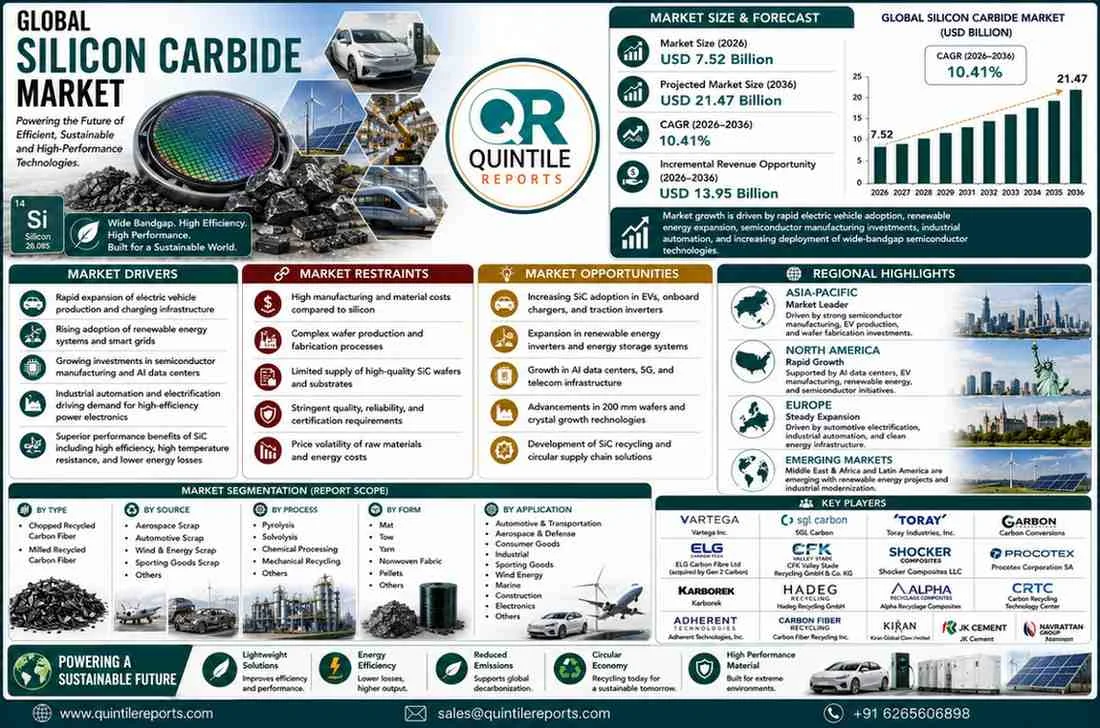
The global Silicon Carbide (SiC) Market is entering one of the most dynamic growth phases in semiconductor history. According to the latest research published by Quintile Reports, the market is projected to increase from USD 7.52 billion in 2026 to USD 21.47 billion by 2036, expanding at a CAGR of 10.41% throughout the forecast period.
As industries worldwide transition toward electrification, digitalization, and sustainability, silicon carbide has evolved from a specialized industrial material into a strategic technology enabling the next generation of electric vehicles (EVs), renewable energy systems, AI infrastructure, industrial automation, aerospace platforms, telecommunications equipment, and advanced power electronics.
Unlike conventional silicon semiconductors, silicon carbide offers exceptional thermal conductivity, higher breakdown voltage, faster switching capability, lower energy losses, and superior efficiency under demanding operating conditions. These advantages make SiC one of the most important materials supporting global decarbonization and energy-efficient technologies.
Request Sample PDF Report: https://www.quintilereports.com/request-sample/1322-silicon-carbide-market/
Electric Vehicles Become the Largest Growth Engine
One of the strongest catalysts driving silicon carbide demand is the explosive expansion of electric mobility.
Automotive manufacturers are increasingly replacing traditional silicon-based power devices with SiC semiconductors because they significantly improve vehicle efficiency while reducing energy losses.
Silicon carbide components are now widely integrated into:
- Traction inverters
- On-board chargers
- DC fast charging systems
- Battery management systems
- High-voltage power modules
Compared with conventional silicon devices, SiC power electronics allow electric vehicles to travel longer distances, charge faster, generate less heat, and reduce overall system weight.
As governments continue promoting zero-emission transportation and automotive manufacturers introduce new EV platforms, demand for silicon carbide wafers, MOSFETs, Schottky diodes, and power modules is expected to accelerate rapidly over the next decade.
Renewable Energy Expansion Creates Massive Opportunities
Global investments in renewable energy are also reshaping silicon carbide demand.
Modern solar farms, wind energy installations, battery energy storage systems, and smart grid infrastructure require highly efficient power conversion technologies.
Silicon carbide enables:
- Higher inverter efficiency
- Reduced power losses
- Better thermal management
- Improved high-voltage operation
- Longer equipment lifespan
As countries continue investing in clean energy infrastructure and energy transition programs, silicon carbide is becoming a critical component supporting renewable power generation and electricity transmission.
AI Data Centers Are Emerging as a Powerful Demand Driver
Artificial Intelligence is no longer influencing only software—it is also reshaping semiconductor demand.
Hyperscale AI data centers require enormous computing capacity while simultaneously reducing energy consumption.
Discount Now: https://www.quintilereports.com/request-discount/1322-silicon-carbide-market/
Silicon carbide-based power devices provide:
- Efficient server power supplies
- High-voltage power conversion
- Reduced cooling requirements
- Improved energy efficiency
- Higher operational reliability
As AI workloads continue expanding globally, data center operators are investing heavily in advanced power management technologies, creating an entirely new market opportunity for silicon carbide manufacturers.
Industrial Automation Accelerates Adoption
Industry 4.0 initiatives are increasing the deployment of robotics, automation systems, intelligent manufacturing equipment, and high-performance motor drives.
Silicon carbide enables industrial systems to operate more efficiently while minimizing electricity consumption and heat generation.
Manufacturers are increasingly deploying SiC across:
- Industrial motor drives
- Robotics
- Factory automation
- Smart manufacturing
- Power supplies
- Industrial controls
Growing automation across manufacturing industries is expected to remain a major contributor to long-term market expansion.
Transition Toward 200 mm Wafers Improves Manufacturing Economics
One of the industry’s biggest technological milestones is the commercialization of 200 mm silicon carbide wafers.
Larger wafer platforms enable manufacturers to:
- Increase production volumes
- Improve manufacturing yields
- Lower production costs
- Reduce device pricing
- Expand commercial scalability
Several leading semiconductor manufacturers are heavily investing in advanced crystal growth technologies and wafer fabrication capacity to support rising global demand.
As manufacturing efficiency improves, silicon carbide adoption is expected to expand into additional commercial and industrial applications.
Supply Chain Localization Becomes a Strategic Priority
Recent geopolitical developments have highlighted the importance of resilient semiconductor supply chains.
Governments across North America, Europe, and Asia-Pacific are investing billions of dollars into domestic semiconductor manufacturing.
Buying Now: https://www.quintilereports.com/request-enquiry/1322-silicon-carbide-market/
These initiatives include:
- Local wafer fabrication
- Crystal growth facilities
- Semiconductor packaging
- Advanced research centers
- Supply chain diversification
Government incentive programs are expected to strengthen silicon carbide manufacturing capacity while reducing dependence on overseas production.
Regional Outlook
Asia-Pacific Leads Global Production
Asia-Pacific remains the largest silicon carbide market due to its strong semiconductor ecosystem.
Countries including China, Japan, South Korea, and Taiwan continue investing heavily in:
- Semiconductor fabrication
- Electric vehicle manufacturing
- Renewable energy
- Industrial automation
- Advanced electronics
The region is expected to maintain its market leadership throughout the forecast period.
North America Strengthens Manufacturing
North America is witnessing rapid expansion driven by:
- AI data centers
- Domestic semiconductor production
- Electric vehicle manufacturing
- Renewable energy deployment
- Government semiconductor incentives
The United States continues expanding its silicon carbide manufacturing ecosystem through investments in wafer production, crystal growth, and vertically integrated fabrication.
Europe Accelerates Green Technologies
Europe continues investing aggressively in:
- Automotive electrification
- Railway electrification
- Industrial automation
- Renewable energy
- Green manufacturing
European demand for high-performance silicon carbide power electronics is expected to increase as industries pursue carbon-neutral operations.
Technology Innovation Defines Market Competition
Competition within the silicon carbide market is increasingly centered on technology leadership rather than manufacturing scale alone.
Leading companies are investing in:
- Advanced MOSFET technologies
- Schottky diodes
- Power modules
- Crystal quality improvements
- Defect reduction
- Epitaxial wafer production
- Packaging innovation
- Sustainable manufacturing
Manufacturers capable of delivering higher-quality wafers while simultaneously increasing production capacity are expected to capture significant market share.
Strategic Industry Developments
Several recent developments demonstrate how rapidly the silicon carbide industry is evolving.
Major semiconductor manufacturers have announced commercial readiness for 200 mm silicon carbide wafer platforms, enabling higher-volume production for electric vehicles and renewable energy applications.
Collaborations between semiconductor companies and automotive manufacturers are accelerating the development of next-generation EV powertrain technologies.
Researchers are also exploring sustainable manufacturing methods using recycled silicon and captured carbon dioxide to reduce the environmental footprint associated with silicon carbide production.
These innovations reinforce silicon carbide’s role as one of the most strategically important semiconductor materials supporting future industrial transformation.
Future Outlook
Over the next decade, silicon carbide will move well beyond its traditional industrial applications.
Rapid electrification, renewable energy deployment, AI infrastructure expansion, and industrial digitalization will continue generating unprecedented demand for highly efficient power electronics.
At the same time, technological improvements in wafer manufacturing, manufacturing automation, and semiconductor localization will improve affordability and production scalability.
Organizations capable of investing in innovation, sustainable manufacturing, and next-generation semiconductor technologies will be best positioned to capitalize on this expanding global opportunity.
With electric mobility, AI computing, renewable energy, and advanced manufacturing converging simultaneously, the Silicon Carbide Market is expected to remain one of the fastest-growing segments within the global semiconductor industry through 2036.
Frequently Asked Questions (FAQs) for Key Opinion Leaders
1. Why is Silicon Carbide gaining importance over conventional silicon?
Silicon carbide offers higher efficiency, superior thermal conductivity, lower switching losses, higher voltage tolerance, and better performance under extreme operating conditions.
2. Which industries are driving Silicon Carbide demand?
Electric vehicles, renewable energy, industrial automation, AI data centers, aerospace, defense, telecommunications, healthcare, and advanced manufacturing are major growth sectors.
3. Why are EV manufacturers rapidly adopting SiC technology?
SiC improves driving range, enables faster charging, reduces power losses, enhances battery efficiency, and lowers system weight.
4. What role does Silicon Carbide play in renewable energy?
SiC enhances inverter efficiency, supports high-voltage power conversion, improves grid reliability, and increases energy system performance.
5. What is the significance of 200 mm Silicon Carbide wafers?
Larger wafers improve manufacturing yields, reduce production costs, increase fabrication capacity, and support large-scale commercialization.
Our Latest Publication:
Silicon Carbide Market (2026 – 2036)
Hot Rolled Coil Steel Market to Reach USD 834.47 Billion by 2036 Driven by Global Infrastructure

Adarsh
Business Strategy — Quintile Reports
Adarsh is a Business Strategy professional focused on transforming market insights into actionable growth plans. He supports strategic initiatives through market analysis, competitive intelligence, and data-driven decision-making to help drive long-term business success.
His core skills include strategic planning, market research, growth opportunity assessment, trend analysis, performance tracking, stakeholder communication, cross-functional collaboration, and critical problem-solving.