
The global firefighting industry is undergoing a technological transformation as artificial intelligence, autonomous navigation, and advanced drone technologies redefine how fires are detected, monitored, and suppressed.
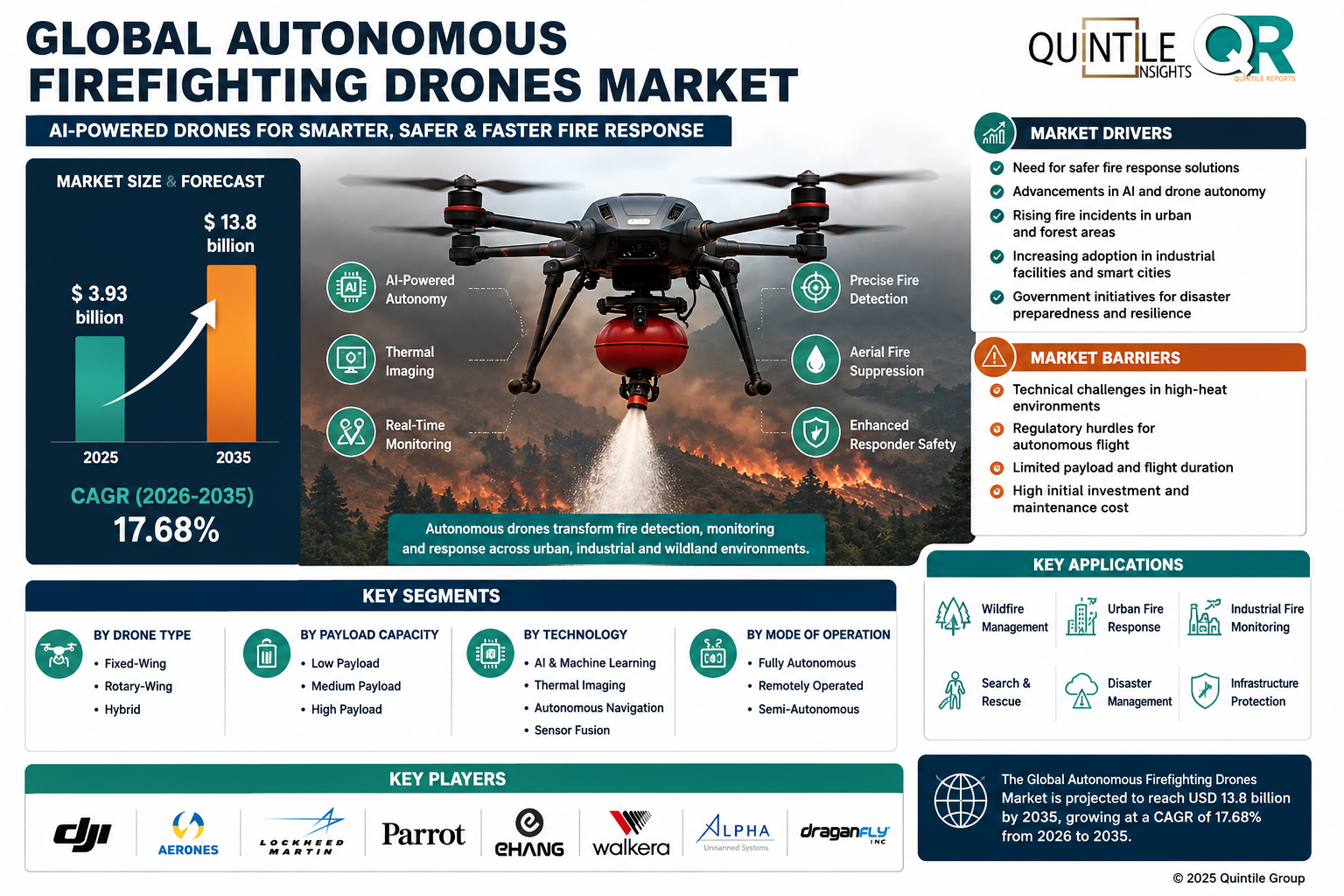
According to recent industry analysis, the Global Autonomous Firefighting Drones Market was valued at USD 3.93 billion in 2025 and is expected to reach USD 13.8 billion by 2035, growing at a remarkable CAGR of 17.68% during the forecast period.
As climate change intensifies wildfire incidents, urbanization increases fire risks, and industrial facilities seek enhanced safety measures, autonomous firefighting drones are emerging as critical tools for modern emergency response operations. These advanced unmanned aerial systems provide rapid situational awareness, reduce risks to first responders, and improve fire suppression effectiveness in environments where human intervention can be dangerous or limited.
Request Sample PDF Report: https://www.quintilereports.com/request-sample/1282-autonomous-firefighting-drones-market/
Rising Global Fire Threats Create Demand for Advanced Technologies
Wildfires, industrial accidents, and urban fire incidents are becoming increasingly frequent across the globe. Governments and emergency management agencies are actively searching for innovative technologies capable of improving response times and minimizing property damage and loss of life.
Autonomous firefighting drones offer a unique solution by combining aerial mobility, real-time intelligence, thermal imaging, and autonomous decision-making capabilities. These systems can quickly reach inaccessible areas, assess fire intensity, monitor fire spread, and provide critical information to emergency response teams.
The increasing frequency of climate-related disasters has accelerated investment in next-generation firefighting infrastructure, creating favorable conditions for market expansion.
Artificial Intelligence Enhancing Fire Detection and Suppression
Artificial intelligence is becoming a foundational component of modern firefighting drone systems. AI-powered navigation and analytics enable drones to identify smoke, heat signatures, and fire patterns with exceptional accuracy.
Key AI capabilities include:
- Automated fire detection
- Real-time threat assessment
- Autonomous route optimization
- Predictive fire spread analysis
- Hazard mapping
- Emergency response coordination
These intelligent systems significantly reduce response times while improving operational efficiency. By analyzing data in real time, drones can assist emergency personnel in making faster and more informed decisions during critical incidents.
Discount Now: https://www.quintilereports.com/request-discount/1282-autonomous-firefighting-drones-market/
As machine learning algorithms continue to evolve, autonomous firefighting platforms are expected to become even more capable of managing complex emergency scenarios with minimal human intervention.
Wildfire Management Driving Market Expansion
One of the strongest growth drivers for autonomous firefighting drones is the escalating threat of wildfires worldwide. Forest fires have increased dramatically over recent decades, fueled by prolonged droughts, rising temperatures, and changing weather patterns.
Firefighting drones provide several advantages in wildfire management:
- Early fire detection
- Continuous surveillance
- Thermal mapping
- Fire perimeter monitoring
- Aerial deployment of fire retardants
- Search and rescue support
These capabilities enable authorities to identify and contain fires before they escalate into large-scale disasters. Drones can remain operational in hazardous environments where traditional firefighting crews face significant risks.
Many forestry agencies are now integrating autonomous drone fleets into wildfire prevention and response strategies, further supporting market growth.
Smart Cities Adopting Drone-Based Emergency Response
Urban environments present unique firefighting challenges due to population density, vertical infrastructure, and limited accessibility in congested areas. Smart cities are increasingly incorporating autonomous drones into public safety frameworks to improve emergency response capabilities.
Drones can access:
- High-rise buildings
- Rooftop structures
- Narrow urban corridors
- Underground facilities
- Transportation hubs
Equipped with thermal cameras and advanced sensors, these systems provide emergency responders with real-time situational awareness, helping them assess fire severity and identify evacuation routes.
The integration of drones into municipal emergency management systems is expected to become a standard practice in many metropolitan regions over the coming decade.
Industrial Facilities Strengthening Fire Prevention Strategies
Industrial sites such as oil refineries, chemical plants, manufacturing facilities, and energy infrastructure face elevated fire risks due to hazardous operating conditions.
Buying Now: https://www.quintilereports.com/request-enquiry/1282-autonomous-firefighting-drones-market/
Autonomous firefighting drones are increasingly being deployed for:
- Routine fire patrols
- Thermal inspections
- Gas leak detection
- Equipment monitoring
- Emergency response activation
- Post-incident assessments
Industrial operators recognize the value of drone-based monitoring systems in identifying potential hazards before they develop into critical incidents. By reducing downtime and improving safety compliance, these technologies deliver both operational and economic benefits.
The growing adoption of Industry 4.0 practices is further accelerating demand for intelligent aerial monitoring systems across industrial environments.
Drone Delivery Technologies Creating New Opportunities
Technologies originally developed for commercial drone delivery are finding new applications within firefighting operations. Advanced cargo drones can transport essential supplies directly to emergency response teams operating in remote or inaccessible locations.
Potential payloads include:
- Fire retardants
- Medical kits
- Emergency communications equipment
- Protective gear
- Water delivery systems
This capability enhances operational flexibility while improving response effectiveness during large-scale emergencies.
As payload capacities continue to improve, cargo-enabled firefighting drones are expected to become increasingly valuable assets within disaster management operations.
Government Investments Supporting Market Development
Governments worldwide are investing heavily in disaster resilience and public safety initiatives. Numerous national and regional programs are funding the deployment of autonomous firefighting technologies as part of broader climate adaptation and emergency preparedness strategies.
Public-sector investments are supporting:
- Pilot drone programs
- Smart city infrastructure
- Wildfire prevention projects
- Emergency communication networks
- AI-enabled disaster response systems
Regulatory agencies are also gradually adapting airspace regulations to facilitate the safe deployment of autonomous drones in emergency scenarios.
These supportive policy environments are expected to create long-term growth opportunities for technology developers and service providers.
Challenges Remain Despite Strong Growth Prospects
Although market potential remains substantial, several challenges continue to affect adoption rates.
Key barriers include:
Regulatory Restrictions
Many countries maintain strict drone regulations that limit beyond-visual-line-of-sight operations and autonomous flight capabilities.
Battery Limitations
Flight duration remains constrained by battery technology, particularly when carrying heavy firefighting payloads.
Environmental Conditions
High winds, dense smoke, and thermal turbulence can impact drone performance during active fire events.
Cybersecurity Concerns
Secure communication networks and data protection measures are essential for emergency response operations.
Addressing these challenges will require ongoing innovation and collaboration among technology providers, regulators, and emergency response organizations.
Regional Market Outlook
North America
North America currently leads the market due to increasing wildfire incidents, strong government funding, and advanced drone technology adoption across the United States and Canada.
Europe
European nations are utilizing autonomous firefighting drones for urban fire prevention, forest protection, and smart emergency response initiatives supported by public-sector investments.
Asia-Pacific
Countries such as Japan, South Korea, Australia, China, and India are rapidly expanding drone deployments as part of broader disaster preparedness and smart city programs.
Latin America
Growing wildfire threats in Brazil, Chile, and neighboring countries are encouraging investment in aerial firefighting technologies.
Middle East & Africa
The region is witnessing increasing adoption for oilfield safety, infrastructure protection, desert surveillance, and wildfire monitoring applications.
Competitive Landscape Focused on Innovation
Leading companies are investing heavily in AI, thermal imaging technologies, autonomous navigation systems, and payload optimization capabilities.
Major industry participants include:
- DJI
- Lockheed Martin Corporation
- Aerones
- EHang
- Walkera Technology
- Parrot SA
- Drone Amplified
- Azur Drones
- Draganfly Inc.
- Fotokite
- Yuneec International
Strategic partnerships, technological advancements, and government collaborations are expected to remain key competitive strategies throughout the forecast period.
Future Outlook
The Autonomous Firefighting Drones Market is entering a period of rapid evolution. As artificial intelligence, automation, and drone capabilities continue to advance, these systems will become indispensable components of modern fire prevention and emergency response operations.
From wildfire management and industrial safety to smart city emergency services, autonomous firefighting drones are poised to transform how organizations protect lives, property, and critical infrastructure. With strong government support, increasing climate-related risks, and continuous technological innovation, the industry is positioned for sustained long-term growth through 2035 and beyond.
1. What are autonomous firefighting drones?
Autonomous firefighting drones are AI-powered unmanned aerial systems designed to detect, monitor, and help suppress fires with minimal human intervention.
2. What is the projected size of the Autonomous Firefighting Drones Market by 2035?
The market is expected to reach USD 13.8 billion by 2035.
3. What is the forecast CAGR for the market?
The market is projected to grow at a CAGR of 17.68% from 2026 to 2035.
4. Which technologies are commonly used in firefighting drones?
Thermal imaging, AI-based navigation, GPS systems, real-time video streaming, and autonomous flight technologies.
5. What are the major applications of autonomous firefighting drones?
Urban firefighting, wildfire management, industrial fire monitoring, rescue operations, and disaster response.
6. Which region leads the market?
North America currently leads due to rising wildfire incidents and strong investments in public safety technologies.
7. How do firefighting drones improve emergency response?
They provide real-time aerial intelligence, rapid fire detection, hazard assessment, and support safer firefighting operations.
8. What are the primary market challenges?
Regulatory restrictions, battery limitations, harsh environmental conditions, and cybersecurity concerns.
Our Latest Publication:
Autonomous Firefighting Drones Market (2026-2036)
Shape Memory Alloys Market Set to Reach USD 45.92 Billion by 2034 Amid Smart Material Revolution

Adarsh
Business Strategy — Quintile Reports
Adarsh is a Business Strategy professional focused on transforming market insights into actionable growth plans. He supports strategic initiatives through market analysis, competitive intelligence, and data-driven decision-making to help drive long-term business success.
His core skills include strategic planning, market research, growth opportunity assessment, trend analysis, performance tracking, stakeholder communication, cross-functional collaboration, and critical problem-solving.