
The global precision medicine market is entering a transformative phase as healthcare systems worldwide shift toward personalized, data-driven treatment approaches.
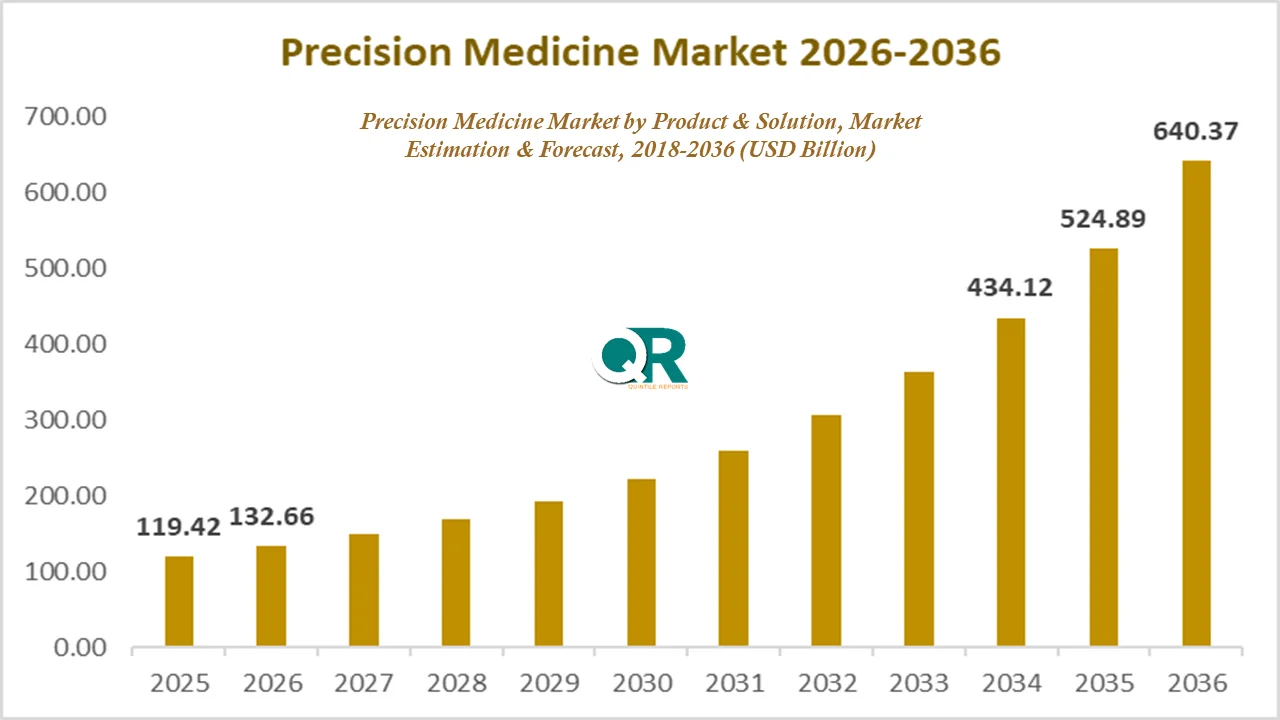
Valued at USD 119.42 billion in 2025, the market is projected to reach USD 640.37 billion by 2036, growing at a remarkable CAGR of 16.51% during the forecast period.
Precision medicine focuses on tailoring medical treatment to individual patients based on their genetic makeup, lifestyle, and environmental factors. This approach is revolutionizing traditional healthcare by improving treatment outcomes, minimizing adverse effects, and enabling more accurate disease diagnosis.
Request Sample PDF Report: https://www.quintilereports.com/request-sample/1291-precision-medicine-market/
One of the primary drivers of this growth is the rapid advancement in genomics and next-generation sequencing (NGS) technologies. These innovations allow healthcare providers to analyze genetic data at unprecedented speed and accuracy, facilitating the development of targeted therapies. In particular, oncology has emerged as the leading application area, where precision medicine is being widely used to develop personalized cancer treatments.
The integration of artificial intelligence (AI) and bioinformatics platforms is further accelerating market expansion. AI-powered tools enable real-time data analysis, predictive modeling, and clinical decision support, helping physicians make informed treatment decisions. Additionally, the adoption of clinical decision support systems (CDSS) integrated with electronic health records (EHRs) is enhancing patient management and treatment planning.
Limited-Time Discount Available: https://www.quintilereports.com/request-discount/1291-precision-medicine-market/
Another significant growth factor is the increasing prevalence of chronic diseases such as cancer, cardiovascular disorders, and neurological conditions. As these diseases require long-term and complex treatment strategies, precision medicine offers a more effective and efficient alternative to conventional therapies.
Pharmaceutical and biotechnology companies are also playing a crucial role in market growth. These organizations are investing heavily in precision-based drug development, leading to a robust pipeline of innovative therapies. Companion diagnostics and pharmacogenomic testing are becoming essential tools for optimizing drug selection and dosage, reducing the risk of adverse drug reactions.
Regionally, North America leads the market, driven by advanced healthcare infrastructure, strong research capabilities, and early adoption of innovative technologies. However, Asia-Pacific is emerging as the fastest-growing region, supported by increasing healthcare investments, expanding genomics research, and favorable government initiatives in countries like China and India.
Despite its promising outlook, the precision medicine market faces certain challenges. High costs associated with genomic testing, data privacy concerns, and the complexity of integrating large-scale biological data into clinical workflows remain significant barriers. However, ongoing advancements in technology and increasing awareness are expected to address these challenges over time.
Buy Now to Access: https://www.quintilereports.com/request-enquiry/1291-precision-medicine-market/
Looking ahead, the future of precision medicine will be shaped by AI integration, real-time patient monitoring, and decentralized clinical trials. As genomic sequencing becomes more affordable and data interoperability improves, the adoption of precision medicine is expected to expand rapidly across both developed and emerging markets.
In conclusion, precision medicine is set to redefine the global healthcare landscape by enabling more personalized, efficient, and effective treatment solutions. Companies that invest in advanced technologies, data integration, and strategic collaborations will be well-positioned to lead in this rapidly evolving market.
Q1. What is precision medicine?
A: Precision medicine is an advanced healthcare approach that customizes treatment and prevention strategies based on an individual’s genetic profile, lifestyle, and environmental factors.
Q2. How does next-generation sequencing (NGS) support precision medicine?
A: NGS enables rapid and accurate analysis of genetic data, helping identify mutations and biomarkers that guide targeted therapies and personalized treatment plans.
Q3. What are companion diagnostics in precision medicine?
A: Companion diagnostics are tests used to determine whether a patient will benefit from a specific drug, improving treatment effectiveness and safety.
Q4. Which diseases benefit the most from precision medicine?
A: Precision medicine is widely used in oncology, rare genetic disorders, cardiovascular diseases, neurological conditions, and infectious diseases.
Q5. What is pharmacogenomics and its role in precision medicine?
A: Pharmacogenomics studies how genes affect a person’s response to drugs, enabling optimized drug selection and dosage to reduce adverse effects.
Q6. How are bioinformatics platforms used in this market?
A: Bioinformatics platforms analyze complex biological and genomic data, supporting clinical decision-making and accelerating drug discovery.
Q7. What role do electronic health records (EHRs) play in precision medicine?
A: EHRs integrate patient data with clinical decision support systems, enabling more accurate diagnosis and personalized treatment planning.
Q8. What are AI-driven precision medicine platforms?
A: These platforms use artificial intelligence to analyze large datasets, predict disease risks, and recommend personalized treatment strategies.
Q9. What are the cost challenges associated with precision medicine?
A: High costs of genomic testing, advanced technologies, and data infrastructure can limit accessibility, especially in developing regions.
Q10. How is data privacy managed in precision medicine?
A: Strict regulations, encryption technologies, and secure data-sharing frameworks are used to protect sensitive patient genetic information.
Q11. What opportunities exist for new entrants in this market?
A: Opportunities include AI-based diagnostics, affordable genetic testing solutions, data analytics platforms, and emerging market expansion.
Q12. What is the future of precision medicine?
A: The future includes wider adoption of AI, real-time patient monitoring, decentralized clinical trials, and more accessible personalized healthcare solutions.
Our Latest Publication
Precision Medicine Market (2026-2036)
Hydraulic Filter Market Set to Reach $3.69 Billion by 2035 Amid Industrial Automation Surge

Adarsh
Business Strategy — Quintile Reports
Adarsh is a Business Strategy professional focused on transforming market insights into actionable growth plans. He supports strategic initiatives through market analysis, competitive intelligence, and data-driven decision-making to help drive long-term business success.
His core skills include strategic planning, market research, growth opportunity assessment, trend analysis, performance tracking, stakeholder communication, cross-functional collaboration, and critical problem-solving.