
The global liver cancer diagnostics market is undergoing a rapid transformation, driven by the urgent need for early detection, technological innovation, and rising global disease burden.
As liver cancer continues to rank among the leading causes of cancer-related deaths worldwide, healthcare systems are placing increasing emphasis on advanced diagnostic solutions that enable timely intervention and improved patient outcomes.
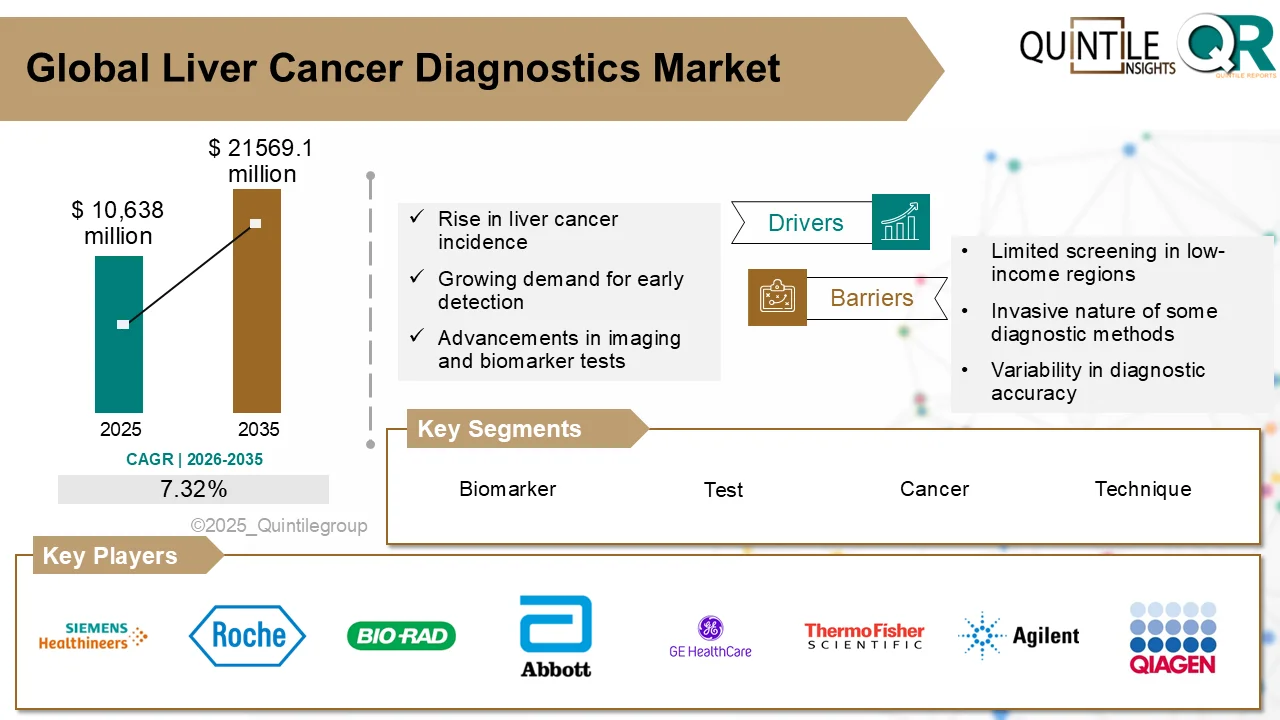
According to recent market insights, the liver cancer diagnostics market is projected to grow from USD 10,638.0 million in 2026 to USD 21,569.1 million by 2035, registering a strong CAGR of 7.32% over the forecast period. This growth underscores the increasing importance of diagnostic technologies in combating one of the most challenging forms of cancer.
Understanding Liver Cancer Diagnostics
Liver cancer diagnostics encompass a range of tests and technologies used to detect cancer at various stages. These include laboratory tests, imaging techniques such as CT scans and MRI, biopsy procedures, and advanced molecular diagnostics.
The primary goal of these tools is to identify tumors early, monitor disease progression, and guide treatment decisions. Early detection is particularly critical in liver cancer, as symptoms often appear in advanced stages, reducing the chances of successful treatment.
Download Free Sample PDF of the Report: https://www.quintilereports.com/request-sample/1114-liver-cancer-diagnostics-market/
Common diagnostic methods include:
- Blood Tests: Alpha-fetoprotein (AFP) testing and other biomarkers
- Imaging: Ultrasound, CT scans, MRI
- Biopsy: Tissue analysis for confirmation
- Molecular Diagnostics: Genetic and biomarker-based testing
Key Drivers Fueling Market Growth
1. Rising Global Burden of Liver Cancer
The increasing prevalence of liver cancer is a major factor driving demand for diagnostic tools. Chronic liver conditions such as hepatitis B, hepatitis C, fatty liver disease, and cirrhosis are contributing to a growing patient population worldwide.
With over 700,000 deaths annually attributed to liver cancer, the need for early and accurate diagnosis has never been more critical.
Get Discount On The Purchase Of This Report: https://www.quintilereports.com/request-discount/1114-liver-cancer-diagnostics-market/
2. Growing Focus on Early Screening
Healthcare providers are increasingly prioritizing early screening, especially for high-risk populations. Patients with chronic liver diseases are now routinely monitored using imaging and blood-based tests, leading to earlier detection and better treatment outcomes.
3. Technological Advancements in Diagnostics
Advances in imaging technologies and molecular diagnostics are revolutionizing liver cancer detection. High-resolution imaging systems provide clearer visualization of tumors, while genetic testing enables personalized treatment strategies.
Emerging innovations such as AI-powered imaging and liquid biopsy are further enhancing diagnostic accuracy and efficiency.
4. Expansion of Diagnostic Infrastructure
The growth of diagnostic laboratories and healthcare facilities, particularly in emerging markets, is improving access to advanced testing services. Both public and private sectors are investing in modern diagnostic tools to meet rising demand.
This study presents a complete evaluation of market dynamics, opportunities, and regional performance: https://www.quintilereports.com/request-enquiry/1114-liver-cancer-diagnostics-market/
Challenges Hindering Market Growth
Despite its strong growth potential, the liver cancer diagnostics market faces several challenges:
- Late Diagnosis: Many patients are diagnosed at advanced stages due to lack of awareness and limited screening programs.
- High Costs: Advanced imaging and molecular tests can be expensive, limiting accessibility in low-income regions.
- Limited Infrastructure: In developing countries, a shortage of diagnostic equipment and trained professionals hampers early detection efforts.
- Test Limitations: Some biomarkers, such as AFP, may produce false positives, requiring additional confirmatory tests.
Addressing these challenges will be essential to ensure equitable access to diagnostic services and improve patient outcomes globally.
Regional Market Insights
North America: Leading the Market
North America dominates the liver cancer diagnostics market, driven by advanced healthcare infrastructure, strong research capabilities, and widespread adoption of cutting-edge technologies. The United States, in particular, leads in early screening and the use of AI-based diagnostic tools.
Europe: Strong Public Healthcare Support
Europe is experiencing steady growth, supported by well-established public healthcare systems and government-funded screening programs. Countries like Germany, France, and Italy are at the forefront of adopting advanced diagnostic technologies.
Asia-Pacific: Fastest Growing Region
The Asia-Pacific region is witnessing rapid growth due to increasing healthcare investments, rising liver cancer cases, and expanding screening initiatives. Countries such as China, India, and Japan are playing a crucial role in driving market expansion.
Latin America and Middle East & Africa
These regions are gradually improving their diagnostic capabilities through investments in healthcare infrastructure and awareness programs. However, challenges such as limited access and affordability remain.
Competitive Landscape: Innovation Driving Competition
The liver cancer diagnostics market is highly competitive, with a mix of global medical device companies, diagnostic test developers, and specialized laboratories.
Key players such as Roche Diagnostics, Abbott Laboratories, Siemens Healthineers, and Thermo Fisher Scientific are leading the market through continuous innovation and strategic partnerships.
These companies are focusing on:
- Developing advanced imaging systems
- Introducing novel biomarkers and molecular tests
- Leveraging AI for improved diagnostic accuracy
- Expanding global distribution networks
Startups and emerging players are also contributing to innovation, particularly in areas such as liquid biopsy and AI-based diagnostics.
Emerging Trends Shaping the Future
AI and Digital Diagnostics
Artificial intelligence is transforming liver cancer diagnostics by enabling faster and more accurate analysis of imaging data. AI tools can detect subtle abnormalities that may be missed by human interpretation.
Liquid Biopsy and Non-Invasive Testing
Non-invasive diagnostic methods, such as liquid biopsy, are gaining traction as they offer a safer and more convenient alternative to traditional biopsy procedures.
Personalized Medicine
Advances in molecular diagnostics are paving the way for personalized treatment approaches, allowing doctors to tailor therapies based on individual patient profiles.
Integration of Diagnostics and Treatment
Healthcare systems are increasingly integrating diagnostic tools with treatment planning systems, improving efficiency and patient outcomes.
Future Outlook: A Decade of Opportunity
The liver cancer diagnostics market is poised for sustained growth over the next decade, driven by technological advancements, increasing disease prevalence, and expanding healthcare infrastructure.
Emerging markets will play a key role in shaping the future of the industry, offering significant growth opportunities for companies that can adapt to local needs and regulatory environments.
As innovation continues to accelerate, the focus will remain on improving early detection, reducing costs, and enhancing accessibility to diagnostic services worldwide.
FAQ’s for Key Opinion Leaders (KOLs)
1. Why is early detection critical in liver cancer?
Early detection significantly improves survival rates, as treatment is more effective in the initial stages of the disease.
2. What are the most commonly used diagnostic methods?
Blood tests (AFP), imaging techniques (CT, MRI, ultrasound), biopsy, and molecular diagnostics are widely used.
3. How is AI transforming liver cancer diagnostics?
AI enhances imaging analysis, enabling faster and more accurate detection of tumors and improving diagnostic efficiency.
4. What challenges limit market growth?
High costs, limited infrastructure, late diagnosis, and lack of awareness are major challenges.
5. Which region offers the highest growth potential?
Asia-Pacific is expected to grow the fastest due to rising healthcare investments and increasing disease burden.
6. What role do biomarkers play in diagnosis?
Biomarkers help detect cancer early, monitor progression, and guide treatment decisions.
7. How are companies gaining a competitive edge?
Through innovation, strategic partnerships, AI integration, and development of non-invasive diagnostic solutions.
Our Latest Publication:
Liver Cancer Diagnostics Market (2026 – 2035)
Chiral Chromatography Columns Market Set for Strong Growth Through 2036 Driven by Pharma Innovation

Adarsh
Business Strategy — Quintile Reports
Adarsh is a Business Strategy professional focused on transforming market insights into actionable growth plans. He supports strategic initiatives through market analysis, competitive intelligence, and data-driven decision-making to help drive long-term business success.
His core skills include strategic planning, market research, growth opportunity assessment, trend analysis, performance tracking, stakeholder communication, cross-functional collaboration, and critical problem-solving.