
The global piezoelectric motor market is entering a transformative decade, driven by the accelerating demand for ultra-precise, compact, and energy-efficient motion technologies.
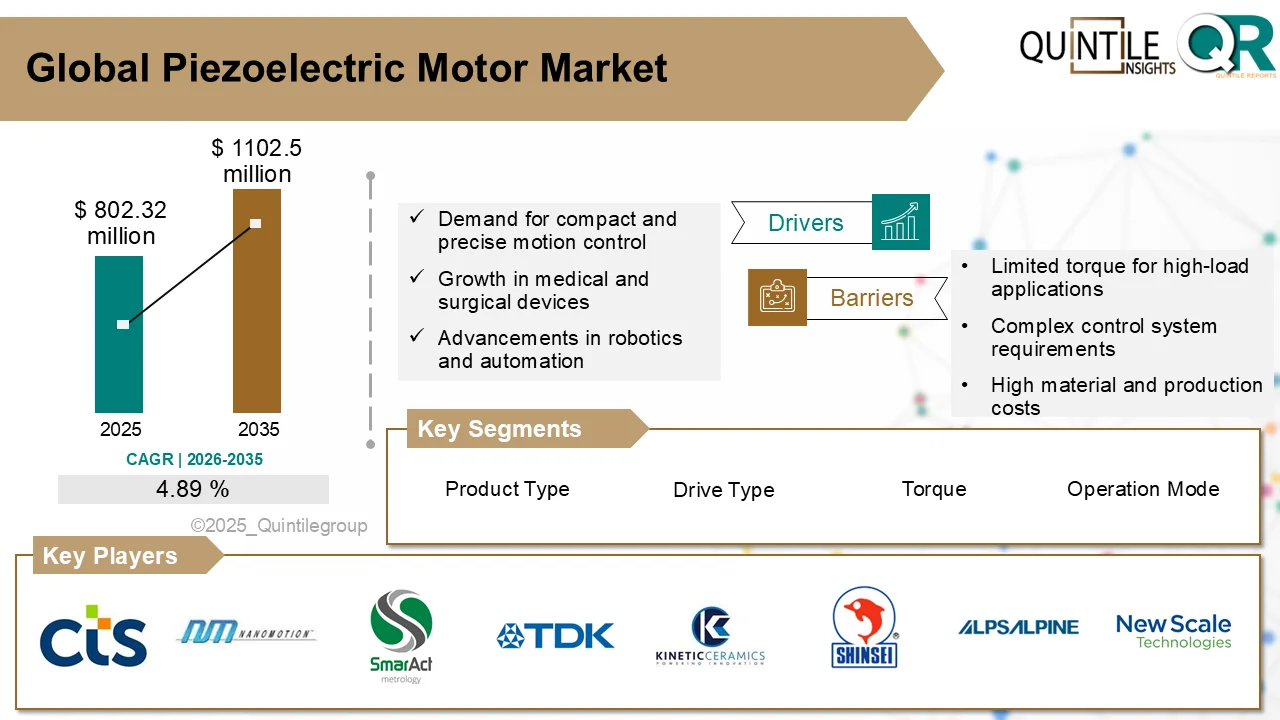
According to recent industry analysis, the market was valued at USD 802.32 million in 2025 and is projected to reach USD 1,102.5 million by 2035, expanding at a CAGR of 4.89% between 2026 and 2035.
This growth trajectory reflects a broader shift toward miniaturization, automation, and high-performance systems across industries such as healthcare, robotics, aerospace, and semiconductor manufacturing. As innovation intensifies, piezoelectric motors are increasingly becoming the silent backbone of next-generation precision devices.
Request Sample PDF Report: https://www.quintilereports.com/request-sample/1147-piezoelectric-motor-market/
📊 Market Overview: Why Piezoelectric Motors Matter
Unlike conventional electromagnetic motors, piezoelectric motors operate by converting electrical energy into mechanical motion through the deformation of piezoelectric materials. This unique mechanism allows them to deliver:
- Exceptional positioning accuracy
- Silent operation
- Compact form factors
- High torque at low speeds
- Zero electromagnetic interference
These advantages make them indispensable in applications where precision and reliability are critical, especially in micro- and nano-scale environments.
Get Discount On The Purchase Of This Report: https://www.quintilereports.com/request-discount/1147-piezoelectric-motor-market/
🔍 Key Drivers Accelerating Market Growth
1. Rising Demand for Miniaturization
Modern devices are becoming smaller, smarter, and more complex. From medical instruments to consumer electronics, manufacturers are prioritizing compact components without compromising performance. Piezoelectric motors excel in confined spaces, making them ideal for next-gen innovations.
2. Expansion in Medical Technology
Healthcare is one of the largest adopters of piezoelectric motors. These motors power:
- Robotic surgical systems
- Diagnostic imaging equipment
- Laboratory automation tools
Their silent and vibration-free operation enhances precision, especially in minimally invasive procedures.
3. Growth in Robotics and Automation
As robotics evolves toward micro-robotics and precision automation, the demand for accurate and efficient motion systems is surging. Piezoelectric motors are widely used in:
- Camera autofocus systems
- Micro-positioning devices
- Robotic arms
Their high responsiveness and efficiency make them a preferred choice in advanced automation.
4. Need for EMI-Free Operation
In sensitive environments like optical systems and communication equipment, electromagnetic interference can disrupt performance. Piezoelectric motors eliminate this concern, ensuring signal integrity and reliability.
Buy Now: https://www.quintilereports.com/request-enquiry/1147-piezoelectric-motor-market/
5. Advancements in Aerospace & Defense
Precision and reliability are non-negotiable in aerospace and defense. Piezoelectric motors are used in:
- Satellite positioning systems
- Drone navigation
- Precision targeting equipment
Their durability and accuracy make them ideal for mission-critical applications.
⚠️ Market Challenges: Barriers to Adoption
Despite their advantages, several challenges continue to shape the market landscape:
High Manufacturing Costs
The advanced materials and technology involved in piezoelectric motors make them more expensive than traditional motors, limiting adoption in cost-sensitive markets.
Limited Speed and Range
These motors are not suitable for high-speed or long-distance motion, restricting their use in heavy industrial applications.
Integration Complexity
Piezoelectric systems often require specialized controllers and drivers, increasing system complexity and overall costs.
Durability Concerns
In high-load or harsh environments, certain piezoelectric materials may degrade faster, affecting long-term reliability.
Lack of Standardization
Global inconsistencies in standards and awareness pose challenges for new entrants and wider adoption.
🌍 Regional Insights: Where Growth is Happening
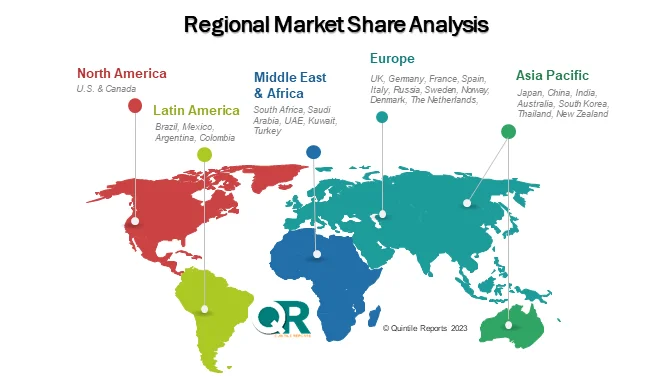
North America
A stronghold for innovation, North America—particularly the U.S.—is witnessing increased adoption in:
- Medical imaging
- Robotic surgery
- Defense systems
Europe
Countries like Germany and France are leading in:
- Industrial automation
- Semiconductor manufacturing
- Nanotechnology
The push toward Industry 4.0 is fueling demand.
Asia-Pacific
The fastest-growing region, led by:
- Japan (precision engineering leader)
- China (electronics and automation expansion)
- South Korea (advanced manufacturing)
This region benefits from strong production capabilities and technological expertise.
Latin America & Middle East
Emerging markets like Brazil, Mexico, UAE, and Israel are gradually adopting piezoelectric technologies, though growth is moderated by infrastructure and cost challenges.
🏢 Competitive Landscape: Innovation at the Core
The piezoelectric motor market is highly competitive, with key players focusing on innovation, customization, and strategic partnerships. Leading companies include:
- PiezoMotor Uppsala AB
- Physik Instrumente (PI) GmbH & Co. KG
- Nanomotion Ltd.
- SmarAct GmbH
- TDK Corporation
- Canon Inc.
- Alps Alpine Co., Ltd.
- Yaskawa Electric Corporation
These companies are investing heavily in R&D to develop high-performance, application-specific solutions.
Q1. What makes piezoelectric motors different from traditional motors?
They use piezoelectric materials instead of electromagnetic fields, enabling higher precision, silent operation, and compact design.
Q2. Which industries will drive the highest demand?
Healthcare, robotics, aerospace, and semiconductor industries are expected to be the primary growth drivers.
Q3. What is the biggest challenge in adoption?
High manufacturing costs and integration complexity remain the most significant barriers.
Q4. How important is miniaturization in this market?
Extremely important—miniaturization is one of the core drivers, especially in medical and electronics applications.
Q5. Which region offers the most growth opportunities?
Asia-Pacific is expected to dominate due to strong manufacturing capabilities and rising demand.
Q6. Are piezoelectric motors suitable for heavy industrial use?
Not typically, as they are better suited for precision and low-speed applications rather than high-load operations.
Q7. What role does R&D play in this market?
R&D is critical for improving efficiency, durability, and expanding application areas.
Our Latest Publication
Piezoelectric Motor Market (2026 – 2035)
Oscillating Tools Market to Reach $800.88 Million by 2035 Driven by DIY & Cordless Innovation

Adarsh
Business Strategy — Quintile Reports
Adarsh is a Business Strategy professional focused on transforming market insights into actionable growth plans. He supports strategic initiatives through market analysis, competitive intelligence, and data-driven decision-making to help drive long-term business success.
His core skills include strategic planning, market research, growth opportunity assessment, trend analysis, performance tracking, stakeholder communication, cross-functional collaboration, and critical problem-solving.