
The global Rotary Pumps Market is entering a phase of steady and sustained growth as industries increasingly prioritize efficient and reliable fluid handling technologies.
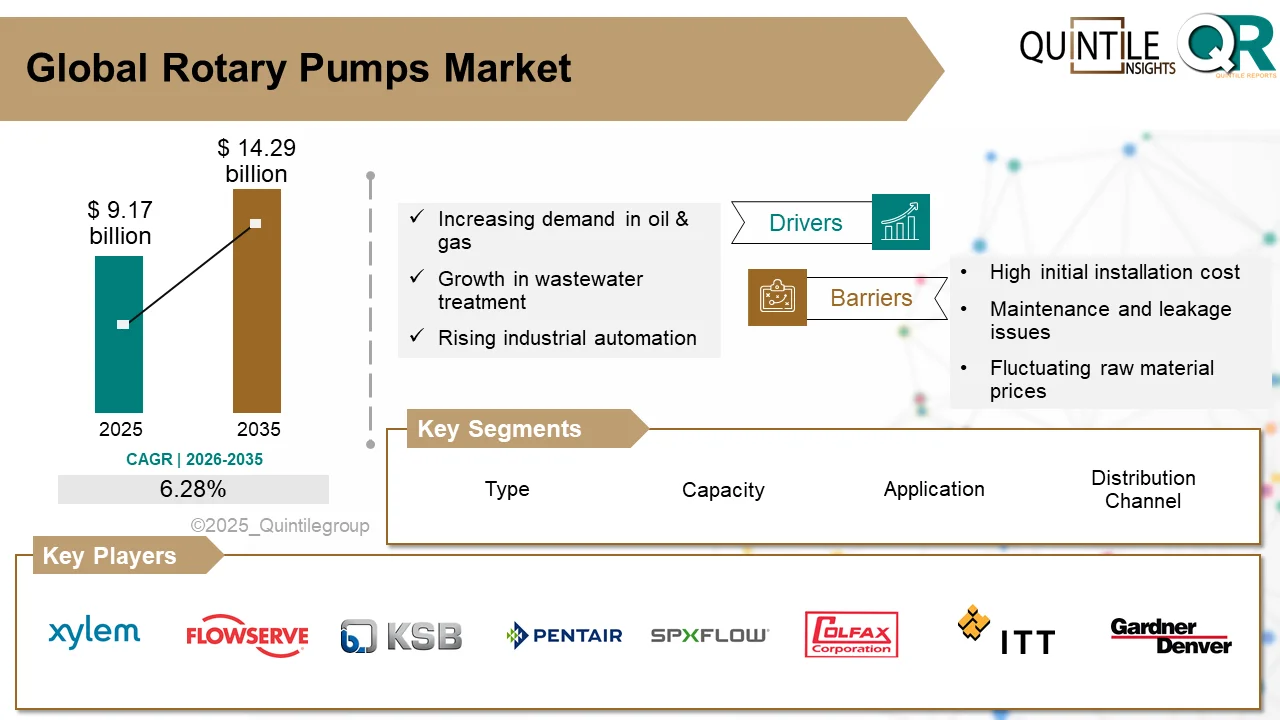
According to recent market analysis, the industry was valued at USD 9.17 billion in 2025 and is projected to reach USD 14.29 billion by 2035, expanding at a compound annual growth rate (CAGR) of 6.28% between 2026 and 2035. The expansion reflects rising industrial activity, increasing infrastructure development, and growing adoption of advanced pumping systems across key sectors.
Rotary pumps are widely used positive displacement pumps that transfer fluids through rotating internal components such as gears, screws, vanes, and lobes. Their ability to handle a wide range of viscosities while delivering consistent flow makes them essential across industries including oil and gas, chemicals, power generation, water treatment, food processing, and pharmaceuticals. These pumps are particularly valued in applications that require continuous and precise fluid movement under high pressure or demanding operating conditions.
Request Sample PDF Report: https://www.quintilereports.com/request-sample/1127-rotary-pumps-market/
One of the major factors driving market growth is the integration of smart technologies into pump systems. Modern rotary pumps increasingly incorporate Internet of Things (IoT) connectivity, remote monitoring, and predictive maintenance capabilities, allowing operators to monitor performance in real time and reduce unexpected downtime. These innovations help industries optimize maintenance schedules, improve operational efficiency, and extend equipment lifespan.
Limited-Time Discount Available: https://www.quintilereports.com/request-discount/1127-rotary-pumps-market/
The oil and gas sector continues to be a major contributor to rotary pump demand. These pumps play a critical role in upstream and downstream operations, including crude oil transfer, hydraulic fracturing, and refinery processing. As global energy demand stabilizes and investments in energy infrastructure resume, rotary pump manufacturers are seeing renewed opportunities in exploration, refining, and petrochemical production.
Another key growth driver is the expansion of water and wastewater infrastructure worldwide. Governments and municipalities are investing heavily in water management systems to address urbanization, industrial expansion, and climate-related water challenges. Rotary pumps are highly suitable for these applications because of their durability, efficiency, and capability to handle both clean and contaminated fluids.
Buy Now to Access Full Market Insights and Future Forecasts: https://www.quintilereports.com/request-enquiry/1127-rotary-pumps-market/
Regional trends also highlight strong market momentum across Asia Pacific, which is currently the largest and fastest-growing market for rotary pumps. Rapid industrialization, infrastructure development, and expanding manufacturing sectors in countries such as China, India, and Southeast Asian economies are significantly increasing demand for industrial pumping solutions. Meanwhile, North America and Europe are focusing on energy-efficient equipment and automation, driven by strict environmental regulations and sustainability initiatives.
However, the market also faces certain challenges. Advanced rotary pumps equipped with smart features often require high upfront investment and specialized maintenance, which may limit adoption among small and medium-sized enterprises. Additionally, fluctuations in the prices of key raw materials such as stainless steel and industrial alloys can impact manufacturing costs and profit margins for pump manufacturers.
Despite these challenges, the competitive landscape remains dynamic. Leading companies including Xylem Inc., Flowserve Corporation, KSB SE & Co. KGaA, Pentair Ltd., Alfa Laval, Atlas Copco, Dover Corporation, and Schlumberger are actively investing in research and development to improve energy efficiency, reliability, and digital integration in pumping systems. Strategic partnerships, product innovations, and regional expansion remain key strategies among industry players.
Looking ahead, the rotary pumps market is expected to benefit from industrial automation, smart manufacturing initiatives, and increased infrastructure investment across both developed and emerging economies. Companies that focus on technological innovation, sustainability, and customized solutions will be best positioned to capitalize on the growing demand for advanced fluid handling systems worldwide.
1. What is the projected size of the global Rotary Pumps Market by 2035?
The global rotary pumps market is expected to reach USD 14.29 billion by 2035, growing from USD 9.17 billion in 2025, at a CAGR of 6.28% during the forecast period 2026–2035.
2. What are rotary pumps and how do they work?
Rotary pumps are positive displacement pumps that move fluids through rotating components such as gears, vanes, lobes, or screws. These pumps provide steady flow, high efficiency, and the ability to handle fluids with varying viscosity, making them ideal for industrial applications.
3. Which industries are the primary users of rotary pumps?
Rotary pumps are widely used in several industries including:
-
Oil and Gas
-
Chemical Processing
-
Water and Wastewater Treatment
-
Food and Beverage Manufacturing
-
Pharmaceutical Production
-
Power Generation
-
Mining and Marine Operations
4. What are the major growth drivers of the rotary pumps market?
Key growth drivers include:
-
Increasing industrial automation and digital monitoring technologies
-
Rising demand for efficient fluid handling systems
-
Growth in oil & gas exploration and refinery activities
-
Expanding water treatment and infrastructure projects
-
Demand for hygienic pumps in food and pharmaceutical industries
5. What technological trends are shaping the rotary pumps industry?
Major technological trends include IoT-enabled pump monitoring, predictive maintenance systems, smart sensors, energy-efficient pump designs, and integration with Industry 4.0 technologies.
6. Which region dominates the rotary pumps market?
The Asia Pacific region currently dominates the market due to rapid industrialization, expanding infrastructure projects, and increased manufacturing activity in countries such as China, India, and Southeast Asian nations.
7. What challenges are affecting the rotary pumps market growth?
The market faces challenges such as high initial installation costs, complex maintenance requirements, fluctuating raw material prices, and strict environmental and energy regulations.
8. Who are the leading companies in the global rotary pumps market?
Major companies operating in the market include Xylem Inc., Flowserve Corporation, KSB SE & Co. KGaA, Pentair Ltd., SPX Flow, ITT Inc., Alfa Laval, Atlas Copco, Dover Corporation, Gardner Denver Inc., and Schlumberger.
9. How are rotary pumps used in the oil and gas industry?
In oil and gas operations, rotary pumps are used for crude oil transfer, hydraulic fracturing, refinery processing, lubrication systems, and chemical injection, where reliable high-pressure fluid movement is required.
10. What future opportunities exist in the rotary pumps market?
Future opportunities are expected to arise from smart industrial systems, water infrastructure modernization, renewable energy projects, and increased demand for energy-efficient pumping solutions.
Our Latest Publication:
Rotary Pumps Market (2026 – 2035)
Continuous Subcutaneous Insulin Infusion Market Expands as Smart Insulin Pump Technologies Transform Diabetes Care

Adarsh
Business Strategy — Quintile Reports
Adarsh is a Business Strategy professional focused on transforming market insights into actionable growth plans. He supports strategic initiatives through market analysis, competitive intelligence, and data-driven decision-making to help drive long-term business success.
His core skills include strategic planning, market research, growth opportunity assessment, trend analysis, performance tracking, stakeholder communication, cross-functional collaboration, and critical problem-solving.