
The global wellness industry continues to evolve rapidly, and one of the most intriguing developments within the functional nutrition landscape is the growing popularity of liquid mushroom products.
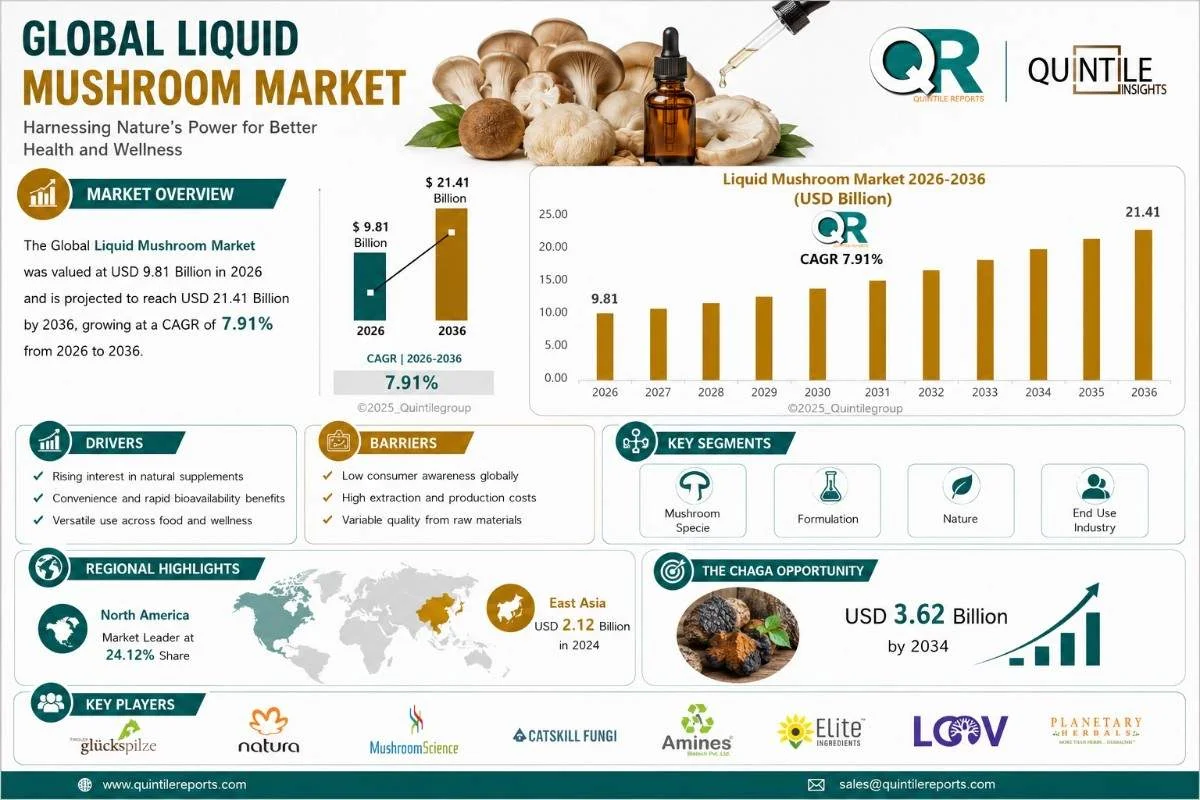
According to recent market analysis, the global Liquid Mushroom Market was valued at USD 9.81 billion in 2026 and is projected to reach USD 21.24 billion by 2036, registering a compound annual growth rate (CAGR) of 7.91% during the forecast period.
This remarkable growth reflects more than a temporary consumer trend. Instead, it signals a fundamental shift in how consumers approach preventive healthcare, nutrition, and daily wellness routines. Functional mushrooms, once primarily associated with traditional medicine practices, have now entered mainstream markets through innovative liquid formulations that prioritize convenience, absorption efficiency, and versatility.
Request Sample PDF Report: https://www.quintilereports.com/request-sample/1301-liquid-mushroom-market/
Functional Mushrooms Move Beyond Traditional Use
Medicinal mushrooms have been used for centuries in various cultures, particularly across Asia. Today, modern extraction technologies are transforming these traditional ingredients into highly accessible wellness products.
The liquid mushroom market encompasses extracts, tinctures, infusions, concentrates, ready-to-drink beverages, mushroom coffees, teas, elixirs, and liquid supplements derived from functional mushroom species such as lion’s mane, reishi, chaga, cordyceps, turkey tail, shiitake, and maitake.
Unlike traditional capsules and powders, liquid formulations are often preferred because they offer enhanced bioavailability. Active compounds such as beta-glucans, polysaccharides, terpenoids, and antioxidants can be absorbed more efficiently, making liquid products increasingly attractive to health-conscious consumers seeking convenient daily supplementation.
Functional Beverage Revolution Creates New Opportunities
One of the primary drivers fueling market expansion is the explosive growth of the functional beverage sector.
Request Discount: https://www.quintilereports.com/request-discount/1301-liquid-mushroom-market/
Modern consumers are increasingly seeking beverages that provide benefits beyond hydration. Products marketed for cognitive support, immune enhancement, stress management, and sustained energy have gained widespread popularity among younger demographics.
Mushroom-infused coffees, adaptogenic wellness shots, herbal blends, and functional beverages have become common offerings across health-focused retailers, cafés, and e-commerce platforms. Lion’s mane coffee blends are often positioned as alternatives to traditional energy drinks, while reishi and chaga products are frequently promoted for relaxation and immune support.
Retail innovations continue to validate growing consumer interest. Major retailers have started incorporating functional mushroom beverages into mainstream wellness categories, indicating broader acceptance beyond niche health food audiences.
Preventive Healthcare Continues to Reshape Consumer Spending
The global healthcare landscape has undergone significant transformation in recent years. Consumers increasingly prioritize preventive health strategies designed to support long-term well-being rather than relying solely on treatment-focused healthcare approaches.
Liquid mushroom products align closely with this trend. Many consumers view these products as daily wellness rituals that may support immunity, cognitive performance, stress resilience, and overall vitality.
The growing interest in preventive healthcare has encouraged manufacturers to invest heavily in product innovation, clinical validation, and ingredient transparency. As consumers become more informed, demand for evidence-based wellness products continues to strengthen.
Enquiry Before Buying: https://www.quintilereports.com/request-enquiry/1301-liquid-mushroom-market/
Plant-Based Nutrition Supports Market Expansion
The rise of plant-based lifestyles represents another important growth catalyst.
Consumers are actively seeking natural, vegan-friendly, and minimally processed nutritional solutions. Functional mushrooms satisfy several key purchasing criteria simultaneously, including clean-label positioning, sustainable sourcing potential, plant-based credentials, and perceived nutritional benefits.
As environmental awareness and ethical consumption become increasingly influential purchasing factors, mushroom-based wellness products are benefiting from strong alignment with evolving consumer values.
Challenges Remain Despite Strong Market Momentum
While growth prospects remain highly encouraging, the liquid mushroom market faces several challenges that industry participants must address.
Consumer Education
Despite increasing awareness, many consumers remain unfamiliar with the specific benefits and applications of individual mushroom species. Understanding the differences between lion’s mane, reishi, chaga, cordyceps, and other varieties remains limited among mainstream buyers.
Brands that invest in transparent communication and science-based education are likely to gain competitive advantages as the market matures.
Taste and Formulation Complexity
Functional mushrooms often possess earthy or bitter flavor profiles that can be difficult to incorporate into appealing consumer products.
Developing formulations that preserve bioactive compounds while maintaining enjoyable taste experiences requires significant expertise and research investment. Flavor innovation is therefore emerging as a critical competitive differentiator.
Premium Pricing
Advanced extraction methods such as dual extraction processes can be costly. These production expenses frequently translate into higher retail prices, potentially limiting accessibility among budget-conscious consumers.
As production scales increase and manufacturing technologies improve, pricing pressures may gradually ease over the forecast period.
Regulatory Variability
Regulatory frameworks governing mushroom-based supplements and functional foods differ significantly across global markets. Variations in labeling requirements, health claims, potency standards, and product classifications can complicate international expansion efforts.
Industry stakeholders continue advocating for greater regulatory clarity to improve consumer confidence and facilitate market growth.
Regional Markets Showcase Diverse Growth Patterns
North America Leads Global Adoption
North America remains one of the most significant markets for liquid mushroom products. Strong wellness awareness, established supplement industries, and widespread consumer acceptance of adaptogenic ingredients continue to support market leadership.
The United States and Canada have witnessed growing shelf presence for mushroom beverages, tinctures, and wellness supplements across both specialty and mainstream retail channels.
East Asia Combines Tradition and Innovation
East Asia maintains a unique competitive advantage due to its long-standing cultural familiarity with medicinal mushrooms.
Countries such as China, Japan, and South Korea continue integrating traditional wellness practices with modern product formats. Ready-to-drink beverages, single-serving extracts, and premium functional supplements are gaining popularity among younger urban consumers.
Japan’s aging population also presents significant opportunities for products targeting cognitive wellness, healthy aging, and immune support.
Europe Embraces Sustainable Wellness
European demand is being shaped by strong consumer interest in sustainability, clean-label products, and organic certifications.
Markets including Germany, the United Kingdom, the Netherlands, and Scandinavia have demonstrated increasing demand for ethically sourced, environmentally responsible wellness products. Brands emphasizing transparency, traceability, and sustainable sourcing practices are particularly well-positioned in the region.
Emerging Markets Show Long-Term Potential
Latin America, the Middle East, and Africa are emerging as promising growth regions.
Rising disposable incomes, expanding wellness awareness, and increasing exposure to global health trends are creating favorable conditions for market development. Countries such as Brazil, Mexico, the UAE, Saudi Arabia, and South Africa are expected to contribute increasing demand over the coming decade.
Chaga Emerges as a High-Growth Opportunity
Among individual mushroom species, chaga continues to attract significant attention.
Known scientifically as Inonotus obliquus, chaga has gained recognition for its antioxidant-rich composition and association with immune-supporting properties. Its relatively mild flavor profile also makes it highly adaptable for beverages and functional food applications.
Market analysts project substantial growth for the chaga segment as manufacturers continue incorporating the ingredient into premium wellness formulations.
Competitive Landscape Focuses on Quality and Transparency
Competition within the liquid mushroom market extends well beyond pricing strategies.
Leading companies are increasingly differentiating themselves through extraction technologies, ingredient quality, sourcing transparency, organic certifications, and scientific validation.
Third-party laboratory testing and publicly available Certificates of Analysis are becoming important trust-building tools. Consumers increasingly expect detailed information regarding cultivation methods, extraction processes, active compound concentrations, and product authenticity.
Additionally, innovative ingredient combinations are creating new market opportunities. Blends featuring mushrooms alongside adaptogens such as ashwagandha, turmeric, and botanical extracts are expanding product diversity while supporting premium positioning.
Future Outlook
The liquid mushroom market stands at the intersection of several powerful consumer trends, including functional nutrition, preventive healthcare, plant-based living, clean-label consumption, and science-backed wellness.
As consumer awareness continues to expand and product innovation accelerates, liquid mushroom formulations are expected to become increasingly integrated into everyday wellness routines worldwide.
With market value projected to more than double over the next decade, industry participants that prioritize quality, transparency, education, and scientific credibility are likely to emerge as long-term leaders in this rapidly evolving category.
The future of functional wellness appears increasingly connected to natural ingredients capable of delivering measurable benefits. Liquid mushrooms are positioning themselves as one of the most influential segments within that transformation.
1. What is driving the rapid growth of the Liquid Mushroom Market?
The market is being driven by rising demand for functional beverages, preventive healthcare solutions, adaptogenic ingredients, plant-based nutrition, and clean-label wellness products.
2. What is the projected market size by 2036?
The global Liquid Mushroom Market is expected to grow from USD 9.81 billion in 2026 to USD 21.24 billion by 2036.
3. Which mushroom species are seeing the strongest demand?
Lion’s mane, reishi, chaga, cordyceps, turkey tail, shiitake, and maitake are among the most sought-after functional mushroom varieties.
4. Why are liquid mushroom products gaining popularity over capsules?
Liquid formulations typically offer faster absorption, improved bioavailability, ease of consumption, and greater flexibility for integration into beverages and daily wellness routines.
5. Which industries are the largest end-users of liquid mushroom products?
Key industries include food and beverages, nutraceuticals, dietary supplements, pharmaceuticals, cosmetics, personal care, and animal nutrition.
6. Which region currently dominates the market?
North America currently leads the market due to strong consumer awareness, robust supplement distribution channels, and increasing adoption of functional wellness products.
7. What role do functional beverages play in market growth?
Functional beverages represent one of the fastest-growing applications, with mushroom coffees, teas, wellness shots, and ready-to-drink products attracting mainstream consumers.
8. What are the major challenges facing manufacturers?
Key challenges include consumer education, flavor optimization, high extraction costs, ingredient sourcing consistency, and varying regulatory requirements across regions.
Our Latest Publication:
Liquid Mushroom Market (2026 – 2036)
Radiopharmaceuticals Market Set for Transformational Growth as Precision Medicine Drives Global Demand

Adarsh
Business Strategy — Quintile Reports
Adarsh is a Business Strategy professional focused on transforming market insights into actionable growth plans. He supports strategic initiatives through market analysis, competitive intelligence, and data-driven decision-making to help drive long-term business success.
His core skills include strategic planning, market research, growth opportunity assessment, trend analysis, performance tracking, stakeholder communication, cross-functional collaboration, and critical problem-solving.