
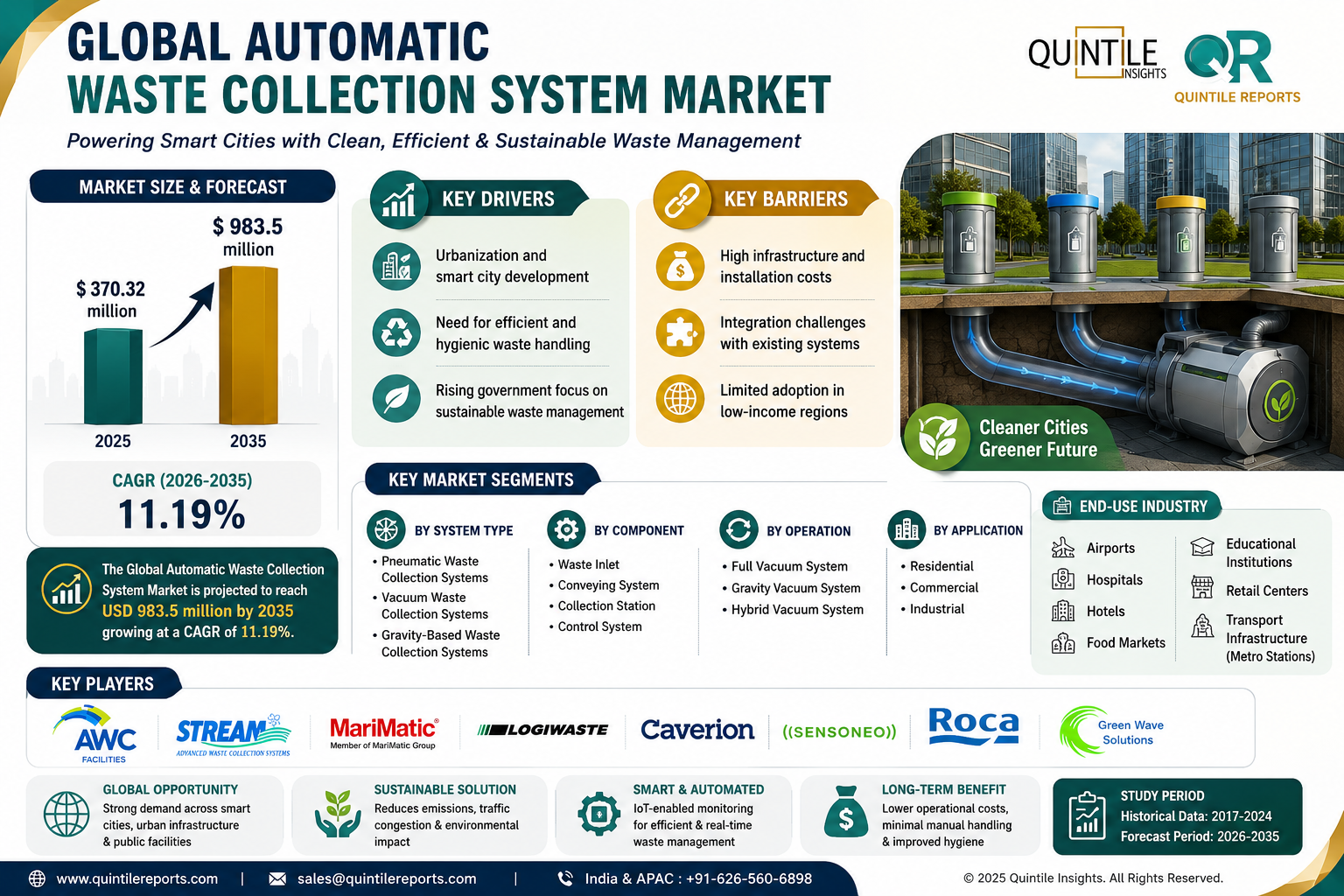
The global Automatic Waste Collection System (AWCS) Market is entering a new era of expansion, fueled by rapid urbanization, smart city development, and increasing demand for efficient waste management solutions.
According to the latest industry analysis, the market was valued at USD 370.32 million in 2025 and is projected to reach USD 983.5 million by 2035, registering a remarkable CAGR of 11.19% during the forecast period.
As cities worldwide grapple with growing populations, rising waste generation, and stricter environmental regulations, automated waste collection technologies are emerging as a critical component of modern urban infrastructure. These advanced systems are transforming the way municipalities, healthcare facilities, airports, residential complexes, and commercial developments manage waste, offering cleaner, safer, and more sustainable alternatives to traditional collection methods.
Growing Urbanization Creates Urgent Need for Modern Waste Solutions
The unprecedented pace of urbanization continues to place enormous pressure on municipal waste management systems. According to global urban development trends, cities are expanding rapidly, creating challenges related to waste disposal, transportation congestion, public hygiene, and environmental sustainability.
Automatic waste collection systems address these concerns by utilizing underground pneumatic or vacuum-powered networks that transport waste through sealed pipelines directly to centralized collection stations. This approach eliminates the need for conventional waste bins and significantly reduces dependence on garbage collection trucks.
As urban populations continue to rise, local governments and urban planners are increasingly investing in infrastructure capable of supporting cleaner and more efficient waste handling operations. The adoption of AWCS technology is expected to play a vital role in enabling sustainable urban growth while enhancing overall quality of life.
Request Sample PDF Report: https://www.quintilereports.com/request-sample/1264-automatic-waste-collection-system-market/
Smart City Investments Fuel Market Expansion
One of the most influential growth drivers for the market is the rapid expansion of smart city initiatives across developed and developing economies. Governments worldwide are allocating substantial budgets toward intelligent infrastructure projects designed to improve urban efficiency, environmental performance, and public services.
Automatic waste collection systems align perfectly with smart city objectives by integrating advanced automation, real-time monitoring, and digital control capabilities. These systems can optimize waste collection schedules, improve operational efficiency, and provide valuable data insights that support city planning efforts.
Countries across Europe, Asia-Pacific, and the Middle East are leading investments in smart urban infrastructure, creating significant opportunities for AWCS providers. New residential communities, mixed-use developments, transportation hubs, and commercial districts increasingly incorporate automated waste systems as a core component of their infrastructure design.
Health and Hygiene Benefits Drive Adoption
Public health concerns have become a major catalyst for the adoption of automated waste management solutions. Traditional waste collection methods often expose sanitation workers and the public to waste-related contaminants, unpleasant odors, and disease risks.
Automatic waste collection systems help mitigate these challenges by minimizing direct human contact with waste materials. Waste is deposited into sealed inlets and transported through enclosed underground networks, significantly reducing opportunities for contamination and exposure.
Hospitals, healthcare facilities, airports, and educational institutions have emerged as key adopters due to the heightened importance of hygiene and infection control. The ability to maintain cleaner environments while reducing operational risks makes AWCS technology particularly attractive for these sectors.
In a post-pandemic environment where cleanliness and public health remain top priorities, automated waste handling systems are expected to gain further traction globally.
Special Discount: https://www.quintilereports.com/request-discount/1264-automatic-waste-collection-system-market/
Food Waste Recycling Integration Enhances Efficiency
A notable trend shaping the market is the growing integration of food waste recycling technologies with automated collection infrastructure. Food waste accounts for nearly half of municipal solid waste in many urban regions, creating substantial disposal and environmental challenges.
Modern food waste recycling machines can process organic waste on-site, converting it into compost, biofertilizers, or biogas. When integrated with automatic waste collection systems, these technologies improve waste segregation, reduce landfill dependency, and optimize overall waste management efficiency.
The combination of automated collection and organic waste recycling supports circular economy initiatives by transforming waste streams into valuable resources. Municipalities and private developers increasingly recognize this integrated approach as an effective strategy for achieving sustainability objectives while reducing operational costs.
Environmental Sustainability Strengthens Market Momentum
Environmental concerns continue to influence infrastructure investment decisions worldwide. Governments, corporations, and property developers are actively seeking solutions that reduce carbon emissions, support resource efficiency, and contribute to sustainability goals.
Automatic waste collection systems offer several environmental advantages. By reducing the frequency of garbage truck operations, these systems help lower fuel consumption, traffic congestion, noise pollution, and greenhouse gas emissions.
The elimination of large outdoor waste bins also improves urban aesthetics and enhances the utilization of public spaces. These benefits align with broader environmental targets and green building certification programs increasingly adopted across global markets.
As countries pursue carbon neutrality and sustainable development objectives, AWCS technologies are expected to become an increasingly important component of environmentally responsible urban planning.
Challenges Limiting Wider Adoption
Despite strong growth prospects, several factors continue to restrain market expansion.
The most significant challenge remains the high initial investment required for installation. Automatic waste collection systems involve extensive underground infrastructure, vacuum equipment, control systems, and centralized collection stations. These capital-intensive requirements can deter adoption, particularly in budget-constrained municipalities.
Retrofitting existing urban environments presents another obstacle. Many older cities lack the infrastructure flexibility necessary to accommodate underground pipeline networks without extensive reconstruction efforts.
Buying Now: https://www.quintilereports.com/request-enquiry/1264-automatic-waste-collection-system-market/
Operational reliability is also a concern. System blockages, equipment failures, and maintenance requirements can disrupt waste collection services if not managed effectively. Consequently, ongoing technical support and specialized maintenance expertise are essential.
Additionally, limited awareness among policymakers and property developers regarding the long-term economic and environmental benefits of AWCS technology can slow decision-making and project approvals.
Regional Market Analysis
Europe Leads Global Adoption
Europe currently dominates the global Automatic Waste Collection System Market, supported by strong environmental regulations and widespread smart city initiatives.
Countries such as Sweden, Finland, Spain, Germany, and the Netherlands have implemented extensive automated waste collection networks across residential districts, hospitals, airports, and commercial developments. European municipalities continue to invest heavily in infrastructure modernization aimed at reducing emissions and improving urban sustainability.
Asia-Pacific Emerges as Fastest-Growing Region
Asia-Pacific is expected to register the highest growth rate throughout the forecast period. Rapid urbanization, expanding middle-class populations, and government-led smart city projects are driving demand across China, South Korea, Singapore, Japan, and India.
High-density residential developments and integrated urban infrastructure projects create ideal conditions for AWCS deployment. Regional governments are increasingly prioritizing sustainable waste management as part of broader environmental and urban development strategies.
North America Expands Through Pilot Projects
North America is witnessing growing adoption through pilot initiatives in airports, hospitals, universities, and large-scale residential developments.
Cities across the United States and Canada are evaluating AWCS technologies to address congestion, improve sanitation standards, and reduce environmental impacts associated with traditional waste collection fleets.
Middle East Accelerates Smart Infrastructure Development
The Middle East is emerging as an attractive growth market, particularly in the United Arab Emirates and Saudi Arabia. Ambitious smart city projects and large-scale urban developments increasingly incorporate automated waste management systems as part of their sustainability frameworks.
Country-Level Highlights
United States
The United States is exploring AWCS implementation across hospitals, airports, university campuses, and mixed-use developments. Smart city programs in California, Texas, and New York are evaluating automated waste systems as part of broader modernization initiatives.
Japan
Japan continues to lead in automation-driven infrastructure solutions. Dense urban environments and limited space availability make automatic waste collection systems particularly valuable. Government support for contactless technologies and urban efficiency further strengthens market growth.
Germany
Germany is leveraging AWCS technology to support sustainable urban development and environmental objectives. Smart housing projects and urban renewal initiatives increasingly integrate underground waste collection networks designed to improve efficiency and reduce environmental impact.
Competitive Landscape
The competitive environment includes a combination of global engineering firms, waste management technology providers, and infrastructure developers. Major industry participants focus on delivering comprehensive turnkey solutions encompassing system design, installation, operation, and maintenance.
Innovation remains a key differentiator. Companies developing energy-efficient vacuum technologies, cloud-based monitoring systems, IoT-enabled controls, and modular installation models are strengthening their competitive positions.
Strategic partnerships between technology providers, urban planners, architecture firms, and government agencies are becoming increasingly important for securing large-scale infrastructure projects.
Leading companies operating in the market include Envac AB, MariMatic Oy, Logiwaste AB, Caverion Corporation, STREAM Environment Sdn. Bhd., MEIKO Group, Ros Roca Group, Green Wave Solutions, AWC Berhad, Cleantech Civils Pvt. Ltd., MetroTaifun, Europa Co. Ltd., and Aerbin APS.
Recent developments highlight continued market innovation. In 2025, MetroTaifun launched its area collection system in Finland’s Ranta-Tampella residential district, supporting approximately 3,500 residents. During the same year, Envac North America renewed its strategic partnership with Premier Inc. to enhance healthcare waste transportation solutions across the United States.
Future Outlook
Looking ahead, the Automatic Waste Collection System Market is expected to experience sustained double-digit growth as cities continue investing in intelligent, sustainable, and resilient infrastructure. The convergence of automation, smart city development, food waste recycling, and environmental sustainability will create substantial opportunities for industry participants.
As municipalities seek long-term solutions to waste management challenges, automated collection systems are positioned to become a cornerstone of future urban ecosystems. Companies capable of delivering cost-effective, scalable, and technologically advanced solutions will be best positioned to capitalize on the market’s significant growth potential through 2035.
Q1. What is the projected market size of the Automatic Waste Collection System Market by 2035?
The market is projected to reach USD 983.5 million by 2035.
Q2. What is the expected CAGR during 2026-2035?
The market is anticipated to grow at a CAGR of 11.19%.
Q3. What is driving market growth?
Key drivers include smart city investments, urbanization, hygiene requirements, sustainability goals, and automation adoption.
Q4. Which region leads the market?
Europe currently dominates due to extensive smart city infrastructure and environmental regulations.
Q5. Which region is expected to grow the fastest?
Asia-Pacific is forecast to experience the highest growth rate through 2035.
Q6. What are the major benefits of automatic waste collection systems?
Improved sanitation, reduced emissions, lower labor costs, enhanced efficiency, and better urban aesthetics.
Q7. What are the key challenges facing the industry?
High installation costs, infrastructure retrofitting limitations, maintenance complexity, and low awareness among stakeholders.
Q8. Which sectors are major end-users?
Hospitals, airports, residential complexes, hotels, educational institutions, metro stations, and commercial facilities.
Our Latest Publication:
Automatic Waste Collection System Market 2026-2036
Meatainers Market Poised for Strong Growth Through 2035 Amid Rising Meat Exports and Sustainable Packaging Innovations

Adarsh
Business Strategy — Quintile Reports
Adarsh is a Business Strategy professional focused on transforming market insights into actionable growth plans. He supports strategic initiatives through market analysis, competitive intelligence, and data-driven decision-making to help drive long-term business success.
His core skills include strategic planning, market research, growth opportunity assessment, trend analysis, performance tracking, stakeholder communication, cross-functional collaboration, and critical problem-solving.