
The global Dioxin Analyzer Market is witnessing steady growth as environmental monitoring and food safety regulations become increasingly stringent worldwide.
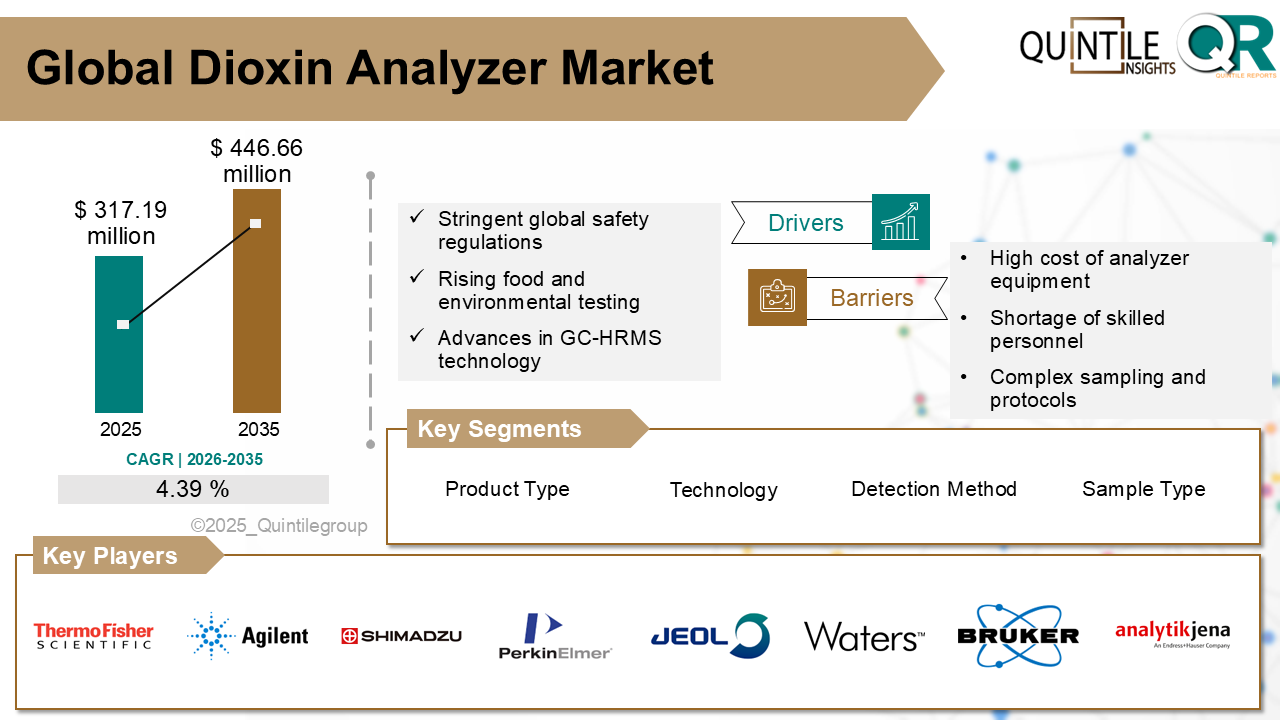
Valued at USD 317.19 million in 2025, the market is projected to reach USD 446.66 million by 2035, expanding at a CAGR of 4.39% during the forecast period.
Dioxin analyzers are advanced analytical instruments used to detect toxic compounds such as dioxins, furans, and dioxin-like polychlorinated biphenyls (dl-PCBs). These harmful substances are often found in industrial emissions, contaminated food products, and environmental samples such as air, water, and soil. Accurate detection at ultra-trace levels is critical for protecting human health and ensuring compliance with global safety standards.
Request Sample PDF Report: https://www.quintilereports.com/request-sample/1275-dioxin-analyzer-market/
🚀 Market Drivers
A major factor fueling market growth is the implementation of strict environmental and food safety regulations across regions. Regulatory frameworks such as those enforced by environmental agencies and food safety authorities require continuous monitoring of dioxin levels in industrial processes and food supply chains. This has significantly increased the adoption of high-precision analytical technologies.
The expansion of global food trade is another key driver. As countries export products like seafood, dairy, meat, and edible oils, there is a growing need for rigorous contamination testing to meet international standards. Food testing laboratories are increasingly investing in advanced dioxin analyzers to ensure compliance and maintain product quality.
Limited-Time Discount Available: https://www.quintilereports.com/request-discount/1275-dioxin-analyzer-market/
Additionally, the growth of industrial sectors such as waste incineration, chemical manufacturing, and paper processing contributes to rising demand. These industries are known sources of dioxin emissions, necessitating continuous environmental monitoring and control.
🔬 Technological Advancements
Innovation is playing a vital role in shaping the market. Technologies such as gas chromatography-mass spectrometry (GC-MS/MS) and high-resolution mass spectrometry (HRMS) are enhancing detection accuracy and efficiency. Modern analyzers now feature automation, real-time data monitoring, and AI-assisted analytics, improving operational productivity and reducing analysis time.
Portable and compact analyzers are also gaining popularity, allowing on-site testing and faster decision-making for environmental agencies and industrial operators.
⚠️ Market Challenges
Despite its growth, the market faces several challenges. The high cost of advanced analytical instruments remains a significant barrier, particularly for small and medium-sized laboratories. Equipment such as high-resolution GC-HRMS systems can cost over USD 1 million, limiting widespread adoption.
Buy Now to Access: https://www.quintilereports.com/request-enquiry/1275-dioxin-analyzer-market/
Another challenge is the shortage of skilled professionals capable of operating complex testing systems and interpreting analytical data. Additionally, regulatory variations across regions create operational complexities for global laboratories.
🌍 Regional Insights
North America leads the market due to strict environmental regulations and advanced laboratory infrastructure. Europe follows closely, driven by strong regulatory frameworks and sustainability initiatives. Meanwhile, the Asia-Pacific region is emerging as the fastest-growing market, supported by industrial expansion, increasing food safety awareness, and government investments in environmental monitoring.
📈 Future Outlook
The Dioxin Analyzer Market is expected to continue its steady growth trajectory, supported by increasing environmental awareness, technological advancements, and expanding regulatory frameworks. Companies focusing on innovation, cost-effective solutions, and automation will be well-positioned to capitalize on future opportunities.
Q1. Why is dioxin monitoring critical in today’s regulatory environment?
Dioxins are highly toxic and persistent environmental pollutants that pose serious health risks, including cancer and immune system damage. Regulatory bodies worldwide mandate strict monitoring to ensure environmental safety and food quality, making dioxin analysis essential.
Q2. Which industries are the primary adopters of dioxin analyzers?
Key industries include environmental monitoring agencies, food and beverage testing laboratories, waste management facilities, chemical manufacturing, pharmaceuticals, and industrial emission control sectors.
Q3. How does global food trade influence the demand for dioxin analyzers?
As international food trade expands, exporters must meet stringent safety standards set by importing countries. This increases the need for accurate contamination testing, boosting demand for advanced dioxin analyzers.
Q4. What technological advancements are shaping this market?
Innovations such as high-resolution mass spectrometry (HRMS), GC-MS/MS systems, AI-based data analysis, and portable analyzers are improving detection accuracy, speed, and operational efficiency.
Q5. What are the cost-related challenges faced by laboratories?
High initial investment, maintenance costs, and the need for specialized consumables make advanced dioxin analyzers expensive, limiting adoption among smaller laboratories.
Q6. How important is skilled workforce availability in this market?
Extremely important. Operating dioxin analyzers requires expertise in analytical chemistry, sample preparation, and data interpretation. A shortage of skilled professionals can hinder market growth.
Q7. What role do third-party testing laboratories play?
Accredited laboratories (e.g., ISO/IEC 17025 certified) provide outsourced testing services, enabling industries to comply with regulations without investing in expensive equipment.
Q8. How is environmental awareness impacting market growth?
Increasing awareness about pollution and health risks associated with dioxins is driving governments and organizations to invest in monitoring technologies, supporting market expansion.
Q9. Which region offers the most growth opportunities?
Asia-Pacific presents the highest growth potential due to rapid industrialization, stricter regulations, and expanding food safety programs.
Q10. What is the long-term outlook for the dioxin analyzer market?
The market is expected to grow steadily, driven by regulatory enforcement, technological innovation, and increasing demand for environmental and food safety testing worldwide.
Our Latest Publication
Dioxin Analyzer Market (2026-2036)
Meatainers Market Set for Strong Growth as Cold Chain Packaging Demand Accelerates

Adarsh
Business Strategy — Quintile Reports
Adarsh is a Business Strategy professional focused on transforming market insights into actionable growth plans. He supports strategic initiatives through market analysis, competitive intelligence, and data-driven decision-making to help drive long-term business success.
His core skills include strategic planning, market research, growth opportunity assessment, trend analysis, performance tracking, stakeholder communication, cross-functional collaboration, and critical problem-solving.