
The global Allergy Diagnostics Market is poised for substantial growth over the next decade, reflecting the rising prevalence of allergic disorders and rapid technological advancements in diagnostic solutions.
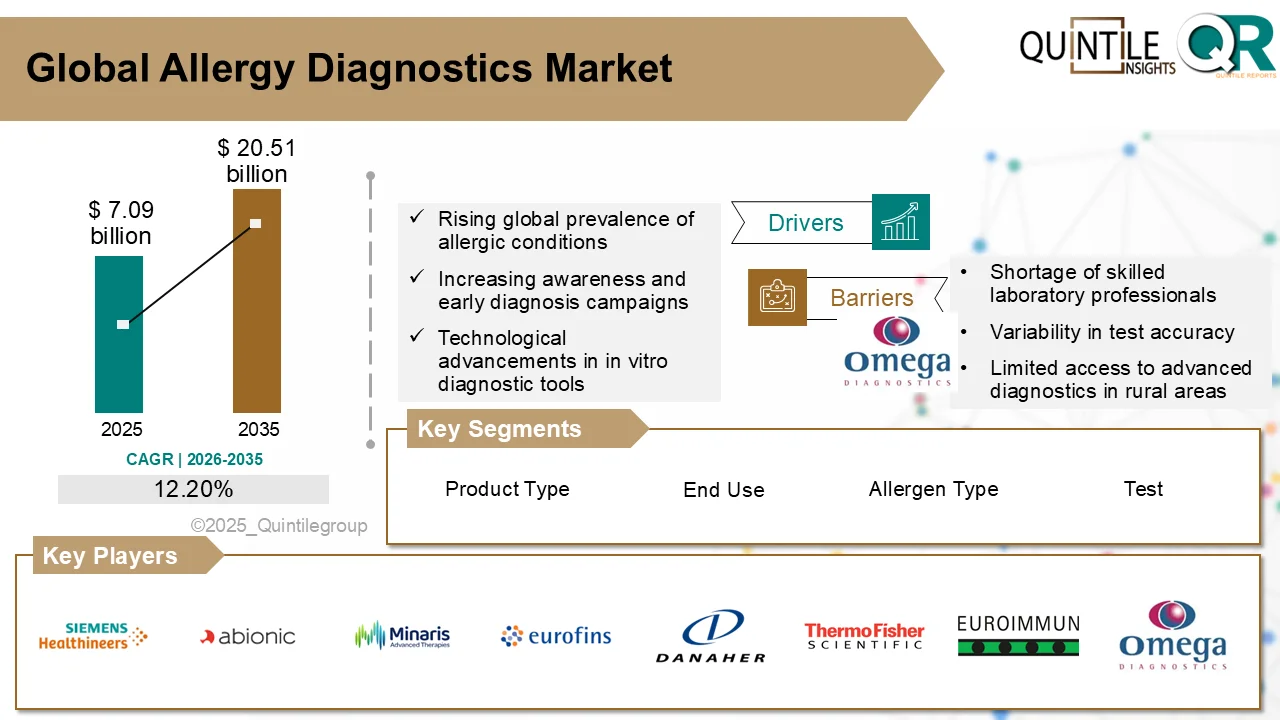
According to recent analysis by Quintile Research, the market was valued at USD 7.09 billion in 2026 and is projected to reach USD 20.51 billion by 2035, expanding at a robust CAGR of 12.2% during the forecast period.
Allergy diagnostics encompasses a broad range of tools and technologies designed to identify allergens responsible for hypersensitivity reactions. These include traditional in vivo methods such as skin prick and intradermal tests, alongside advanced in vitro assays like enzyme-linked immunosorbent assays (ELISA), specific IgE blood testing, ImmunoCAP platforms, and molecular allergen diagnostics. With allergic conditions now affecting an estimated 30–40% of the global population, demand for accurate, rapid, and minimally invasive diagnostic solutions is accelerating worldwide.
Request Sample PDF Report: https://www.quintilereports.com/request-sample/1084-allergy-diagnostics-market/
A major growth driver is the increasing burden of respiratory, food, and skin allergies, exacerbated by urbanization, rising pollution levels, climate change, and evolving dietary habits. Growing awareness among healthcare providers and patients about early detection and preventive care has significantly expanded testing volumes across hospitals, specialty clinics, and diagnostic laboratories. The integration of multiplex testing panels and component-resolved diagnostics has further enhanced precision by enabling identification of specific allergenic proteins, supporting personalized treatment strategies.
Digital transformation is also reshaping the market landscape. The adoption of laboratory automation, AI-enabled result interpretation, and electronic health record (EHR) integration is improving efficiency and throughput. Direct-to-consumer allergy test kits, often paired with telehealth consultations, are broadening access and aligning with the global shift toward personalized health monitoring.
Despite strong growth momentum, the market faces notable challenges. Advanced molecular and multiplex assays remain costly, limiting accessibility in low- and middle-income regions. Reimbursement gaps in certain public healthcare systems create financial barriers for patients. Variability in test accuracy, especially in some over-the-counter kits, can result in false positives or underdiagnosis. Additionally, regulatory complexities and the need for clinical validation may delay commercialization of novel platforms.
Special Discount: https://www.quintilereports.com/request-discount/1084-allergy-diagnostics-market/
Regionally, North America leads the global market, supported by a high allergy prevalence rate and well-established healthcare infrastructure. The United States continues to witness strong adoption of both laboratory-based and point-of-care testing, with innovation driven by companies such as Thermo Fisher Scientific and Danaher Corporation. Europe remains a mature and innovation-focused region, with Germany at the forefront of multiplex immunoassay implementation and standardized laboratory systems.
Asia Pacific is emerging as a high-growth market due to rising pediatric allergy cases and expanding diagnostic infrastructure in countries such as Japan, China, and India. Meanwhile, Latin America and the Middle East & Africa are gradually increasing adoption, particularly in urban centers and through public-private healthcare initiatives.
The competitive landscape features prominent players including Siemens Healthineers, bioMérieux, EUROIMMUN Medizinische Labordiagnostika, and Eurofins Scientific. Companies are differentiating through the development of microarray-based panels, automation-compatible systems, and AI-powered reporting tools. Strategic partnerships, mergers, and geographic expansion remain central to competitive positioning.
Buying Now: https://www.quintilereports.com/request-enquiry/1084-allergy-diagnostics-market/
Looking ahead, sustained investment in research and development, regulatory advancements, and digital health integration will continue to shape the future of allergy diagnostics. As healthcare systems prioritize preventive medicine and personalized treatment pathways, the market is expected to maintain its upward trajectory through 2035. Quintile Research concludes that organizations capable of combining technological innovation with cost-effective solutions and expanded regional access will be best positioned to capture emerging opportunities in this dynamic and rapidly evolving sector.

Adarsh
Business Strategy — Quintile Reports
Adarsh is a Business Strategy professional focused on transforming market insights into actionable growth plans. He supports strategic initiatives through market analysis, competitive intelligence, and data-driven decision-making to help drive long-term business success.
His core skills include strategic planning, market research, growth opportunity assessment, trend analysis, performance tracking, stakeholder communication, cross-functional collaboration, and critical problem-solving.