
Access to clean and safe drinking water remains one of the most pressing public health priorities of the 21st century. While significant investments have been made in centralized water infrastructure, growing concerns over contamination, aging municipal systems, industrial pollution, and emerging contaminants such as PFAS have intensified demand for localized water purification solutions. As a result, Point-of-Use (POU) Water Treatment Systems have emerged as one of the fastest-growing segments within the global water technology industry.
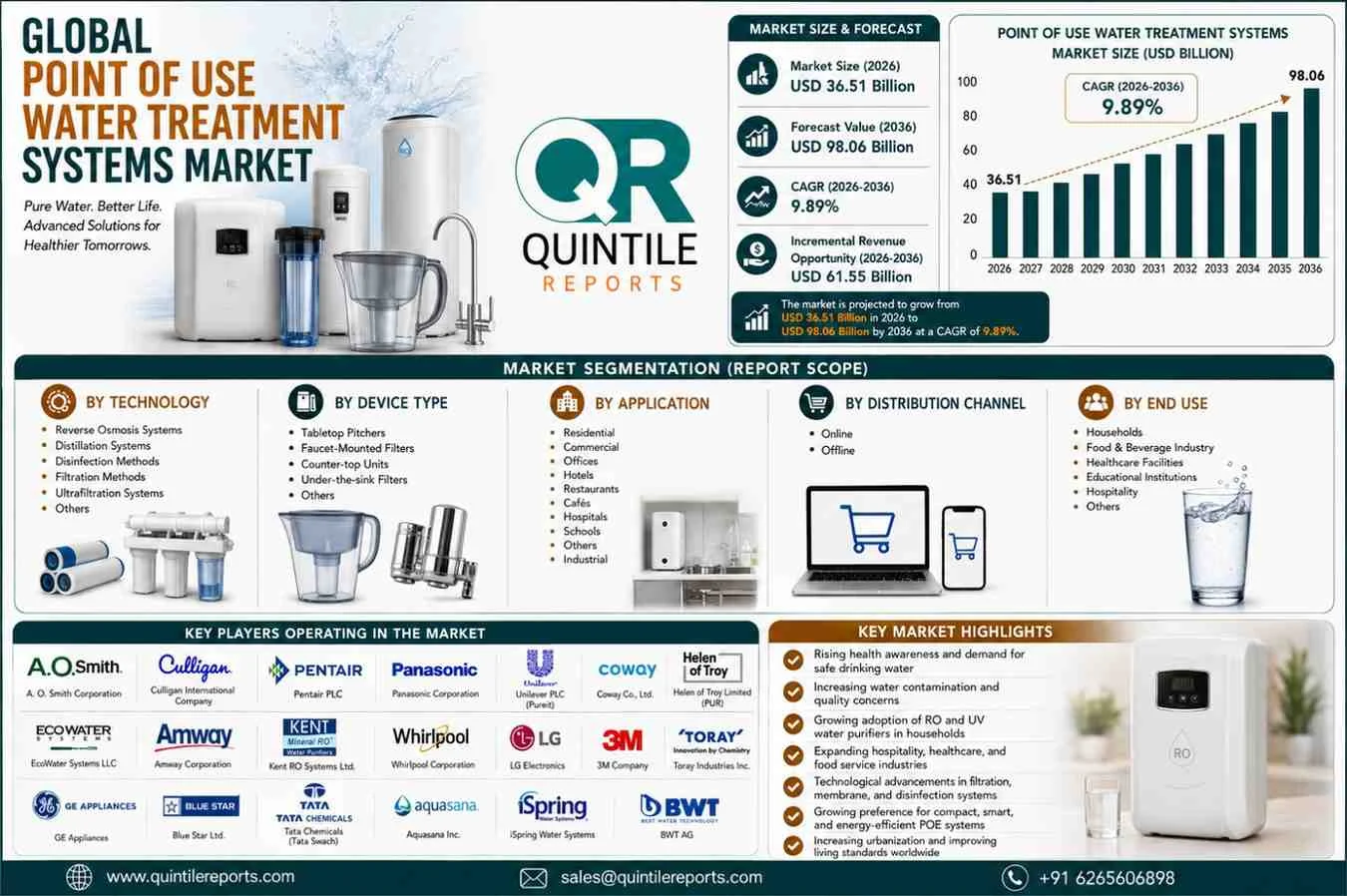
According to recent industry analysis, the global Point-of-Use Water Treatment Systems Market was valued at USD 36.51 billion in 2026 and is expected to reach USD 98.06 billion by 2036, expanding at a robust CAGR of 9.89%. The impressive growth trajectory reflects a combination of rising health awareness, technological innovation, urbanization, and increasing consumer demand for reliable drinking water solutions.
Request Sample PDF Report: https://www.quintilereports.com/request-sample/1311-point-of-use-water-treatment-systems-market/
Understanding Point-of-Use Water Treatment Systems
Point-of-Use water treatment systems are designed to purify water at the location where it is consumed. Unlike centralized treatment facilities that process water before distribution, POU systems provide an additional layer of protection directly at homes, offices, hospitals, schools, restaurants, and commercial establishments.
These systems utilize a range of purification technologies including:
- Reverse Osmosis (RO)
- Ultrafiltration (UF)
- Activated Carbon Filtration
- Ultraviolet (UV) Disinfection
- Distillation Technologies
- Multi-stage Hybrid Filtration Systems
The ability to remove contaminants such as heavy metals, bacteria, viruses, chlorine, pesticides, microplastics, and PFAS compounds has made these systems increasingly attractive to consumers worldwide.
Growing Water Contamination Concerns Fuel Market Expansion
One of the strongest drivers behind market growth is the increasing concern regarding water quality.
Reports of lead contamination, industrial pollutants, microbial contamination, and chemical residues have heightened public awareness regarding drinking water safety. Consumers today are more informed than ever before and are actively seeking solutions that provide confidence in the water they consume.
In many developed economies, aging water infrastructure presents a significant challenge. Pipes, treatment facilities, and distribution networks built decades ago are becoming increasingly vulnerable to deterioration, resulting in concerns about contamination during water delivery.
Meanwhile, developing economies face different challenges, including rapid urbanization, insufficient infrastructure investment, and growing industrial activity that can negatively impact water quality.
Point-of-use treatment systems offer a practical and cost-effective solution to address these concerns without requiring large-scale infrastructure overhauls.
Special Discount: https://www.quintilereports.com/request-discount/1311-point-of-use-water-treatment-systems-market/
The Rise of Smart Water Purification Technologies
Technology is playing a transformative role in reshaping the POU water treatment industry.
Modern consumers increasingly expect connected devices that offer convenience, automation, and real-time information. In response, manufacturers are introducing smart water purification systems equipped with:
- IoT-enabled sensors
- Real-time water quality monitoring
- Automated maintenance notifications
- Predictive filter replacement alerts
- Mobile app integration
- Smart-home compatibility
These innovations not only improve user experience but also enhance system performance and reliability.
Smart monitoring technologies allow users to track filtration efficiency, water consumption patterns, and maintenance schedules directly from smartphones. This transparency builds consumer confidence while reducing the risk of system failures caused by overdue maintenance.
As connected home ecosystems continue expanding globally, smart water purification technologies are expected to become a major competitive differentiator within the industry.
Sustainability Trends Support Market Adoption
Environmental sustainability has become a critical factor influencing purchasing decisions across consumer markets.
The global movement to reduce single-use plastic waste has encouraged consumers to seek alternatives to bottled water. Point-of-use filtration systems provide an environmentally friendly solution by delivering purified drinking water directly from household taps.
By reducing reliance on bottled water, these systems help minimize plastic waste, transportation emissions, and packaging-related environmental impacts.
Manufacturers are also responding to sustainability demands by developing:
- Energy-efficient purification systems
- Recyclable filtration components
- Reduced-water-waste technologies
- Long-life filtration cartridges
These innovations align with broader environmental goals while enhancing product appeal among eco-conscious consumers.
Residential Sector Remains the Largest End User
Residential applications continue to account for the largest share of the global POU market.
Consumers increasingly view water purification systems as essential household appliances rather than optional upgrades. Rising awareness regarding contaminants and health risks has accelerated adoption across urban and suburban households.
Under-sink reverse osmosis systems, countertop filtration units, faucet-mounted filters, and water purification pitchers remain among the most popular product categories.
Growing disposable incomes in emerging economies are further supporting household adoption, particularly across Asia-Pacific markets where water quality concerns remain significant.
Buying Now: https://www.quintilereports.com/request-enquiry/1311-point-of-use-water-treatment-systems-market/
Commercial and Institutional Demand Accelerates
Beyond residential applications, commercial and institutional sectors are emerging as major growth engines.
Businesses increasingly recognize the importance of providing safe drinking water for employees, customers, patients, and students.
Key commercial users include:
- Corporate Offices
- Hotels
- Restaurants
- Cafés
- Healthcare Facilities
- Educational Institutions
Hospitals and healthcare centers, in particular, require stringent water quality standards to protect vulnerable patient populations. Similarly, hospitality businesses use advanced filtration systems to enhance customer satisfaction while reducing bottled water costs.
As organizations prioritize health, sustainability, and operational efficiency, demand across these segments is expected to expand steadily.
Asia-Pacific Leads Global Market Growth
Regional dynamics continue to shape market development worldwide.
Asia-Pacific
Asia-Pacific currently dominates the global market and is expected to maintain its leadership position throughout the forecast period.
Rapid urbanization, industrialization, population growth, and increasing awareness of water quality issues are driving substantial demand across countries such as:
- India
- China
- Japan
- South Korea
- Southeast Asian Nations
Government initiatives aimed at improving public health and expanding access to clean drinking water further strengthen regional growth prospects.
North America
North America remains a highly attractive market due to growing concerns surrounding PFAS contamination, lead exposure, and aging infrastructure.
Consumers in the United States and Canada continue to invest in advanced purification systems capable of removing emerging contaminants while providing real-time monitoring capabilities.
Europe
European markets are witnessing increased adoption of sustainable filtration technologies supported by strict water quality regulations and environmental policies.
Consumers are increasingly choosing advanced purification systems that reduce dependence on bottled water while maintaining high drinking water standards.
Latin America and Middle East & Africa
Emerging economies across Latin America, the Middle East, and Africa present substantial untapped opportunities.
Water scarcity, infrastructure limitations, and growing concerns about waterborne diseases are encouraging adoption of affordable filtration technologies and advanced purification systems.
Competitive Landscape Focuses on Innovation
The competitive environment remains highly dynamic as manufacturers seek differentiation through technology, affordability, and customer experience.
Leading companies are investing heavily in research and development to enhance purification performance while improving convenience and sustainability.
Key market participants include:
- A. O. Smith Corporation
- Culligan International Company
- Pentair PLC
- Panasonic Corporation
- Unilever (Pureit)
- Coway Co., Ltd.
- Kent RO Systems Ltd.
- Whirlpool Corporation
- LG Electronics
- 3M Company
- Aquasana Inc.
- BWT AG
Strategic priorities increasingly include smart technology integration, regional product customization, subscription-based filter replacement services, and environmentally responsible product design.
Challenges Remain Despite Strong Growth
Despite strong momentum, several challenges continue to influence market expansion.
High installation costs associated with advanced purification systems can discourage adoption among price-sensitive consumers.
Additionally, ongoing maintenance requirements, including periodic filter replacements and servicing, contribute to total ownership costs.
Reverse osmosis systems also face criticism regarding wastewater generation, prompting manufacturers to develop more efficient designs that minimize water loss.
Addressing these challenges will be essential for sustaining long-term market growth and expanding accessibility across lower-income populations.
Future Outlook: Water Security Becomes a Global Priority
The future of the Point-of-Use Water Treatment Systems Market appears exceptionally promising.
As governments, businesses, and consumers place greater emphasis on water safety, environmental sustainability, and public health, demand for advanced purification solutions is expected to accelerate.
Emerging technologies such as artificial intelligence, smart diagnostics, predictive maintenance, and next-generation filtration materials are likely to further enhance system performance and affordability.
With increasing concerns surrounding water contamination and infrastructure reliability, point-of-use water treatment systems are positioned to play a central role in ensuring safe drinking water access for billions of people worldwide over the next decade.
The industry’s continued evolution represents more than a market opportunity—it reflects a global commitment to healthier communities, sustainable resource management, and long-term water security.
1. What is driving the rapid growth of the Point-of-Use Water Treatment Systems Market?
Increasing concerns regarding water contamination, PFAS, heavy metals, microbial pollutants, and growing consumer awareness about health and hygiene are major growth drivers.
2. What market size is expected by 2036?
The market is projected to reach approximately USD 98.06 billion by 2036.
3. Which technology segment dominates the market?
Reverse Osmosis (RO) systems currently represent one of the most widely adopted and effective purification technologies globally.
4. How are smart technologies influencing market development?
IoT-enabled monitoring, predictive maintenance, smartphone integration, and real-time water quality tracking are transforming consumer engagement and system efficiency.
5. Which region offers the greatest growth opportunity?
Asia-Pacific remains the largest and fastest-growing market due to rapid urbanization, industrialization, and increasing health awareness.
6. What role does sustainability play in market expansion?
Consumers increasingly prefer filtration systems that reduce bottled water usage, plastic waste, and environmental impact.
7. Which end-use sectors are expected to witness the fastest growth?
Healthcare facilities, hospitality businesses, educational institutions, and commercial offices are expected to experience strong adoption rates.
8. What are the biggest challenges facing manufacturers?
High installation costs, maintenance requirements, filter replacement expenses, and wastewater concerns associated with reverse osmosis technologies remain key challenges.
Our Latest News:
Point of Use Water Treatment Systems Market (2026 – 2036)
Last Mile Drone Delivery Market Set to Transform Global Logistics, Expected to Reach USD 6.16 Billion by 2035

Adarsh
Business Strategy — Quintile Reports
Adarsh is a Business Strategy professional focused on transforming market insights into actionable growth plans. He supports strategic initiatives through market analysis, competitive intelligence, and data-driven decision-making to help drive long-term business success.
His core skills include strategic planning, market research, growth opportunity assessment, trend analysis, performance tracking, stakeholder communication, cross-functional collaboration, and critical problem-solving.