
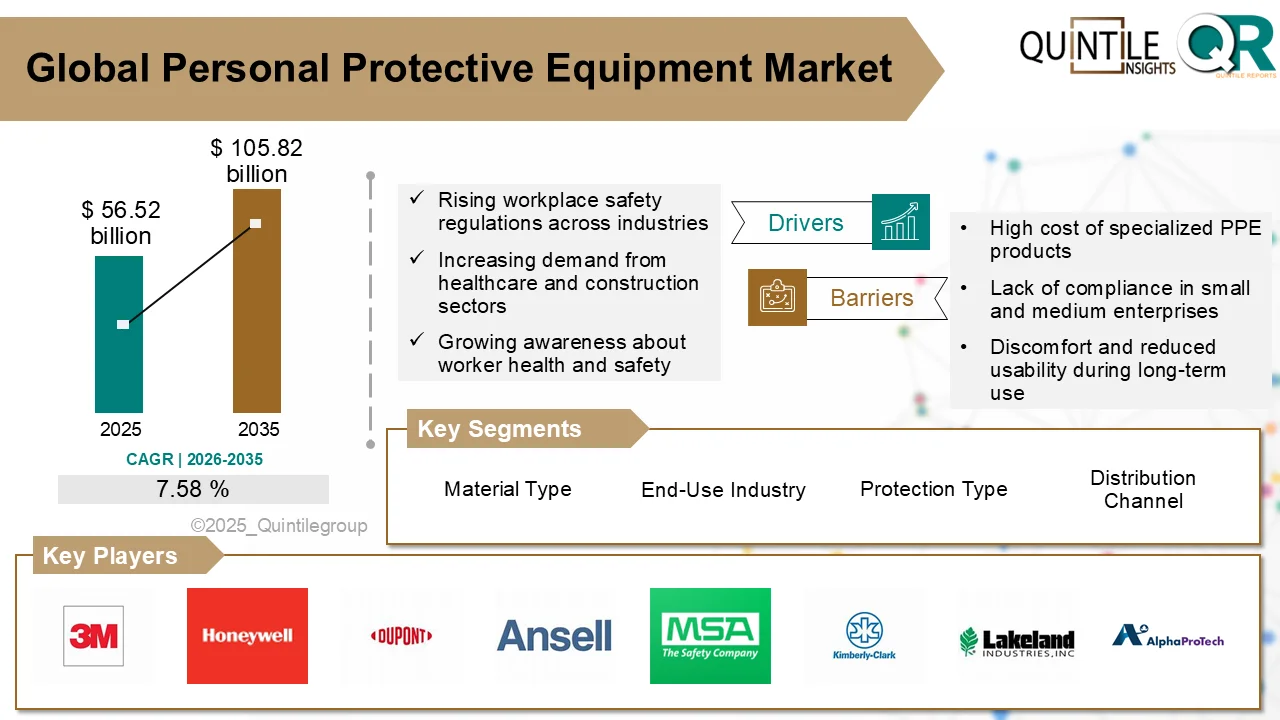
The Personal Protective Equipment Market is entering a new phase of sustained expansion as industries worldwide strengthen safety protocols and adopt advanced protective technologies.
According to Quintile Research, the Global Personal Protective Equipment Market was valued at USD 56.52 billion in 2025 and is projected to reach USD 105.82 billion by 2035, registering a CAGR of 7.58% during the forecast period from 2026 to 2035.
The growth of the Personal Protective Equipment Market is largely supported by increasing workplace safety awareness, strict government regulations, and rapid industrialization across emerging economies. Regulatory authorities such as the Occupational Safety and Health Administration (OSHA) and the Health and Safety Executive (HSE) are enforcing stringent compliance requirements, compelling industries to maintain consistent procurement of certified safety products.
Request Sample PDF Report: https://www.quintilereports.com/request-sample/1148-personal-protective-equipment-market/
The Personal Protective Equipment Market includes a broad product portfolio such as head protection (hard hats, safety helmets), eye and face protection (goggles, face shields), hearing protection (earplugs, earmuffs), respiratory protection (N95 masks, air-purifying respirators), protective clothing (coveralls, high-visibility garments), hand protection (chemical-resistant and cut-resistant gloves), foot protection (safety shoes, rubber boots), and fall protection systems (harnesses, lifelines). Demand for these products continues to expand across construction, healthcare, oil & gas, manufacturing, chemicals, mining, transportation, and food processing industries.
The construction sector remains one of the strongest contributors to the Personal Protective Equipment Market. Rapid urbanization, infrastructure modernization programs, and large-scale commercial projects across North America, Asia-Pacific, and the Middle East are significantly increasing PPE deployment. Construction sites expose workers to hazards such as falling debris, silica dust, electrical risks, and extreme weather conditions, reinforcing the need for high-quality protective equipment.
Special Discount: https://www.quintilereports.com/request-discount/1148-personal-protective-equipment-market/
Technological innovation is transforming the Personal Protective Equipment Market. Smart PPE solutions integrated with IoT sensors, biometric monitoring, GPS tracking, and heat-stress detection are redefining workplace safety standards. Connected helmets, intelligent gloves, and wearable vests now provide real-time monitoring of worker fatigue, temperature, hazardous gas exposure, and movement patterns. These advancements enhance predictive safety management and reduce incident rates across high-risk industries.
Ergonomic design is another key growth factor within the Personal Protective Equipment Market. Manufacturers are focusing on lightweight materials, breathable fabrics, moisture-control technology, and fatigue-reducing footwear. Improved comfort increases worker compliance and productivity, creating a competitive advantage for companies offering ergonomically advanced products.
Despite strong momentum, the Personal Protective Equipment Market faces certain challenges. High costs associated with advanced protective solutions, including flame-resistant apparel and smart wearables, may limit adoption among small and medium-sized enterprises. In addition, global variations in safety certification standards increase compliance complexity for manufacturers operating across multiple regions. Supply chain disruptions and the presence of counterfeit or low-quality products further impact market stability.
Buying Now: https://www.quintilereports.com/request-enquiry/1148-personal-protective-equipment-market/
Regionally, North America represents a mature segment of the Personal Protective Equipment Market, supported by strong regulatory enforcement and rapid adoption of connected safety technologies. Europe emphasizes sustainability, CE certification, and recyclable PPE materials. Asia-Pacific leads in volume consumption due to infrastructure expansion and cost-effective production capabilities. Meanwhile, Latin America and the Middle East & Africa are witnessing steady growth driven by industrial development and construction investments.
Sustainability is increasingly shaping the competitive landscape of the Personal Protective Equipment Market. Manufacturers incorporating recycled materials, biodegradable components, and circular-use programs are gaining preference among environmentally conscious buyers and government agencies aligned with ESG objectives.
Leading participants in the Personal Protective Equipment Market include major global manufacturers investing in R&D, mergers, acquisitions, and product innovation to strengthen their competitive positioning. As industries prioritize workforce safety, regulatory compliance, and operational resilience, the Personal Protective Equipment Market is expected to maintain robust growth through 2035. Companies that integrate smart technologies, sustainability strategies, and region-specific compliance frameworks will secure long-term opportunities in this evolving global market.
1. What is the current valuation of the market?
The global industry was valued at USD 56.52 billion in 2025 and is projected to reach USD 105.82 billion by 2035, expanding at a CAGR of 7.58% between 2026 and 2035.
2. What factors are driving industry growth?
Growth is primarily supported by strict workplace safety regulations, expanding industrial activity, and rising awareness regarding occupational hazards. Regulatory authorities such as the Occupational Safety and Health Administration and the Health and Safety Executive enforce compliance standards that require certified protective gear across hazardous job sites.
3. Which industries generate the highest demand?
Key end-use industries include construction, healthcare, manufacturing, oil & gas, mining, chemicals, transportation, and food processing. Among these, construction remains a major revenue contributor due to high exposure to fall risks, dust, electrical hazards, and heavy equipment operations.
4. What are the major product categories?
The market includes a wide range of safety solutions such as:
-
Head protection (helmets, hard hats)
-
Eye and face protection (goggles, shields)
-
Hearing protection (earplugs, earmuffs)
-
Respiratory devices (N95 masks, air-purifying respirators)
-
Protective clothing (coveralls, high-visibility apparel)
-
Hand protection (cut-resistant and chemical-resistant gloves)
-
Foot and leg protection (safety shoes, boots)
-
Fall protection systems (harnesses, lifelines)
5. How is technology influencing product innovation?
Technological advancements are transforming traditional safety gear into connected solutions. Smart helmets, biometric wearables, GPS-enabled boots, and heat-stress monitoring systems are improving real-time worker tracking and predictive safety management. These innovations enhance productivity while reducing accident risks.
6. Which regions lead global demand?
Asia-Pacific dominates in volume due to rapid infrastructure expansion and industrialization. North America and Europe maintain strong positions driven by regulatory enforcement, sustainability initiatives, and early adoption of smart safety technologies.
7. What challenges impact industry expansion?
High costs of advanced protective solutions, inconsistent international certification standards, and supply chain disruptions present ongoing challenges. Additionally, the presence of low-quality counterfeit products affects overall safety standards and brand trust.
8. Who are the leading companies operating globally?
Prominent players include:
-
3M Company
-
DuPont de Nemours Inc.
-
Ansell Limited
These companies focus on R&D, smart product development, sustainability initiatives, and regional expansion strategies.
9. What is the long-term outlook?
The industry is expected to maintain strong momentum through 2035, supported by infrastructure growth, ESG-focused procurement policies, digital integration, and stricter occupational safety frameworks worldwide.
Our Latest Publication
Personal Protective Equipment Market (2026 – 2035)
Our Latest News:
Industrial Motor Market to Reach USD 28.22 Billion by 2035, Driven by Automation and Energy Efficiency Trends

Adarsh
Business Strategy — Quintile Reports
Adarsh is a Business Strategy professional focused on transforming market insights into actionable growth plans. He supports strategic initiatives through market analysis, competitive intelligence, and data-driven decision-making to help drive long-term business success.
His core skills include strategic planning, market research, growth opportunity assessment, trend analysis, performance tracking, stakeholder communication, cross-functional collaboration, and critical problem-solving.