
The global Permanent Magnet Generator (PMG) market is entering a new phase of technological advancement and commercial expansion as industries accelerate the transition toward clean and efficient power generation systems.
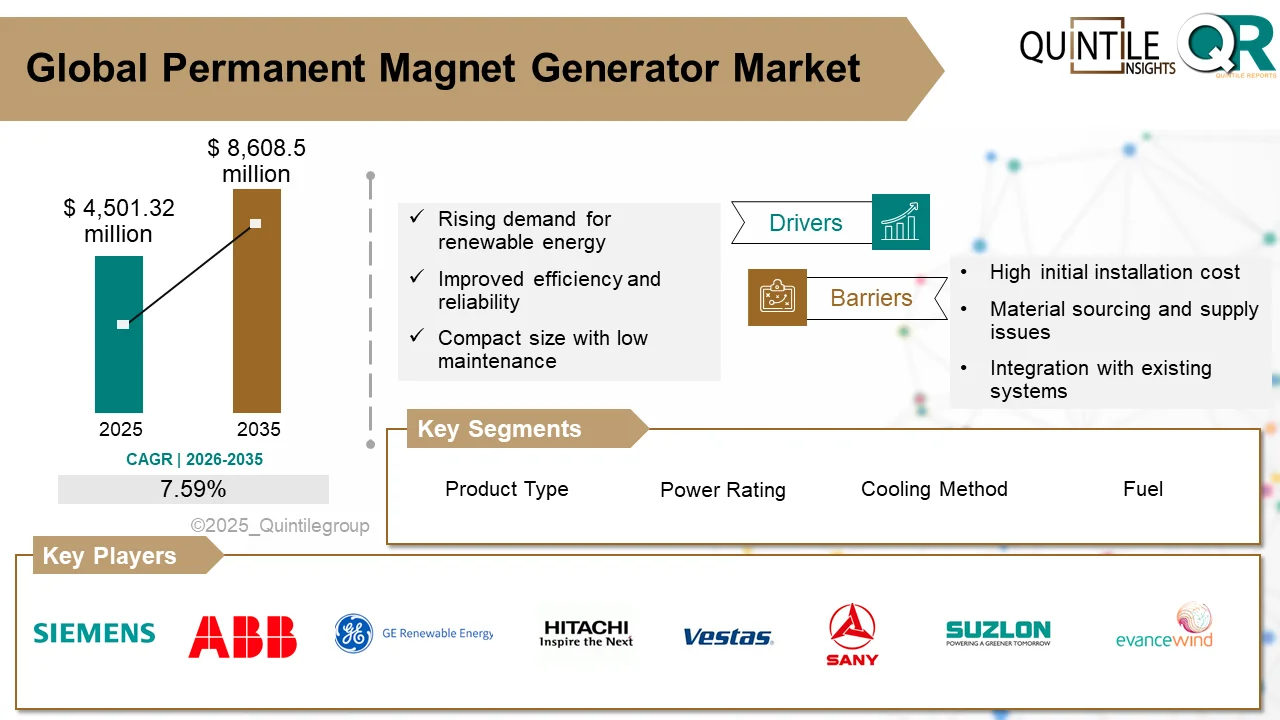
According to recent industry analysis, the market was valued at USD 4.5 billion in 2025 and is projected to reach USD 8.6 billion by 2035, growing at a compound annual growth rate (CAGR) of 7.59% between 2026 and 2035.
Permanent magnet generators have become a cornerstone of modern power generation systems due to their high efficiency, compact design, and lower maintenance requirements compared to traditional generator technologies. These advantages have made PMGs particularly attractive for applications in renewable energy, marine propulsion, industrial machinery, and distributed energy systems.
Request Sample PDF Report: https://www.quintilereports.com/request-sample/1122-permanent-magnet-generator-market/
Renewable Energy Driving Market Momentum
One of the most significant drivers of the permanent magnet generator market is the rapid expansion of renewable energy infrastructure worldwide. Wind turbines, especially direct-drive turbine systems, increasingly rely on PMGs because they eliminate the need for gearboxes and reduce mechanical complexity.
Limited-Time Discount Available: https://www.quintilereports.com/request-discount/1122-permanent-magnet-generator-market/
Countries across North America, Europe, and Asia-Pacific are heavily investing in wind energy capacity, further strengthening the demand for high-performance generator technologies. In particular, offshore wind farms are expected to create strong demand for large-scale PMG systems capable of delivering high power output with minimal maintenance.
Government incentives and energy transition policies are also accelerating adoption. Programs supporting clean energy development encourage the integration of advanced generator technologies to improve efficiency and sustainability.
Buy Now to Access: https://www.quintilereports.com/request-enquiry/1122-permanent-magnet-generator-market/
Technology Advancements Enhancing Generator Performance
Technological progress in magnetic materials and generator design is another key factor reshaping the market landscape. New permanent magnet materials such as neodymium and samarium-cobalt enable higher power density and improved energy conversion efficiency.
Modern permanent magnet generators typically consist of a magnet-embedded rotor, stator windings, precision bearings, and advanced cooling systems. These components work together to convert mechanical rotation into electrical energy with exceptional reliability.
Manufacturers are also investing heavily in research and development to create lighter, more efficient direct-drive PMG configurations, particularly for large-scale renewable energy installations and marine propulsion systems.
Expanding Applications Beyond Wind Energy
While wind turbines remain the dominant application segment, PMGs are increasingly used in micro-hydro systems, distributed energy networks, marine propulsion, aerospace systems, and industrial power generation.
The rise of decentralized power systems and micro-grids has further expanded the use of PMG technologies in remote and off-grid environments. Their ability to operate efficiently at variable speeds makes them well-suited for small-scale renewable installations and hybrid energy systems.
Supply Chain and Cost Challenges
Despite strong growth prospects, the industry faces several challenges. Permanent magnet generators rely heavily on rare-earth materials, particularly neodymium and dysprosium. Supply chain disruptions and price volatility for these materials can significantly impact manufacturing costs.
Additionally, the production of large direct-drive PMGs requires specialized manufacturing processes, precise magnet placement, and complex assembly techniques, which can limit scalability in certain markets.
Competitive Landscape and Strategic Partnerships
The competitive landscape of the permanent magnet generator market includes several global engineering and energy technology leaders. Companies such as Siemens AG, ABB Ltd., GE Renewable Energy, Hitachi Ltd., and Vestas Wind Systems A/S are investing in advanced generator technologies and forming strategic collaborations to expand their global footprint.
These companies are focusing on innovation, improved efficiency, and integration with renewable energy systems to capture the growing opportunities in the global energy transition.
With renewable energy investments accelerating worldwide and industries prioritizing energy efficiency, the permanent magnet generator market is expected to remain a critical component of the global clean energy ecosystem through 2035.
1. What is a permanent magnet generator and how does it work?
A permanent magnet generator (PMG) is an electrical generator that converts mechanical energy into electrical energy using permanent magnets to create a magnetic field. Unlike traditional generators that rely on external power to energize electromagnets, PMGs use magnets embedded in the rotor, which rotate inside stator windings to induce electricity. This design improves efficiency, reliability, and reduces maintenance requirements.
2. Why are permanent magnet generators becoming important in renewable energy systems?
Permanent magnet generators are widely used in renewable energy applications because they provide higher efficiency, lower mechanical losses, and better performance at variable speeds. These characteristics make them particularly suitable for wind turbines, hydro turbines, and decentralized power systems.
3. What are the key advantages of PMG technology over conventional generators?
Permanent magnet generators offer several advantages, including:
-
Higher energy efficiency
-
Reduced maintenance due to fewer moving parts
-
Elimination of external excitation systems
-
Compact and lightweight design
-
Improved reliability in harsh operating environments
These benefits make PMGs attractive for both renewable energy and industrial applications.
4. Which industries are driving demand for permanent magnet generators?
Several sectors are driving market growth, including:
-
Renewable energy (wind and hydro power)
-
Marine propulsion systems
-
Aerospace and defense
-
Industrial machinery and manufacturing
-
Oil and gas energy systems
-
Distributed power and microgrid installations
Among these, wind energy remains the largest application segment globally.
5. What technological innovations are shaping the future of the PMG market?
Advancements in high-performance magnetic materials such as neodymium and samarium-cobalt, improved generator cooling systems, and direct-drive generator designs are enhancing PMG efficiency and durability. Digital monitoring systems and smart energy integration are also improving operational performance.
6. What challenges are associated with permanent magnet generator manufacturing?
The industry faces several challenges, including:
-
Dependence on rare-earth materials such as neodymium and dysprosium
-
Price volatility in rare-earth supply chains
-
Complex manufacturing processes for large generators
-
High upfront costs compared to conventional generators
These factors can affect scalability and market competitiveness.
7. Which regions are expected to lead growth in the permanent magnet generator market?
The Asia-Pacific region is expected to dominate due to large-scale renewable energy investments, particularly in China, India, and Japan. Meanwhile, North America and Europe are experiencing strong growth due to government incentives supporting clean energy technologies.
8. How are governments supporting the adoption of permanent magnet generators?
Governments worldwide are implementing policies to promote clean energy and energy efficiency. Incentives include renewable energy subsidies, tax credits, funding for research and development, and national strategies focused on wind power expansion and electrification.
9. What role do permanent magnet generators play in offshore wind power?
Offshore wind turbines often use direct-drive PMG systems because they eliminate gearboxes, reducing mechanical failures and maintenance requirements. This improves reliability and efficiency in offshore environments where maintenance costs are high.
10. What is the future outlook for the permanent magnet generator market?
The market outlook remains highly positive as global energy systems shift toward sustainability and electrification. Increasing renewable energy installations, technological innovations, and expanding industrial applications are expected to drive steady market growth through 2035 and beyond.
Our Latest Publication:
Permanent Magnet Generator Market (2026 – 2035)
Lawn Edger Market Growth Accelerates as DIY Landscaping and Smart Garden Tools Rise

Adarsh
Business Strategy — Quintile Reports
Adarsh is a Business Strategy professional focused on transforming market insights into actionable growth plans. He supports strategic initiatives through market analysis, competitive intelligence, and data-driven decision-making to help drive long-term business success.
His core skills include strategic planning, market research, growth opportunity assessment, trend analysis, performance tracking, stakeholder communication, cross-functional collaboration, and critical problem-solving.