
The global non-alcoholic wine market is undergoing a notable transformation, fueled by shifting consumer lifestyles, wellness-driven choices, and rapid advancements in wine dealcoholization technologies.
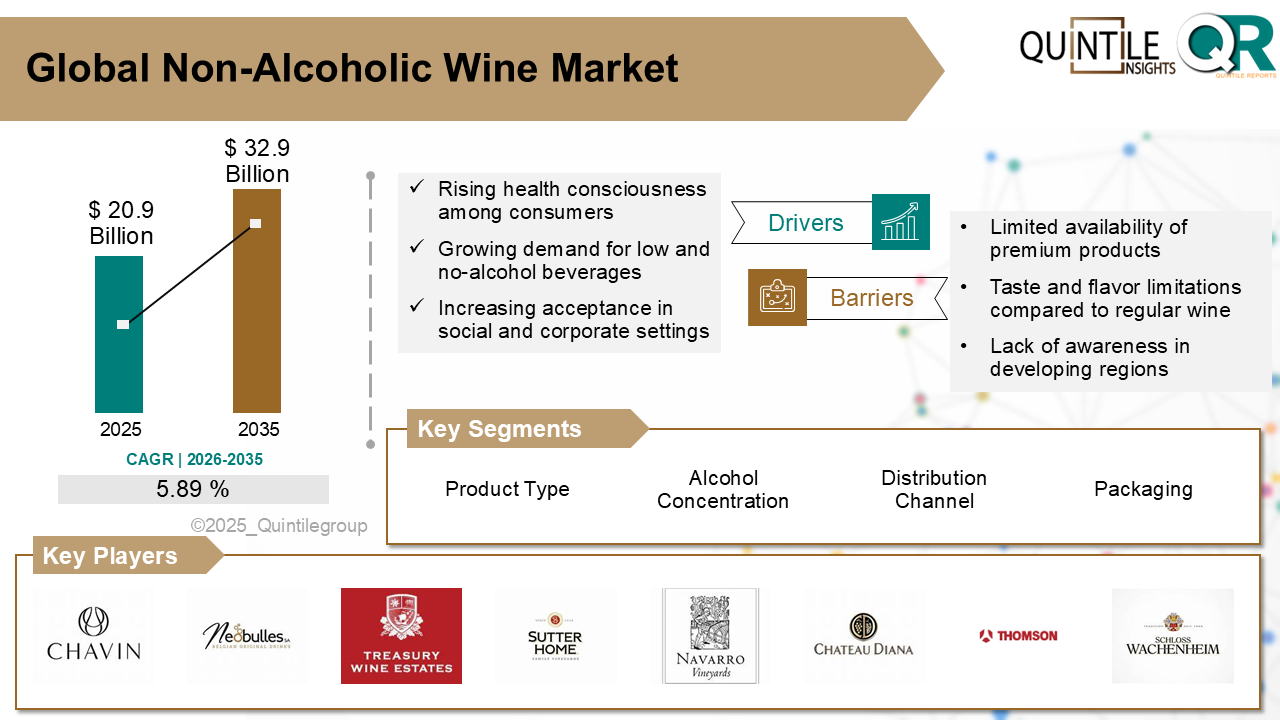
Valued at USD 20.9 billion in 2025, the market is projected to reach USD 32.9 billion by 2035, expanding at a compound annual growth rate (CAGR) of 5.89% during the forecast period from 2026 to 2035.
Non-alcoholic wines—typically containing less than 0.5% alcohol by volume—are designed to replicate the taste, aroma, and mouthfeel of traditional wines while eliminating or significantly reducing alcohol content. These products include both alcohol-free wines, where alcohol is removed after fermentation, and low-alcohol variants aimed at moderation-focused consumers. Once considered niche, the category is now gaining mainstream acceptance across global markets.
Request Sample PDF Report: https://www.quintilereports.com/request-sample/1160-non-alcoholic-wine-market/
Health, Wellness, and Social Inclusion Drive Demand
One of the primary forces driving market growth is the global shift toward healthier lifestyles. Consumers are increasingly aware of the long-term health implications of alcohol consumption, including liver disease, cardiovascular concerns, and mental health effects. As a result, many are seeking alternatives that allow them to enjoy the wine experience without compromising wellness goals.
In parallel, evolving social norms—particularly among Millennials and Gen Z—are reshaping drinking behaviors. The rise of the “sober curious” movement and a growing emphasis on mindfulness, fitness, and mental clarity have reduced alcohol intake across multiple demographics. Non-alcoholic wines offer an inclusive solution for social settings, enabling participation in celebrations, dining occasions, and professional events without alcohol-related limitations.
Place Order: https://www.quintilereports.com/request-enquiry/1160-non-alcoholic-wine-market/
Technological Advancements Improve Product Quality
Historically, non-alcoholic wines faced criticism for lacking depth and complexity. However, this perception is rapidly changing due to technological innovation. Advanced dealcoholization methods such as vacuum distillation and reverse osmosis are enabling producers to remove alcohol while preserving key flavor compounds, aromas, and textures.
Producers are also experimenting with premium grape varieties, organic sourcing, and clean-label formulations to enhance quality and appeal. Some brands are incorporating botanicals and functional ingredients to align with wellness trends, further differentiating offerings in an increasingly competitive market.
Market Challenges Remain
Despite strong growth prospects, the non-alcoholic wine market faces several constraints. Consumer skepticism around taste and authenticity persists, particularly among traditional wine enthusiasts. Additionally, non-alcoholic wines often carry price points comparable to or higher than conventional wines due to premium inputs and complex production processes, limiting broader adoption.
Limited retail shelf space compared to alcoholic beverages also restricts visibility, although the rapid expansion of e-commerce and direct-to-consumer channels is helping address this challenge.
Regional Market Dynamics
Europe remains the largest and most mature market, supported by deep-rooted wine culture and strong demand for organic, low-sugar, and additive-free products. Germany, France, and the UK lead consumption, benefiting from favorable regulations and consumer trust built through clear origin labeling.
North America is experiencing steady expansion, driven by wellness-oriented lifestyles and growing availability across supermarkets, specialty stores, and online platforms. Packaging innovations such as single-serve formats and sustainability-focused branding resonate strongly with U.S. consumers.
The Asia Pacific region represents one of the fastest-growing markets, supported by urbanization, rising disposable incomes, and changing consumption habits. While awareness is still developing, countries such as Japan, China, and Australia are seeing increasing interest through retail expansion and targeted marketing efforts.
Meanwhile, Latin America and the Middle East & Africa are emerging markets, where cultural factors, health awareness, and regulatory environments are gradually creating space for alcohol-free alternatives.
Competitive Landscape and Outlook
Competition in the non-alcoholic wine market centers on taste authenticity, ingredient transparency, packaging innovation, and distribution reach. Leading players such as Treasury Wine Estates, Schloss Wachenheim AG, Pierre Chavin, Thomson and Scott, and Australian Vintage Limited are investing heavily in R&D and branding to capture evolving consumer preferences.
Recent investments—including dedicated non-alcoholic wine production facilities and premium sparkling launches—underscore industry confidence in long-term demand.
As wellness, moderation, and inclusivity continue to redefine global drinking culture, the non-alcoholic wine market is poised to transition from an alternative category to a core segment within the global beverage industry.
1. What is non-alcoholic wine?
Non-alcoholic wine refers to beverages made using traditional winemaking processes, where alcohol is either not fully developed or removed after fermentation. These wines typically contain less than 0.5% alcohol by volume (ABV) and are designed to replicate the taste, aroma, and mouthfeel of conventional wines.
2. How large is the global non-alcoholic wine market?
The global non-alcoholic wine market was valued at USD 20.9 billion in 2025 and is projected to reach USD 32.9 billion by 2035, growing at a CAGR of 5.89% between 2026 and 2035.
3. What factors are driving growth in the non-alcoholic wine market?
Market growth is driven by increasing health and wellness awareness, changing alcohol consumption habits, the rise of the “sober curious” movement, improved dealcoholization technologies, and expanding availability through e-commerce and modern retail channels.
4. Who are the primary consumers of non-alcoholic wine?
Key consumer groups include health-conscious individuals, Millennials and Gen Z consumers, pregnant women, designated drivers, professionals seeking moderation, and individuals with medical or lifestyle reasons to avoid alcohol. Social inclusivity and wellness trends play a major role in adoption.
5. How is non-alcoholic wine produced?
Non-alcoholic wines are commonly produced using advanced techniques such as vacuum distillation and reverse osmosis, which remove alcohol while preserving flavor compounds. Some producers also control fermentation to limit alcohol formation from the outset.
6. What are the main challenges facing the non-alcoholic wine market?
Major challenges include lingering consumer skepticism about taste quality, premium pricing due to complex production methods, limited shelf space in physical retail stores, and lower consumer awareness compared to traditional alcoholic wines.
7. Which regions dominate the non-alcoholic wine market?
Europe leads the global market, supported by a strong wine culture and demand for organic and clean-label products. North America follows, driven by wellness-focused consumption patterns. Asia Pacific is the fastest-growing region, while Latin America and the Middle East & Africa represent emerging opportunities.
8. Which product segments are growing the fastest?
Sparkling non-alcoholic wines, alcohol-free variants, and premium offerings are among the fastest-growing segments. Packaging innovations such as single-serve bottles and cans are also gaining traction, particularly among urban and younger consumers.
9. Who are the key players in the non-alcoholic wine market?
Prominent players include Treasury Wine Estates, Schloss Wachenheim AG, Pierre Chavin, Thomson and Scott, Australian Vintage Limited, Sutter Home Winery, and Mionetto, among others. Competition is centered on taste authenticity, ingredient quality, branding, and distribution reach.
10. What is the future outlook for the non-alcoholic wine industry?
The market is expected to continue expanding as moderation, wellness, and inclusivity redefine global drinking culture. Ongoing investments in R&D, premiumization, sustainable packaging, and flavor innovation are likely to position non-alcoholic wine as a mainstream beverage category rather than a niche alternative.
Our Latest Publication
Non-Alcoholic Wine Market Size Estimation, Share & Future Growth Trends Analysis, By Product Type (Still Non-Alcoholic Wine, Sparkling Non-Alcoholic Wine), By Alcohol Concentration, By Packaging, By Distribution Channel and Regional Analysis, 2026-2035
Our Latest News:
Non-GMO Flour Market Set for Steady Growth as Clean-Label Demand Accelerates Through 2035

Adarsh
Business Strategy — Quintile Reports
Adarsh is a Business Strategy professional focused on transforming market insights into actionable growth plans. He supports strategic initiatives through market analysis, competitive intelligence, and data-driven decision-making to help drive long-term business success.
His core skills include strategic planning, market research, growth opportunity assessment, trend analysis, performance tracking, stakeholder communication, cross-functional collaboration, and critical problem-solving.