
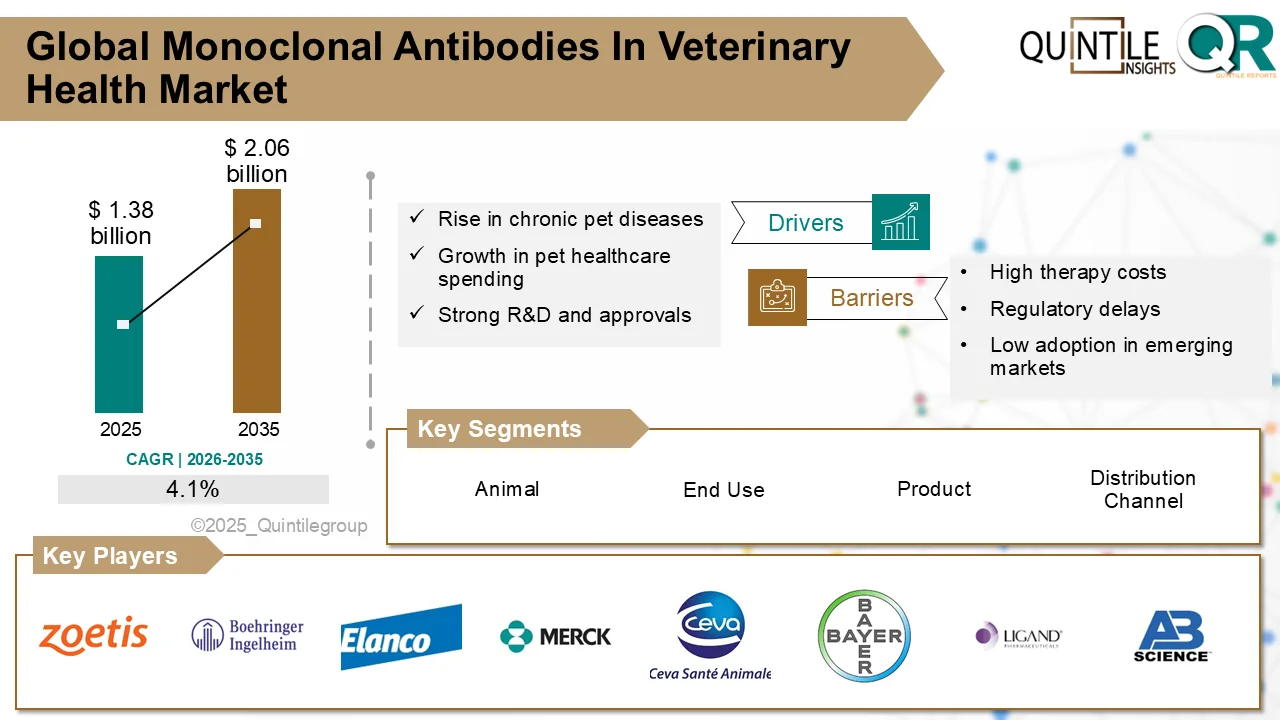
The Monoclonal Antibodies in Veterinary Health Market is poised for sustained expansion over the next decade, driven by rising pet healthcare spending, advances in biotechnology, and increasing demand for targeted therapies in animal treatment.
Valued at USD 1.38 billion in 2026, the market is projected to reach approximately USD 2.06 billion by 2035, registering a compound annual growth rate (CAGR) of 4.1% during the forecast period.
Monoclonal antibodies (mAbs) are laboratory-engineered biologics designed to bind with high specificity to disease-related antigens. Initially developed for human medicine, these therapies have increasingly been adapted for veterinary applications, particularly for companion animals such as dogs and cats. Their ability to deliver precise therapeutic effects with minimal side effects makes them an attractive alternative to conventional small-molecule drugs.
📄 𝐃𝐎𝐖𝐍𝐋𝐎𝐀𝐃 𝐒𝐀𝐌𝐏𝐋𝐄 𝐏𝐃𝐅: https://www.quintilereports.com/request-sample/1101-monoclonal-antibodies-in-veterinary-health-market/
Rising Demand for Advanced Veterinary Care
A key factor fueling growth in the Monoclonal Antibodies in Veterinary Health Market is the growing trend of pet humanization. As pets are increasingly regarded as family members, owners are more willing to invest in advanced medical treatments. Chronic conditions such as osteoarthritis, atopic dermatitis, cancer, and immune-mediated diseases are becoming more commonly diagnosed in companion animals, creating strong demand for innovative therapies.
🔥 𝐒𝐏𝐄𝐂𝐈𝐀𝐋 𝐃𝐈𝐒𝐂𝐎𝐔𝐍𝐓 🔥: https://www.quintilereports.com/request-discount/1101-monoclonal-antibodies-in-veterinary-health-market/
Products such as Cytopoint, Librela, and Solensia have pioneered precision medicine in veterinary care. These treatments specifically target pain and inflammatory pathways, offering long-lasting relief with fewer systemic effects compared to traditional medications.
Technological Advancements and Regulatory Support
Technological progress in genetic engineering, antibody development platforms, and scalable bioproduction methods has significantly reduced development timelines and improved product efficacy. Artificial intelligence-driven discovery tools are also accelerating the identification of species-specific antibodies.
Regulatory frameworks in regions such as North America and Europe are gradually adapting to support biologic innovation. In the United States, agencies like the USDA Center for Veterinary Biologics (CVB) and the FDA’s Center for Veterinary Medicine (CVM) have introduced approval pathways that encourage innovation while maintaining safety standards. Conditional approvals for infectious disease mAbs further highlight regulatory flexibility in addressing urgent animal health needs.
Expanding Applications Beyond Companion Animals
While companion animals currently account for the largest market share, livestock applications are gaining traction. Concerns surrounding antimicrobial resistance and restrictions on antibiotic use in animal farming have prompted the search for targeted alternatives. Monoclonal antibodies offer disease-specific interventions that can help reduce antibiotic dependency in agricultural settings.
Applications span cancer treatment, infectious diseases, dermatology, inflammatory disorders, and pain management. As research continues, additional indications are expected to emerge, broadening the market’s therapeutic scope.
Regional Market Insights
North America dominates the global landscape due to advanced veterinary infrastructure, high pet ownership rates, and strong biotechnology ecosystems. Europe follows closely, supported by regulatory oversight from the European Medicines Agency (EMA) and policies promoting reduced antimicrobial usage.
The Asia-Pacific region is projected to witness the fastest growth, driven by urbanization, rising disposable income, and increasing pet adoption. Countries such as Japan, China, and India are strengthening veterinary healthcare systems, creating new opportunities for biologic therapies.
Challenges and Competitive Landscape
Despite positive momentum, the Monoclonal Antibodies in Veterinary Health Market faces several challenges. High research and manufacturing costs contribute to premium pricing, which may limit accessibility in cost-sensitive regions. Additionally, fragmented regulatory standards across countries can delay approvals and complicate global expansion strategies.
Leading companies such as Zoetis Inc., Elanco Animal Health Incorporated, Merck Animal Health, and Boehringer Ingelheim Animal Health continue to invest heavily in research, partnerships, and acquisitions to strengthen their biologics portfolios.
Outlook Through 2035
Looking ahead, continued innovation, strategic collaborations, and expanding clinical applications are expected to sustain market growth. As awareness increases among veterinary professionals and pet owners, adoption rates are likely to improve across both developed and emerging markets.
Overall, the Monoclonal Antibodies in Veterinary Health Market represents a transformative shift toward precision medicine in animal care, offering long-term growth potential and improved therapeutic outcomes for animals worldwide.
1. What is the Monoclonal Antibodies in Veterinary Health Market?
The Monoclonal Antibodies in Veterinary Health Market refers to the global industry focused on the development and commercialization of laboratory-engineered antibodies designed to treat diseases in animals. These biologic therapies target specific antigens and are widely used in companion animals and livestock for precise and long-lasting treatment outcomes.
2. What is the market size of the Monoclonal Antibodies in Veterinary Health Market?
The Monoclonal Antibodies in Veterinary Health Market was valued at USD 1.38 billion in 2026 and is projected to reach approximately USD 2.06 billion by 2035, growing at a CAGR of 4.1% during the forecast period.
3. What factors are driving the growth of the Monoclonal Antibodies in Veterinary Health Market?
Major growth drivers include:
-
Rising pet humanization and increased veterinary spending
-
Growing prevalence of chronic conditions such as cancer, osteoarthritis, and dermatitis in animals
-
Technological advancements in antibody engineering and AI-based drug discovery
-
Regulatory support for veterinary biologics
-
Increasing concerns about antimicrobial resistance in livestock
4. Which animals are primarily targeted in the Monoclonal Antibodies in Veterinary Health Market?
The market is segmented by animal type into:
-
Companion Animals
-
Livestock Animals
-
Dogs
-
Others
Companion animals, especially dogs and cats, currently account for the largest share due to higher spending on advanced therapies.
5. What are the key applications of monoclonal antibodies in veterinary health?
Monoclonal antibodies are used for treating:
-
Cancer
-
Infectious Diseases
-
Allergies
-
Inflammatory Diseases
-
Dermatology Conditions
-
Pain Management (e.g., osteoarthritis)
These biologics provide targeted treatment with fewer side effects compared to traditional drugs.
6. Which regions dominate the Monoclonal Antibodies in Veterinary Health Market?
North America leads the market due to advanced veterinary infrastructure, high pet ownership rates, and strong regulatory frameworks. Europe follows steadily, while Asia-Pacific is expected to witness the fastest growth during the forecast period.
7. Who are the key players in the Monoclonal Antibodies in Veterinary Health Market?
Major companies operating in the market include:
-
Elanco Animal Health Incorporated
-
Boehringer Ingelheim Animal Health
-
Ceva Santé Animale
These companies focus on innovation, regulatory approvals, and strategic collaborations to expand their biologics portfolios.
8. What challenges does the Monoclonal Antibodies in Veterinary Health Market face?
Key challenges include:
-
High R&D and manufacturing costs
-
Premium pricing compared to conventional therapies
-
Fragmented regulatory frameworks across regions
-
Limited awareness among veterinary practitioners in developing markets
Our Latest Publication
Monoclonal Antibodies In Veterinary Health Market (2026 – 2035)
Our Latest News:
Veterinary Telemetry Systems Market to Witness Strong Growth Through 2032 Driven by Digital Monitoring Advancements

Adarsh
Business Strategy — Quintile Reports
Adarsh is a Business Strategy professional focused on transforming market insights into actionable growth plans. He supports strategic initiatives through market analysis, competitive intelligence, and data-driven decision-making to help drive long-term business success.
His core skills include strategic planning, market research, growth opportunity assessment, trend analysis, performance tracking, stakeholder communication, cross-functional collaboration, and critical problem-solving.