
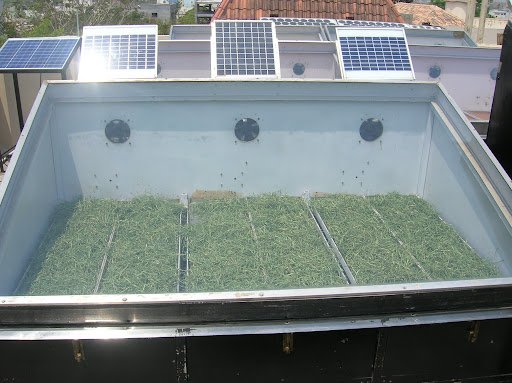
Insights from recent stakeholder engagements and interactions with farmers in Panchkhal, Banepa, and Dhulikhel highlight the practical potential of solar-powered drying technologies. Farmers shared experiences demonstrating how solar dryers can improve food quality, reduce losses, and extend shelf life, making them suitable for both household consumption and market-oriented production.
Renewable energy has already proven its value in strengthening sustainable agriculture and rural livelihoods. In Nepal, renewable energy solutions have supported off-farm income-generating activities, particularly in off-grid areas, helping reduce the economic gap between rural and urban communities. Solar drying has delivered promising results in other developing economies as well. In Bangladesh, solar dryers have achieved efficiency rates between 34.67 and 39.08 percent, offering faster drying times, better colour retention, and lower moisture levels. Uganda has reported dramatic improvements, with solar drying enabling up to a 200-fold increase in the production of quality cassava flour. Similarly, Indian farmers have leveraged solar drying to improve product quality, protect produce from dust and rain, and command higher market prices.

Solar drying is emerging as a sustainable solution in Nepal, helping farmers reduce post-harvest losses, improve food quality, and strengthen rural livelihoods.
Despite these benefits, the adoption and scaling of solar drying technologies in Nepal remain constrained by several challenges. Limited awareness, low acceptability, restricted availability, and affordability issues continue to hinder widespread uptake. Institutional and policy gaps, inadequate training, weak incentive structures, and insufficient financing mechanisms further exacerbate the problem. Research also indicates that female-headed households face additional barriers in accessing solar energy-related policies and support systems.
Government initiatives, such as subsidy programmes implemented by the Alternative Energy Promotion Centre (AEPC), have played an important role in encouraging adoption. Under Nepal’s Subsidy Policy for Renewable Energy 2069 BS (2013), households and commercial users can receive subsidies covering up to 50 percent of the cost of solar dryers, with higher incentives for vulnerable groups. However, even with subsidies, the upfront investment remains too high for many smallholders and entrepreneurs, limiting commercial viability.
Socio-economic and demographic factors also affect adoption. Rural outmigration has reduced the agricultural workforce and disrupted traditional farming systems, while the dominance of smallholder farming makes individual investment in solar drying less attractive. Marginalised groups, especially women, often lack decision-making power, access to finance, and technical knowledge, further restricting uptake.
Institutional and market-related barriers compound these challenges. Domestic producers struggle with limited technical skills, market access, and investment support. While products may be labelled organic, insufficient attention to packaging, branding, and certification prevents them from competing effectively in domestic and international markets. Donor-supported projects often face sustainability issues due to weak after-sales service and a lack of long-term technical support.
Looking ahead, innovative financing and scaling models are critical for ensuring long-term viability. Blended approaches combining subsidies with microloans, cooperative financing, crowdfunding, and municipal support could help reduce capital barriers. Service-based models—where entrepreneurs own solar dryers and rent them to farmers—offer another pathway to affordability. While subsidies can help stimulate early demand, long-term success depends on demonstrating clear economic and social value.
Local governments have a key role to play by integrating solar drying into annual plans, budgets, and agricultural policies. Given that women are among the primary users of these technologies, gender-sensitive access, training, and technical support are essential. Continued research and development, grassroots demonstrations, and local capacity-building initiatives will be vital in promoting adoption. When combined with nutrition education and community engagement, solar drying can become a powerful tool to enhance food security, improve health outcomes, and build long-term resilience across Nepal’s rural communities.
Our Latest News
https://www.quintilereports.com/industry-report/1228-solar-dryer-market/

Adarsh
Business Strategy — Quintile Reports
Adarsh is a Business Strategy professional focused on transforming market insights into actionable growth plans. He supports strategic initiatives through market analysis, competitive intelligence, and data-driven decision-making to help drive long-term business success.
His core skills include strategic planning, market research, growth opportunity assessment, trend analysis, performance tracking, stakeholder communication, cross-functional collaboration, and critical problem-solving.